New rules are complex but flexible
The 2009 International Energy Conservation Code (IECC), America’s national model energy code, was released in January of this year. Typically, state and local code adoptions lag several years behind the model code’s three-year upgrade cycle — so a new model code usually isn’t breaking news. But this time around, in response to federal stimulus-package incentives, some states have already upgraded to the new IECC. In Maryland, Maine, New Hampshire, Rhode Island, and Illinois, the 2009 version will take effect as soon as this October, with more states poised to follow suit.
The 2009 IECC is significantly more stringent than the 2006 version. It reduces a new home’s energy use 12 percent to 20 percent compared with levels set by the previous code. The gains come from upgrades to a range of building elements: increased wall, roof, and foundation insulation; higher-performance windows; airtightness testing for ductwork and building envelopes; high-efficacy lighting lamps; and more. But the flexibility built into the new code’s basic R-value and window efficiency tables — and relatively sophisticated software-based “performance path” — allows builders to comply while using strategies that help keep construction costs under control.
Insulation levels. Required wall insulation R-values have been bumped up in Zones 5 and 6 (see map) from R-19 to R-20 — achievable with a high-density fiberglass batt in a 2×6 wall. But there’s a “13 plus 5” loophole that says you can also meet the requirement with an R-13 high-density batt in a 2×4 wall, plus R-5 continuous insulating sheathing (such as an inch of extruded polystyrene), even though on paper the total R-value of that system would only be R-18 (see charts).
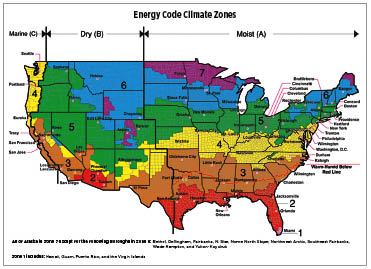
Insulation R-values and window U-factors in the 2009 IECC are based on this climate zone map, which is also used by Energy Star and other model energy codes. On a county-by-county basis, the map divides the country into eight major climate zones based on heating and cooling degree-days, variations in solar radiation, wet-bulb temperature, and other factors that affect local weather conditions. (Zone 8 — not shown — covers much of Alaska.)
Although the 2009 IECC has toughened the R-value requirements for some climate zones (top), it also offers more flexibility than earlier versions. A new U-factor chart (bottom) can be used to calculate total heat loss — or Total UA — through the building envelope (U-factor x area = Total UA), allowing component R-values to be traded off against each other.
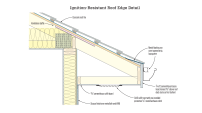
While basic ceiling R-value requirements haven’t changed, an exception has been added for cathedral ceilings that allows reduced insulation in cases where roof framing will not accommodate the full R-value batt thickness (this exception is limited to just 500 square feet or 20 percent of total roof area, whichever is less). There’s also an incentive for raised-heel trusses, or “energy trusses.” If your truss has a raised heel in zones where R-38 attic insulation is required, you can cut back to R-30, in recognition of the better performance achieved by insulation that covers the wall plate at full thickness. (Attic hatches, by the way, have to be insulated to the same level as the attic floor.)
The code now allows you to trade ceiling R-value off against wall R-value. Using the “Total UA” method, you can reduce wall insulation and increase roof insulation — or vice versa — as long as the total calculated heat loss, or “U,” through the whole house envelope remains the same. To perform these whole-system calculations, there are U-factor tables included in the code. In theory, you could use these tables to calculate your Total UA numbers, but in practice, you’ll want to use the DOE’s free REScheck software, which is available in Windows desktop or Web-based interactive form (energycodes.gov /rescheck/).
The wall R-value table also offers special allowances and requirements for walls that aren’t wood-framed. “Mass walls” — such as heavy log construction, poured concrete, and concrete masonry — have their own column in the table, reflecting the way mass heat storage can improve a wall’s performance. Insulation requirements for mass walls vary, however, depending on whether the insulation is on the side facing the conditioned space or on the side facing the outdoors: If you place insulation on the inside, you need more of it, because the mass wall limits total heat flow more effectively when the mass is interacting with the occupied space.
And the insulating value of the massive material in the wall is most significant in cooling climates: In Zone 1, for example, where a wood frame wall would require R-13 cavity insulation, a concrete wall needs just R-3 (exterior) or R-4 (interior) continuous foam. In Zone 8 (found only in northern Alaska), by contrast, a mass wall needs R-19 continuous insulation — barely different from the R-21 required for batt or blown insulation installed between studs in a wood wall.
Steel-framed walls and ceilings also have a column in the tables. In this case, though, the R-value requirements are higher, to reflect bypass losses from heat conduction through the steel. And with steel framing, you need less insulation if you provide it in the form of continuous insulated sheathing, instead of as fiber insulation between studs or trusses.
Foundation insulation. The 2009 code adds a requirement for slab edge insulation in Zone 4, the southernmost of the northern zones. It’s not much, just R-5 (an inch of rigid foam) — but you need an additional R-5 if the slab is heated. Slab insulation has to extend 2 feet down from the top of the slab in Zones 4 and 5, and 4 feet down in Zones 6, 7, and 8. But any combination of horizontal and vertical insulation qualifies — so you could run your foam 2 feet down and then 2 feet sideways, either toward the inside (under the slab) or to the outside (under the soil, as long as there’s at least 10 inches of soil cover on top of the insulation). The slab-edge insulation requirement can be waived in termite country at the building official’s discretion.
For basement insulation, things get a little more complicated. The R-value table provides two numbers, one for continuous foam insulation and another for cavity insulation installed between studs in a framed-out basement wall. So in Zone 3, for example, you can choose between R-13 batts between the studs and R-5 rigid foam applied over the concrete. Again, this disparity is greater in the South; in northern Zones 6, 7, and 8, R-19 batts between the studs are the equivalent of R-15 continuous foam.
When basement walls are set into a slope and only partially backfilled, you have to be careful. If the wall area is more than half exposed, then the code treats it as an above-grade wall. If it’s more than half buried, it’s a basement wall.
Window requirements. In Zones 3 and 4, window rating requirements have tightened. Zone 3 now requires a window U-value of 0.50 (down from 0.65); in Zone 4, you need U-0.35 windows (down from 0.40). But this isn’t a minimum — it’s a required average for the whole house. So, for instance, you’ll meet the 0.50 requirement if half your window area is rated U-0.40 and the other half is rated U-0.60 (that’s by square footage of window, including frame — not by window unit).
Airtightness testing. Air infiltration can make or break a home’s energy performance. For the first time, the 2009 code requires air leakage rates to be verified, by one of two methods. Either you can get a point-by-point inspection during construction of a long checklist of air-sealing measures (similar in scope to the EPA Energy Star for Homes program’s Thermal Bypass Checklist); or you can simply get a blower-door test at the end of construction. For most builders, the blower-door test is the simpler process.
Ductwork testing. Duct sealing can make a big difference in home performance, particularly in cases where the ducts run in an attic or vented crawlspace. In the new code, all duct systems that extend outside the conditioned envelope have to be pressure-tested to verify acceptable leakage. (Ducts within a conditioned basement, conditioned attic, or interior building chase don’t need to be tested, but they do have to be air-sealed and inspected.) According to the DOE, duct-sealing measures called for in the new code should result in an 8 percent reduction in seasonal home energy use.
Lighting efficacy. The 2009 code has new — and potentially confusing — lighting requirements: At least 50 percent of the lamps in permanent fixtures must be high-efficacy (meaning a compact fluorescent bulb or something better). Because this rule is stated in terms of “lamps” — meaning bulbs — not fixtures or wattage, a chandelier with 50 5-watt incandescent bulbs would need to be offset by 50 compact fluorescent bulbs elsewhere in the house. By the same token, an LED rope light with 100 tiny high-performance bulbs — drawing less than one watt each — could theoretically outweigh 99 incandescent bulbs at 200 watts apiece. In practice, your local code official will have the final interpretation of this rule.
Additions and renovations. Any substantial renovation of a home — and any addition — has to meet the energy code. There are two ways to achieve this: The whole house can meet the code’s prescriptions, or you can choose to evaluate just the renovated area by itself. So an energy-efficient addition on an old, underperforming house would meet the code; and a lower-performance addition to a super-insulated, high-performance house could as well.
Sunrooms — one-story attached rooms that are mostly glass — are a special case. The ceiling R-value requirements and window U-factor limits are relaxed — provided that the rooms are thermally isolated from the main house (including doors that close) and separately zoned for heating and cooling.
The software option. With so many variables to balance, sticking to the prescriptive tables can be cumbersome. Some builders may prefer to use the software-driven “performance path,” which offers far more flexibility — as long as the model predicts total house energy consumption that’s equal to or better than a code-compliant “baseline” home.
The software model’s output may reflect things that the code tables don’t even mention — such as window shading and reflective roofs in southern climates or passive solar gain and heat-recovery ventilation in northern climates. Unlike in past versions of the code, however, you can’t trade off hvac efficiency against building-envelope characteristics. A high-efficiency furnace or air conditioner, for instance, won’t let you get away with reduced wall or ceiling insulation.
The basic software tool for IECC compliance is DOE-2 (available for free at doe2 .com). Other packages that offer the same capabilities include EnergyGauge, REM/Design, and REM/Rate.
Home labeling. Finally, for the first time, the code now requires documentation of every new home’s energy-conservation characteristics. The builder must post a label that specifies window U-values, wall and ceiling R-values, hvac efficiencies, and other key building characteristics on the home’s electrical panel.
For a detailed walk-through of the requirements of the 2009 IECC, view the DOE’s 90-minute online training session at jlconline.com/training. — Ted Cushman
Offcuts
An Illinois manufacturer accused of violating the FTC’s “R-value Rule” has been fined $155,000. According to the FTC, Meyer Enterprises claimed an R-value of 7.54 for its Insul-Tarp underslab blanket insulation, when in fact the product’s Rvalue is less than 2. A related case against Enviromate, which claims that its Polycell cellulose insulation has a chemical additive that doubles its actual R-value, was settled without a fine. A third case, against Edward Sumpolec and Energy Conservation Specialists — who sell Thermalkool, an aluminum radiant barrier with a “theoretical R-value of 53,” and Thermalcool, a four-layer insulating ceramic coating that will “reduce wall and roof temperatures by 50–95 degrees” — is still in litigation.
A temporary moratorium on some building permit fees in June saved Denver residents $85,773 and generated $6,283,957 in new construction. Part of a program announced by Mayor John Hickenlooper to spur the local economy, the two-week break resulted in 1,234 new building permits — a three-fold increase in daily activity compared with the previous month. Projects that required a permit review, like new homes or additions, weren’t included in the program.
After several months of continuous decline, the price for materials used in single-family construction rose slightly in May, according to the Bureau of Labor Statistics’ monthly survey of wholesalers and manufacturers. The Producer Price Index (PPI) had fallen 5.3 percent in the previous seven months, but inched up 0.1 percent last month thanks to rising energy and metals costs that offset continued declines in the price of lumber, plywood, and drywall. Overall, plywood prices are down 17 percent from a year ago; softwood lumber is down 36 percent; and gypsum products are down 22 percent.
The cost of photovoltaic electricity is plummeting. Thanks to an oversupply in worldwide manufacturing capacity and lower demand, prices for PV panels are expected to decline 43 percent by the end of 2009, says the research firm New Energy Finance. Now that the government has eliminated the $2,000 cap on the 30 percent solar-energy tax credit, a typical $32,000 4-kw solar system that cost a California homeowner $23,000 last year after state and federal incentives would — according to these predictions — cost less than $12,000 this year.
About 9,000 DeWalt framing nailers have been recalled because of possibly defective bump-trigger mechanisms that could cause the gun to misfire or prevent the trigger lock-off from functioning properly. The voluntary recall announced by DeWalt and the CPSC applies to models D51850 (a round-head nailer) and D51825 (the clipped-head version) sold from January to September 2008. DeWalt advises nail-gun owners to stop using the gun and contact the company at 877/437-7181 for a free replacement bump-action trigger.
Since 2007, 84 Lumber has closed 124 of its lumberyards and manufacturing plants while cutting more than 5,000 employees — but on July 1, the Pennsylvania-based company reopened its Houston facility. “We believe we are starting to climb out of the housing and general construction downturn, and we view Houston as one of those markets that will be at the forefront of the rebound,” said 84 Lumber vice president Frank Cicero in a recent statement to the press.