
Site-Made Arched Window Trim
by Brian Cinski
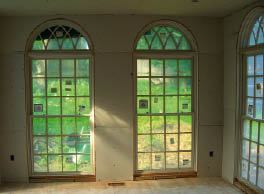
Here’s a technique that has saved me a lot of time when trimming arch-topped windows (1). It offers an economical alternative to stain-grade methods and doesn’t require a shaper or molder. I start by tacking up a piece of 1/8-inch hardboard over each window (2), then use a laminate trimmer to trim it flush to the inside edge of the arch (3). I make templates for all the windows I have to trim, then position them on a sheet of 3/4-inch MDF so that I get four head casings out of one 8-foot sheet (4).
1.
2.
3.
4.
I first trace the templates on the MDF and rough-cut with a jigsaw, staying 1/8 inch away from the pencil line. I then screw the templates to the MDF, making sure to put the screws out of the way of the finished casing, and trim the stock flush to the template (5). At this point, the casing stock matches the jamb line, but because I need a setback, I make a pass along the inside edge with a 1/4-inch rabbet bit set to a depth of around 3/8 inch (6). I use a flush trim bit, with the bearing riding along the edge of the rabbet, to finish the cut. I now have a head casing that will fit the jamb perfectly with a consistent 1/4-inch reveal.
5.
6.
In this case, I had decided to put a classic quirk and bead on the inside edge. This was easy on the straight casings, but for the radius pieces I made a custom router base, tracing the curve of the casing onto a piece of 2×6 and cutting it out on the band saw. Some fine-tuning with a sanding block made for a good fit and ensured the bead bit would track smoothly (7).
7.
I next traced the outer edge of the casing with a shop-made gauge block and cut with the jigsaw to within 1/16 inch of the line (8). I finished the edge with a belt sander clamped to my worktable. These casings were only 2 1/2 inches wide. Ordinarily I would have made them wider, but I was limited by the ceiling height on the job.
8.
As is common, I had to install extension jambs on most of these windows; I used the same templating technique to make them out of MDF (9), belt-sanding them flush with the drywall where necessary — a challenge, but doable. Any areas where I wandered with the belt sander got covered later by the casing.
9.
10.
11.
I used a plywood gauge block to get a consistent reveal (10) and put a #0 biscuit at the joints between the straight and arched casing to help keep them flush and tight. I installed 5/4 poplar sills and patched the drywall beneath the windows to complete the two-day job (11).
Brian Cinski is a finish carpentry contractor in the Pittsburgh area.
Clean Blades Cut Better
by Kyle Dunkley When I first started out as a carpenter, I worked my saw blades hard, forcing them through cut after cut, even after the teeth were covered in pitch and resin. Eventually it occurred to me that while a little burning and smoking might not matter much during framing, it was taking its toll on any finish carpentry I attempted. For a while I increased my sharpening budget, but when that began to hurt, I sought the advice of an old journeyman friend who pointed out that often simply cleaning a blade will make it cut almost like new. So now, here’s how I refresh my carbide edges.
1.
2.
3.
4.
5.
I first spray the blade with Simple Green All-Purpose Cleaner (1) — a nontoxic alternative to the oven cleaner I’d used in the past — then scrub the teeth and gullets with an old toothbrush (2). After I’ve cleared off the crud, I rinse the blade (3), dry it (4), and give it a shot of silicone spray (5) to prevent rust (paste wax will provide the same line of defense). I clean my router bits the same way; it sure extends the time between sharpenings.
Kyle Dunkley owns Konstant Construction in Victoria, British Columbia.


