
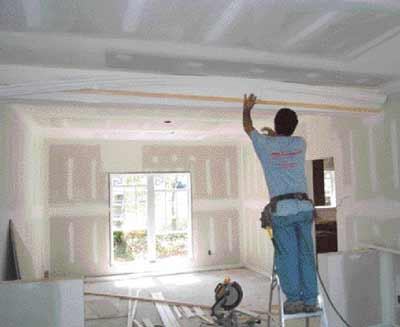
Not too many years ago, a carpenter would have been proficient in framing, siding, interior trim, and even cabinet and furniture making. Although there may be some tradespeople who still wear the many hats of a true journeyman carpenter, the reality is that most have chosen to specialize in one area. This is especially true in the competitive, fast-paced realm of new home production building. In the Charlotte, N.C., area, where my business partner and I work as interior trim carpenters, the landscape is dotted with countless new home developments flush with retirees and northerners escaping harsh winters. Capitalizing on the influx of people into the Sunbelt, many large national builders have set up operations to cater to these new arrivals.
We decided to specialize in servicing the needs of these large national builders, so we’ve had to develop systems to cope with the large volume they require. In a sense, we’ve created subspecialties within the already specialized trade of interior trim carpentry. Our current methods allow us to produce a high-quality interior finish for our customers while working quickly and efficiently. In this article, I’ll focus on the three major subspecialties that enable us to trim hundreds of houses a year with surprisingly few people.
Rough Trim Crew
We start with the “rough” trim crew; this is the group that trims what I call the meat and potatoes of a house. To guarantee that this crew can work as efficiently as possible, we first make sure that all the material is stacked in the garage or the house. By doing that, we avoid an unnecessary trip or a lost day.
Next, my partner or I make sure that all the appropriate door swings are clearly marked on the doorjamb rough openings. If the house has been primed or the drywall has been splatter-textured, it may be necessary to remark the door swings. This step is important, because it enables the carpenters to start spreading the doors throughout the house right away without having to consult the blueprints.
All the termination points of specialty trim such as crown, chair rail, wainscot, and so forth are next marked on the drywall in the appropriate rooms. Although we specialize in tract housing, a number of builders we work with are now offering semicustom homes, so marking out the specialty trim accurately is crucial.
Trim upgrades are clearly defined for us by the builder’s sales center, which typically posts an option sheet on site for us to consult. This careful communication helps to ensure that customers get the upgrades they are paying for. It also helps to create uniformity in the builder’s houses, so a customer can get the same finished product as a model home she visited in a different neighborhood.
Once these tasks are complete, the rough crew is prepared to work with few impediments. On occasion, a slight problem may arise — a door rough opening that is too large or a bowed stud in a wall, for example. Minor problems like these are communicated directly to the building superintendent, who then makes the necessary repair.
A precise spec sheet from the builder clarifies trim options.
Stocking the site with the complete trim package and marking door swings and special trim locations ahead of time (top) allow AMK’s carpenters to do what they do best — work competently and efficiently. A two-part carbon form (bottom) records missing items before they get to be a big problem.
As a matter of good recordkeeping, as well as to limit the potential blame game, we note any such problems, whether minor or major, on our company’s two-part carbon forms. We record the date, subdivision name, lot number, and the supervisors of both our crew and the builder. If there’s a need for extra material, for example, the quantity ordered is recorded and both the builder and our office get a copy. This serves two purposes. The first is that it prevents the inevitable confrontation that would happen when we needed the material to finish the house and no one remembered whether it was ordered. The second is that it allows us and the builder to track trends. If, for example, both our office and the superintendent notice that a particular floor plan is always short of base molding, then a revision can be made for all future takeoffs. This is especially helpful when a new home plan is developed. Using this method in some of the larger subdivisions, we have gotten material takeoffs so accurate that we’ve eliminated returns and saved the builder the cost of leftover material or restocking.
Stair & Rail Crew
Assuming everything goes as planned, the house is then ready for our next subspecialty, the stair and railing crew. Although we call them our stair and rail crew, they concentrate mainly on railings. In our area of the country, most stairways are prebuilt in a factory and set in the field by either the frame carpenter or the stair maker. Nevertheless, our crew is able to site-build stairs when it’s needed.
Although the stairs are prebuilt, the railing systems are not. Depending on what the customer selects or the style of the home, our crew might encounter post-to-post railings, volutes, pin-top easings and goosenecks, or occasionally wrought iron. We supply the stair crew with a well-appointed van equipped with any tools they might need — the usual trim equipment such as miter saws, finish guns, and table saws, as well as routers, a biscuit joiner, an assortment of clamps and glues, and, for the occasional blocking installation, a framing gun.
Adding missing blocking for a stair rail rosette from the back of the wall produces an invisible patch.
Blocking is critical for a secure, sturdy rail connection when the rail and rosette intersect with a wall. Unfortunately, the needed block is often overlooked by the rough carpenters. Our first reaction used to be to rip open the wall and nail a block in from the front side, but we’ve learned that it’s far less obtrusive to cut the drywall on the back of the wall. After locating the stud bay where the blocking is to be installed, we cut the drywall very carefully so that the same piece can be reinstalled for a perfect patch. After the block is nailed off, we screw the drywall patch back to the studs and mark it clearly with an X so the touchup crews won’t miss it.
In addition to the necessary tools, we also stock a large assortment of fasteners, wood plugs, and extra rail fittings such as goosenecks and easings, just in case of the rare mistake. Our stair crew requires little supervision; they’re seasoned veterans and are more than capable of spotting potential problems. Instead, at this stage, my partner or I take the time to make a trim punch list. If we notice anything that’s missing or not up to our standards, we’ll have the rail crew complete the punch-out before they leave. Victims of their own efficiency, our rail crew is rarely unable to complete at least one house’s rail system in a day. Rather than have them unpack all their tools and start a second house, we typically use their time to catch loose ends. Sometimes the “extra” time can be used to build specialty items such as bookshelves, art niches, or mantels.
Although there are local competitors who specialize only in the fabrication and installation of stairs and railings, our system is both efficient and cost effective for our customers. Because we eliminate the need to bring in another subcontractor, we avoid the scheduling conflicts that might arise. For example, when our company installs both the trim and the railings, we’re clear on who’s running the base cap on the stringers, and how the various baseboard termination details will get built. Although items like these may seem trivial, we aim to finish the house as close to 100% as possible before the painters are scheduled to begin. We learned long ago that a return trip into a production house is neither cost effective nor good for our reputation.
Lockout Crew
Our first phase is typically finished when the rail system is complete and the house is completely trimmed. Later, after the painting is done and the finish floors are installed, we bring in our “lockout” crews. In our area of the Southeast, lockout entails installing all the interior doorknobs, exterior locks and deadbolts, house numbers, and kickplates, and running any shoe moldings on hardwood, tile, and vinyl floors. Depending on the scope of work, it might also include installation of bath accessories such as toiler paper holders, towels bars, and medicine cabinets.
Lockout crews install door and other hardware and fine-tune the finished job.
Early on, we couldn’t rationalize how these functions fell under our scope of work, but we’ve since come to use the lockout as a fine-tuning process. Any doors that need to be adjusted or trimmed are done at this stage. Exterior doors, which are almost always set by the framers, are given a final adjustment so that they operate easily for the new owners. Plus, we have one last opportunity to correct any small mistakes or to finish any task left hanging. For example, the lockout crew sometimes has to patch in small sections of base molding that we may have been unable to complete during the first trim — for example, next to base cabinets that were not yet set. Lockout gives us a chance to catch these things. Upon completion of lock, the house should be totally finished, according to our scope of work.
An added benefit of our lockout process is that it creates a great opportunity for us to try out potential carpenters before throwing them into the faster-paced rough crews. It’s become a sort of minor league for our company. We feel it provides a great advantage for a new carpenter to see what we expect in the finished house. By creating a familiarity with the final process, we also believe it leads to greater efficiency when trimming new houses. Nothing can be more counterproductive than having to explain every detail of what we expect a finished house to look like or having the carpenter feel that he has to ask lots of questions before installing trim. Many of our long-term carpenters started out on our lockout crews and still fill in there when needed.
Uniformity and Flexibility
In conjunction with this informal training process, we also try to keep the same group of carpenters working in the same product line when possible. One of the biggest demands that our national builder clients make is for a uniform finished product. One builder told us that they like to enter a house and not know what area of the country they’re in. Needless to say, that sort of uniformity doesn’t happen overnight, so it’s crucial for us to maintain a stable group of employees. Fortunately for my partner and me, our carpenter turnover has been very low. In fact, nearly two-thirds of the carpenters on our jobs have been working with us for at least three years. This stability has helped eliminate what I call the “A-team, B-team mentality” — what you get when you hire some really good carpenters and some not-so-good carpenters. Instead, we like to employ exceptional carpenters and excellent carpenters.
We realized a long time ago that things will not always go as planned. People call in sick, trucks break down, and houses are not always ready when a builder says they will be. By accounting for the many variables of completing a house quickly and efficiently, we’ve created a system of redundancy that allows everyone to settle into their own routine, performing the tasks they enjoy most and reaping the satisfaction of great productivity and a job well done. At the same time, there’s just enough flexibility to prevent anyone from getting bored. Because our carpenters are versatile, if we need someone to change gears and pitch in to finish a job on time, it’s not a problem.
The result is a system that allows us to trim several homes a day without having to compromise our quality, while providing a satisfying work environment for our carpenters.
Keith Kelly runs AMK Construction in Charlotte, N.C., along with his partner, Wally Ackerson.


