
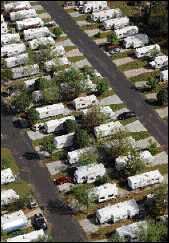
Will the Gulf rebuilding raise the image of modular housing or drive it deeper into the sand?
A national emergency. Thousands displaced. A government plan to house people in sprawling trailer parks.
Hurricanes Katrina, Rita, and Wilma may be the latest crises to spur plans for emergency housing in mobile homes. But the first crisis occurred more than a half century ago, when World War II created a huge demand for munitions-plant workers. The plants were built in rural, unpopulated areas to protect them from bombers. Government officials solved the problem by buying 45,000 trailers, packing them into cities such as Richmond, Calif., then home to four shipyards and 50 defense industries.
For the nascent trailer industry, the effects were profound. The war changed “the popular perception of trailers from vehicles for vacation travel to mobile homes for year-round residence,” write John Fraser Hart, Michelle J. Rhodes, and John T. Morgan, authors of 2002’s The Unknown World of the Mobile Home.
In the aftermath of the 2005 hurricanes, insiders in the mobile home industry wondered if they were in for another transformative moment. There were obvious opportunities, and not just in filling government orders for emergency housing. The Gulf Coast faces massive rebuilding, shortages of skilled labor and materials, and a need for fast solutions — conditions that play to the advantages of mobiles and their more upscale cousins, modular homes. But manufacturers fear that government, seeking stripped-down single-wides, would reinforce what they say are outdated stereotypes.
“You want to do what you can to assist in this emergency situation, but at the same time it could exacerbate the image issue,” notes Bruce Savage, spokesman for the Virginia-based Manufactured Housing Institute.
Or, as Allan Wallis, a historian of the mobile home industry, puts it, “I think there is a real opportunity for affordable housing, but I think there is a tension in the industry. My sense is that the industry does not want to present itself as this great affordable housing initiative.”
FEMA is providing temporary emergency housing like these travel trailers in Biloxi, Miss., but given the extent of the Gulf rebuilding effort, some experts worry that these may become semi-permanent neighborhoods.
As the latest in a list of industry-preferred names suggests, manufactured homes have suffered from an image problem almost since their origin as small trailers toted to national parks by pre-War campers. The early versions earned their reputation for cheap materials and lousy workmanship. That rap stuck, despite passage in 1976 of a federal mobile home building code requiring minimum standards for safety and durability. It didn’t help that devastated mobile home parks were a prominent legacy of Hurricane Andrew — though, in later hurricanes, performance improved for newer mobile homes built to withstand stronger winds and secured with proper tie-downs.
Modular homes, assembled from factory-built sections and built on block foundations, must conform to state and local building codes. But modulars also “get stereotyped a lot,” notes Dennis Jones, president of the National Modular Housing Council and C.E.O. of R-Anell Homes, a North Carolina-based modular home manufacturer.
Katrina struck just as the mobile home industry was pulling out of a six-year slump, Savage explains. Although a debate about the Federal Emergency Management Agency’s reliance on mobile homes raged in late fall, there was no question but that they would be part of the response: By mid-October, FEMA had purchased or placed orders with manufacturers totaling 19,000 homes, Savage reports.
He and others argue the mobile and modular home industries are uniquely qualified to contribute to permanent replacement housing for the hundreds of thousands of homes lost to Katrina and Rita. They point out that most manufacturers are not located in the hurricane zones, meaning they were neither slowed by the storm’s aftermath nor suffered from a shortage of manufacturing labor. Not only that, but mobile and modular homes offer quick, comparatively inexpensive housing, both otherwise a rare commodity.
Craig Savage (no relation to Bruce), of Building Media Inc., a construction industry marketing company, is currently working with well-known Not So Big House designer Sarah Susanka to showcase a Susanka-designed modular home. He calls government orders for cheap mobile homes “tragic,” saying “my fear is FEMA is going to push hundreds of thousands of the absolute cheapest HUD-code homes down there and we’ll end up with even worse neighborhoods than we had before.”
Indeed, while mobility has its advantages, it also carries risks. Following the ’04 hurricanes, FEMA built a 550-home mobile home park in a remote part of Florida’s hard-hit Charlotte County. Crime, domestic violence, and joblessness have been constant problems at the featureless park, where 480 homes were still occupied more than a year later, reports Bob Hebert, county recovery coordinator.
Once again, FEMA has begun work on several mammoth parks in Katrina’s wake. Bruce Savage worries the outcome will reinforce people’s jaundiced view of mobile homes. He and Hebert say the agency should rethink its plans — if nothing else, for the occupants’ sakes.
The parks “have to be smaller, they have to be 100 or less. Closer to 50 would be better,” Hebert explains, adding that FEMA should locate people near their destroyed homes “so they can re-establish roots and be part of the recovery of their own neighborhoods.” — Aaron Hoover
Currents
Common Code Violations
According to a survey of code officials by the International Code Council, the most common code violations in the construction of new homes include: Structural and wood framing problems (30%), including improper framing techniques, inadequate fastening, improper notching and boring in load-bearing walls, and problems with fire blocking or fire stopping.
Grading (to ensure proper drainage), foundation, footing, and concrete problems (24%) were second on the list.
Exit (egress) issues were also noted (11%), especially problems with stairway handrails.
The most common code violations cited in the remodeling of existing homes included electrical problems, structural and wood framing violations, exit problems, and fire safety related issues:
In more than 15% of cases, electrical issues such as shorted or dead outlets and missing electrical junction box covers are identified as code violations, according to respondents.
Framing problems are recognized in 14% of code violations found.
Problems with egress and fire issues are cited in 13% of cases, most notably handrails and stairways, lack of accessibility to windows, and inoperable or improperly installed smoke detectors.
Code Option Flies Out the Window
Opening protection takes precedence over the “partially enclosed” rule
A confluence of building code changes and damaging hurricanes is poised to make shutters or hardened windows all but standard in East and Gulf Coast beach homes. Most states follow the International Residential Code, which in 2006 will drop a provision allowing builders to avoid using shutters or impact-resistant glass by structurally reinforcing homes to withstand hurricane-force winds. Not only that, but the extensive damage from the 2004 and 2005 hurricanes has prompted a public shift in favor of so-called “opening protection,” weakening longtime opposition by builders.
“New York State has impact requirements, and a lot of other states will follow suit this year,” says Dave Olmstead, spokesman for PGT Industries, a Florida-based window and door manufacturer. “When you look at the publicity of the Florida hurricanes and this past fall, obviously, the awareness has gone up tenfold.”
Hurricane-force winds can literally blow apart a home once they breach a window or door. To guard against this threat, the 2003 International Residential Code allowed either opening protection or structural enhancements. Added roofing tie-downs and strengthened exterior walls will keep the home’s walls and roof intact — even if wind and rain ruin the interior.
This so-called “partially enclosed” option is the cheapest and most common. On the west coast of Florida, the nation’s most hurricane-prone state, at least 80% of homes built before the ’04 storms have no shutters or impact-resistant glass, Olmstead says. On the east coast, Olmstead guesses the percentage is closer to 50-50. “It’s because they build higher-end custom homes over there,” he explains.
The “partially enclosed” option, which allowed for strengthening a home to resist high winds by beefing up the framing, has been dropped from the 2006 International Residential Code. Currently, opening protection using shutters or impact-resistant windows is mandatory practice in high-wind zones.
Builders have a track record of opposing opening protection, citing added cost. But although they protested it at first, home-builders associations did not publicly oppose the final versions of the 2006 IRC, Olmstead says. And Florida home builders are not fighting the state’s adoption of the IRC effective in its revised code in 2008.
“We take the position to support the international code as a basis for the Florida Building Code, and if the IRC does away with that provision, we’ll endorse it,” says Jack Glenn, technical services director for the Florida Homebuilders Association.
Olmstead estimates that shutters increase the cost of an average 2,000-square-foot home by about $1,000. Impact-resistant windows, three to four times more expensive than standard windows, would elevate the total cost considerably. Glenn maintains that shutters are the cheapest option in the highest wind zones, while structural reinforcement is less expensive in lower zones. That’s because the bracing and other hardware to keep a home standing in 130-mph-plus zones actually costs more than shutters, he notes.
But Jeff Burton, building codes manager for the Institute for Business & Home Safety, a Florida-based advocacy group, points out cost doesn’t have to be a major issue.
Florida’s building code allows builders to meet opening protection standards simply by precutting and drilling plywood sheets and leaving them with fasteners for homeowners to install when storms are approaching, he says. “Florida was looking out for the affordable housing market by doing that,” he says. — A.H.
With a total of 26 named storms, the 2005 Atlantic storm season became the most active (and costliest) season on record.


