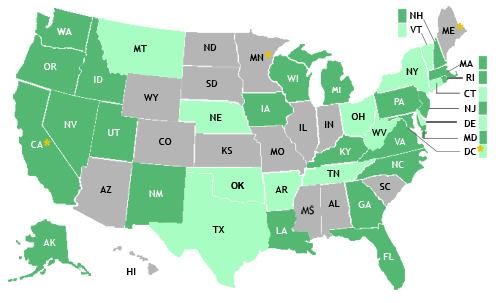
The 787-billion-dollar American Recovery and Re-Investment Act (ARRA), signed into law by President Barack Obama on February 17, included $3.1 billion for energy assistance grants to states for adopting and administering advanced model energy codes. But to qualify for the money, states have to certify that they are adopting the latest residential and commercial building energy codes, and that they have a plan to ensure 90% compliance with those codes within 8 years in all new or substantially renovated buildings. On the residential side, states have to adopt a code that meets or exceeds the 2009 International Energy Conservation Code (IECC); on the commercial side, they have to adopt a statewide code that meets or exceeds the ASHRAE Standard 90.1-2007. Along the Gulf and Atlantic coasts, many states are moving to upgrade their codes and apply for their grant money, which amounts to tens of millions of dollars per state. There are several ways to keep track of where your state’s energy code stands in comparison to other states. The Building Code Assistance Project (BCAP) website maintains a color-coded map with state-by-state code adoption information and a frequently updated news page. And the Department of Energy now has a similar map indicating every state’s eligibility and involvement in ARRA grants, and the amount of money allocated. At the DOE site, you can also read the letters from state Governors to the Secretary of Energy, providing the required assurance that the state has embraced the goals of the program and taken the steps needed to qualify for funding. However, a closer look at the various state policies, and at the Governors’ letters, reveals that the required assurances are being treated as little more than a formality. Mississippi, for example, has a voluntary code that was created in 1975 and seems to have no plans to change the codes, while Maryland has passed legislation adopting the 2009 IECC, effective this October. But the letters from both state Governors read in similar fashion, and both states appear to be on track to receive their stimulus funding.
Here’s a quick rundown of the coastal states that have, and have not, updated their residential energy codes. • Maine passed a law in April of 2008 to adopt the 2009 IECC, with implementation phased in from 2010 to 2012. (Portland, Maine has also moved to require LEED Silver certification for all new city-owned buildings.) • New Hampshire currently enforces the 2006 IECC. The state Building Code Review Board has voted to upgrade to the 2009 IECC effective October 1, 2009. • Massachusetts adopted the 2006 IECC in 2007, and is on a routine code change schedule that would adopt the 2009 IECC in 2010. • Rhode Island currently enforces the 2006 IECC. Governor Donald Carcier signed a bill on May 14 that will update the state’s code to the 2009 IECC. (Rhode Island, according to the DOE, pays some of the nation’s highest energy prices, but uses the least energy per capita of any state.) • Connecticut currently enforces the 2003 IECC, and state agencies are considering an update to the 2006 IECC. (Connecticut, which has strong incentive programs for solar energy, also has two nuclear power plants that provide half the state’s electricity, according to the DOE.) • New York currently enforces a statewide code based on the 2004 IECC with amendments. At Governor Patterson’s request, the state legislature is considering a measure to update to the 2009 IECC. (New York City is considering its own new legislation to drastically cut the city’s carbon footprint. And several Long Island towns have adopted or are considering measures to adopt Energy Star residential standards as local building energy code.) New York is eligible for more than a billion dollars in DOE funding for energy efficiency. • New Jersey adopted the 2006 IECC effective in 2007. There is no current word on any plans to update to the 2009 version. (Also, they have not yet found Jimmy Hoffa’s body.) • Delaware’s Senate passed a bill May 12 to require adoption of the latest model energy code, and to push for zero-energy performance for all residential buildings by 2025. The measure is now under consideration by the Delaware House Energy Committee. • Maryland Governor Martin O’Malley has signed legislation adopting the 2009 IECC, effective October 1, 2009. (Montgomery County, Maryland, requires LEED Silver certification for county buildings, and has adopted the Energy Star standard as residential code effective January 2010.) • The District of Columbia City Council voted December 3, 2008, to adopt a residential energy code incorporating the so-called “30% Solution,” a package of amendments considered, but not adopted, at the International Code Council hearings for the 2009 IECC. The 30% Solution stipulates a 30% energy use reduction from the 2006 IECC; the 2009 IECC as actually adopted achieves only a 12% improvement over the 2006 code. So the D.C. code, which has a one-year phase-in period, will represent a tougher standard than the 2009 IECC. • Virginia currently enforces the 2006 IECC, and plans to update to a later version on schedule in September 2010. • North Carolina currently enforces the 2006 IECC, and will upgrade to the 2009 IECC in 2012. • South Carolina currently enforces the 2003 IECC, but a loophole in state laws allows insulation R-value lower than code-specified levels, with disclosure to the home buyer of the reduction. Legislation to update to the 2006 IECC and to remove the exceptions has passed the legislature and awaits action by the Governor. • Georgia adopted the 2006 IECC effective January 1, 2008. • Florida’s state-authored code exceeds the requirements of the 2006 IECC, and an executive order by Governor Charlie Crist instructs state officials to pursue further tightening of the energy standard in coming years, keeping the state’s code ahead of the expected advances in the model code. • Alabama has adopted the 2006 IECC, but only as a voluntary standard without state enforcement. In his letter of assurances to the Department of Energy, Governor Bob Riley promised to “request that the State Legislature consider actions to improve state energy codes.” However, a move to make the code mandatory failed in the state Senate in February. • Mississippi’s residential energy code, which is voluntary, is based on the 1975 edition of the American Society of Heating, Refrigeration, and Air-Conditioning Engineers (ASHRAE) Standard 90. • Louisiana currently enforces the 2006 IECC. • Texas currently enforces the 2000 IECC, but many jurisdictions in the state have adopted more recent IECC versions (as allowed by the state law). A bill to adopt the 2009 IECC statewide is under consideration by the legislature.