
These days, it’s not an exaggeration to say that almost all homeowners expect their homes to be durable, energy efficient, safe, and comfortable. But this is especially true in coastal markets that cater to high-end clients who demand supreme quality and impeccable performance from their homes. Even in today’s markets, which are euphemistically described as “relaxing,” there seems to be no shortage of wealthy home buyers snapping up second-home properties along the coveted coast. If you build in this market, it’s this kind of discriminating home buyer who will most expect you to get things right.
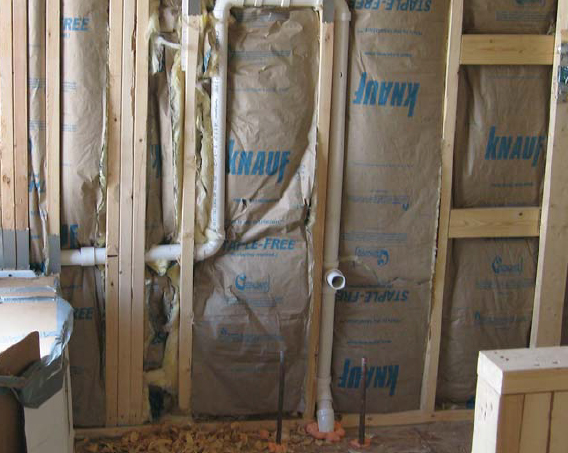
In more than 25 years of consulting with builders on ways to reduce callbacks, I’ve spent most of my time solving problems related to heat and moisture transfer through buildings, because this is often where builders — even very good builders who deliver well-appointed homes to the coastal elite — get things wrong. Most of the serious (read “expensive”) performance failures are moisture related, and a good number of these are closely tied to the thermal performance of the home. Yet I am surprised how often the insulation is installed without much thought or understanding about how it works. Consequently, very little attention gets paid to the details that really matter. Typically, fiberglass — selected as the least expensive option up front — is jammed in the walls and stuffed around electrical wires, plumbing pipes, and HVAC ducts, then covered up as soon as the municipality allows. The result is gaps, compression, and hollow voids that compromise occupant comfort and increase the building’s energy loads. A sloppy insulation job can also lead to moisture problems by creating thermal conditions in walls and ceilings that promote condensation, wetting, mold growth, and rot.
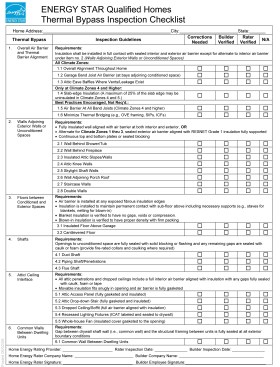
The Energy Star Thermal Bypass Inspection Checklist must be completed by a certified home energy rater. However, in order for a home to qualify for the Energy Star label, up to six items may be verified by the builder to minimize required field trips by the rater.
Bright Star
The updated Energy Star label for homes provides a quality standard that can guide builders away from these problems. New program requirements have raised the level of quality in the program, making it a label that savvy home buyers will more likely be looking for. As of January 1, 2007, a home that qualifies for an Energy Star label must pass a “thermal bypass inspection”: a rigorous assessment of a home’s air barrier. The bypass inspection requires builders to follow the EPA’s Thermal Bypass Inspection Checklist — a 25-point list of details aimed at stopping the movement of heat around or through the insulation. Thermal bypasses — the defects that most commonly reduce the energy performance and comfort of homes — typically result from missing or compressed insulation, missing air barriers, and gaps between the air barrier and the insulation.
In my opinion, this checklist is one of the best guidelines to come out of the EPA’s Energy Star program, and I think it substantially raises the bar for thermal and moisture performance of building envelopes. Of particular value to builders, the 86-page Thermal Bypass Checklist Guide provides a very practical and comprehensive look at reducing air infiltration. It should be required reading for anyone who’s serious about building a quality home in any climate, but especially in demanding coastal climes.
The issues are easily solved with ccSPF, which sticks to the bottom of the subfloor so insulation and air barrier are always in contact. The foam also stops air infiltration. It is a good idea to wrap any plumbing with a thin layer of fiberglass insulation before spraying foam over it to make servicing the plumbing easier.
An Insulation for All Reasons
I’ve included in this article a short catalog of some of the problem areas addressed on the Thermal Bypass Inspection Checklist that I find are frequently missed.
What stands out about all of these problem points is that they can be difficult to get right with inexpensive fiberglass insulation unless a builder is working with an experienced and service-minded insulation crew. However, these problems are easily avoided when using closed-cell spray foam (ccSPF) insulation. This alone provides a strong argument for always using ccSPF, but it’s certainly not the only reason.
There are many reasons why ccSPF makes particularly good sense in a coastal home:
- It has a high R-value of 6.5 to 7 per inch.
- It absorbs a negligible amount of water.
- It can even be used as an effective secondary rain barrier and is the only FEMA-approved insulation for flood-resistant construction.It does a good job of controlling diffusion.
- It has good air barrier qualities to reduce airflow into and out of wall cavities.
- It expands to fill voids in hard-to-insulate areas.
- It provides some structural integrity to the frame (see “The Structural Properties of Foam” ).


