Interview by Clayton DeKorne
Steven J. Koenig runs a “vertically integrated” construction business that tackles some commercial projects and complex residential developments but mostly specializes in custom residential homes on Kiawah Island, Seabrook Island, and Johns Island along the South Carolina shore. Most are high-end — make that very high-end — homes that vary in size from 3,000 to 10,000 square feet and cost at least $350 per square foot but can run as much as $500 per square foot, or more. (And that’s just construction cost, excluding land.) Recently, one of his homes listed at $23.5 million. Most of these are second homes (“or third or fourth or fifth homes,” notes Koenig) for a global client base, primarily from the northeastern U.S. and Europe. Koenig joins us to discuss how he works with this discriminating clientele and how he meets the even higher expectations of the architects who design the homes he builds.
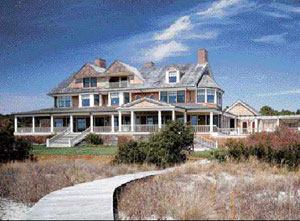
On a special lot on Kiawah Island measuring 100,667 square feet, Steven J. Koenig Construction built the Ballybunion residence designed by architect Robert A.M. Stern. The main house and a guesthouse comprise 9,777 square feet of conditioned space. The structure is built to V-zone flood standards, so the lowest floor is not included in the conditioned space but is dehumidified to provide suitable storage space for the owners.
HOW DO YOU CULTIVATE YOUR HIGH-END CLIENTELE?
Our mantra is “We Build Relationships.” It’s on all our marketing, and we truly strive to do just that. The company is all management; the production is subbed out. Under this model, we emphasize that it’s a team who works with the client; it’s not me, or one individual, making the sale and then turning the job over to others to execute.
To make this work, we try to pick clients who we’re willing to bust our butts for, who we know respect us and our abilities, and who want to have a Steven J. Koenig Construction home. When we find that, the relationship builds on itself.
SO IT SOUNDS LIKE YOU’RE ALSO RATHER DISCRIMINATING ABOUT YOUR CLIENTELE.
In building a home, there is a strain that’s put on everybody involved. There needs to be a base of mutual respect; otherwise, the process will break down. The multiple number of decisions required to complete a custom home puts an enormous burden on someone’s already very complicated life.
When you’ve just asked someone to get back to you with answers on 256 questions, you need someone who’s good at making decisions. It drags out the process when we pick somebody who’s indecisive or, worse, won’t take the time to do this. Our management costs go up for the same amount of income, so it’s worth our while to be selective.
DOES WORKING WITH ELITE ARCHITECTS ADD TO THE STRAIN?
It can if the clients don’t understand what they’re getting involved in. For example, we did a home for a client who’d hired Robert A.M. Stern. This client was far less demanding than Stern and, as a result, paid a significant premium. Where the client was willing to put $15,000 worth of interior door hardware in the house, Stern’s design called for hardware priced out at $125,000. And where the client would have picked off-the-counter trim, we had about 130 custom knives cut for the interior trim profiles. We did full-scale shop drawings of cabinetry and doors just so Stern could see the direction of the grain on each piece that comprised the door of a cabinet. That’s the level of complexity we have to deal with but which a lot of clients don’t understand at first.
To complete the interior trim of the Ballybunion residence, Steven J. Koenig had more than 130 custom molding knives cut to create the trim profiles.
DO YOU GET MOST OF YOUR JOBS THROUGH THESE ARCHITECTS?
It helps to have an established reputation with the better architects, but we don’t get all our jobs that way. Often it’s the other way around: We help the clients select an architect. We ask them a lot of questions in the initial meeting to determine what level of quality they want — if they want an award-winning home or just a place they are comfortable with — and what kind of budget they have to work with. That helps us steer them in the right direction.
Many of our leads come from client referrals. Or they come from real-estate firms that give clients a list of builders and highly recommend certain ones. We also do a lot of in-house marketing: mostly letters of introduction to certain clients who buy high-end lots. We target areas on the islands in certain price ranges. We’ve learned that with the team effort we invest in each job, we would lose money building a home at too low a price point.
The main staircase at Ballybunion includes quartersawn white oak treads. The handrail is also oak, stained to provide sharp contrast to the custom-turned balusters.
HOW DO YOU WORK WITH A GLOBAL CLIENT BASE?
Lots of e-mail. On our Web site, we also have proprietary pages for each project where people can go in and view weekly progress pictures. All of our project managers and superintendents have digital cameras and laptops. We work with a lot of out-of-town architects, too, so we will shoot on site and immediately e-mail the images to the architect’s office to get approval for a decision. All of our financials are posted on the Web site as well. We do cost plus almost exclusively, so it’s important to keep a report of budget versus actual costs for our clients to review. We bill over the Internet and send clients copies of every invoice. All our transactions can take place via the Internet and e-mail.
IF YOU WORK COST PLUS, HOW DO YOU WIN THE JOB? DO YOU GET INVOLVED IN ANY KIND OF BIDDING?
We are up against other builders on many of our jobs. There are at least three other builders in this area who can deliver the same quality we do, and we compete with them for certain high-end clients.
ON A ONE-OF-A-KIND HOME, HOW DO YOU COME UP WITH ACCURATE NUMBERS IN A COMPETITIVE SITUATION?
We do a very detailed breakdown based on records of similar jobs that resemble different areas of a home and on what we know of the architect.
Designed by architect Mark P. Finlay of Southport, Conn., the Bass Creek residence on Kiawah Island is built on a double lot, totaling approximately 50,000 square feet. The pool house and main house combine to a total of roughly 5,200 square feet of conditioned space.
We spend a lot of time educating our clients about what goes into our costs. We explain there are three components: materials, workmanship, and profit. We’re very open about what we charge. But when someone is shopping around, the numbers from different builders aren’t always so transparent. On one job, we were cost plus 16%, and the other guy was cost plus 12%, which the client was quick to mention. After examining the numbers from the other builder, I pointed out that the difference was all in supervisory costs. The other builder was billing for his superintendent on the job site. I said we’d be delighted to do 12%, and then bill every month for our management time on site. That way, we’re guaranteed not to lose any money.
Clients rarely see these differences. So we are very leery of going into any project that has too many builders involved. If a client says, “I’m looking at these three builders,” and we’re one of them, we’ll stay in the game and put some sweat equity into it until the client can make an informed decision. But if there are seven or eight builders, we just walk away.
HOW DO YOU MANAGE PRODUCTION ONCE YOU GET ON SITE?
We have three project managers: my son, my brother, and me. And we have two superintendents, who are soon to be project managers. In our company, we consider a supervisor to be a project manager in training. Our superintendents will be given their own jobs very shortly, and then we’ll bring in another superintendent to take their places. This mentoring system is central to building a team that can ensure the quality we provide.
Our subs are obviously key to quality production, and we’re very loyal to them. We don’t shop around with six or seven subs to get the absolute lowest price. We tend to help mentor them along, too, particularly to make sure they’re pricing properly. The worst thing that can happen is to hire someone who’s underbid the job and gets in over his head.
A lot of selecting the right sub has to do with the complexity of our jobs. When you get into homes that are above $400 per square foot, there’s so much in them and the architecture is so complex that it requires a great deal of our time, in-house, to make sure the puzzle goes together in the right order.
We’d prefer all the architectural details to be called out by the architect, but when those details are lacking, we have to establish the performance criteria ourselves. Over the years we’ve amassed a quality book from which we can print out details — kick-out flashing on a sidewall, for example — and we give those to our subs. If we’re clear about the details, we can pick the right sub to execute them.
WHAT ARE SOME EXAMPLES OF THE COMPLEXITIES INVOLVED?
We have a house going now with an interior trim package — trim and cabinetry, with materials and installation — that will cost about $2.2 million. On that job, we must have a hundred pages of shop drawings just for the interior finishes. That takes a great deal of time working with the architectural firm before production begins. Our estimator does most of that integration for us.
The windows add enormous complexity. We use a lot of commercial windows like Zeluck (www.zeluck.com), Tischler (www.tischlercommerial.com), and Michael Reilly (www.reillywoodworks.com). We’ll put a million dollars in a window-and-door package, when most people wouldn’t spend that much on a house.
Tischler has its own crew that it sends down and who can certify the installation, which is important when we’re spending $30,000 just on installation costs. With Zeluck windows, one of our framing crews has a window division with a separate crew who does nothing but install these high-end windows. That expertise is very influential in deciding which sub gets the job.
Another example of the complexities involved is in painting. We have painters who are painters, and then we have painters who are artists. Some clients are willing to pay for the artist and get interior trim with seven coats of enamel, sanded between each coat.
All of the paint-grade work throughout this 6,000-square-foot home is poplar. The floor leading from the foyer to the main living area is cumaru, a dark mahogany.
The framing is usually pretty involved, too. We’re sitting on a 100-year fault here, so we’re in a seismic zone, as well as in a 130-mph wind zone. In this setting, the consequences of not getting something right can be pretty serious.
The Rhetts Bluff residence is another Mark Finlay design on a single Kiawah lot measuring 34,540 square feet, with the conditioned space of the home comprising 5,567 square feet. Like all of the homes shown throughout this article, construction costs on this caliber home reach over $500 per square foot.
WHAT’S INVOVED IN BUILDING TO RESIST BOTH SEISMIC AND HIGH-WIND CONDITIONS?
We start with a soil analysis to evaluate how deep the liquefaction of the soil goes. This will dictate if the foundation should be pilings and grade beams rather than spread footers, even when building inland where pilings aren’t always required.
In addition, the houses typically have a lot of glass, so with the wind loads, an internal shear wall often isn’t enough. We typically use big steel moment frames that are welded in the field. So selecting a framing crew for a job like this depends on that framer having welding expertise as well.
THAT COMPLEXITY MUST SERIOUSLY LIMIT THE FIELD OF SUBS AVAILABLE.
Absolutely. To select the right sub, we evaluate a combination of availability, quality, and price. On some smaller jobs, we know five framers who could easily handle the job. But on other jobs, we might have only two framers who have the skill, equipment, and manpower required to get the job done.
We have a home going now that’s about 10,000 square feet. If we were to pick one framer — one who does fine work, but lacks the manpower — he would be on that job for two years, and our client would be very upset with us. On jobs like these, quality isn’t just in the final product. ~
All photos by Rick Rhodes.