by Ted Cushman
In the storm-battered Gulf Coast, uncounted building projects are still disrupted by the devastating effects of 2005’s Hurricanes Katrina and Rita. But on the Baton Rouge campus of Louisiana State University (LSU), one building project’s purpose has actually been strengthened by the disaster.
Half-built when the storms struck, the Louisiana House demonstration building (“LaHouse” for short) was intended to serve as a focal point for the LSU Cooperative Extension’s entire housing-related educational effort. Now, the LaHouse program (www.louisianahouse.org) is poised to educate consumers and builders about a whole range of durability and sustainability issues, playing a key role in the region’s rebuilding.
The barely dried-in structure escaped August and September’s killer storms with barely a scratch. “The wind here just tore off a little housewrap,” says LSU building scientist Claudette Reichel, Ed.D. “But Katrina and Rita gave us what we call a ‘teachable moment’ — a really, really big one.”
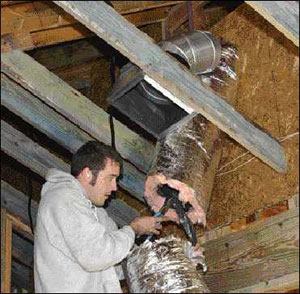
A critical component of an effective cooling system is a well-sealed duct system. Keeping ductwork within the conditioned space (here it runs through a semiconditioned attic) reduces the negative impact of duct leaks.
Comments Reichel, “It was kind of eerie [as to the timing of] when the storms hit. We were right at the point of construction where you could see the hurricane strapping and the shear-wall reinforcements — all the wind- and flood-resistant components that we had put in to address the needs in the coastal areas. So we decided to pause there, both because the storms had affected so many of the people working with us and because visitors wanted to see the structural components revealed like that.” Work resumed in the winter of 2006, as contractors began to install wiring and mechanical systems, but weekly tours of the building continue as the construction progresses.
Simple Styling, Sophisticated Systems
The design of the LaHouse is deceptively simple in appearance. From the outside, the building looks like a normal residence, built in a graceful Italianate style to complement its campus surroundings. Under the surface, however, a smorgasbord of best-practice energy options makes the plan technically complex.
For starters, the house uses three different wall systems — “actually, four,” explains Reichel (Figure 1). “We have ICFs [insulating concrete forms], we have SIPs [structural insulated panels], and we have stick framing. The stick building is done two ways: One section is closer to standard practice using 2x4s but detailed better for energy, moisture, termites, and wind, and the other one is advanced framing” — a lumber-conserving, energy-efficient system that uses 2×6 studs spaced 2 feet on center, with spray cellulose insulation in the stud cavities.
FIGURE 1. The first step in keeping any home cool is providing a thermally efficient building shell. The LaHouse provides several structural systems that optimize insulation, including insulating concrete form walls (top), structural insulated panels (center), and “advanced framing” — a lumber-conserving, energy-efficient system using 2×6 studs spaced 2 feet on center that were eventually packed with spray cellulose insulation (bottom).
Exterior walls showcase a selection of energy-efficient and durable cladding options, including light-colored stucco and reflective metal siding. Assorted high-performance windows are placed to optimize natural lighting while limiting solar heat gain during the summer. Here again, a wide variety of window types are showcased, including clad wood, fiberglass, treated wood, thermally broken aluminum, and vinyl. All were selected to meet Energy Star requirements to minimize solar heat gain (see “Selecting Windows for Coastal Homes,” March/April 2006; available online at www.coastalcontractor.net).
The hip roof likewise offers a selection of strategies. One section is cathedralized and unvented; another part has a vented attic with radiant-barrier sheathing. Shading is important, notes Reichel, but the designers had to consider wind resistance as well (Figure 2): “A hip roof is more aerodynamic and holds up better in storms, but overhangs increase the uplift and create a problem. So we kept our overhangs at 2 feet. That sheds water away from our walls and shades them, but it’s not enough overhang to drastically increase our uplift loads.”
FIGURE 2.In the Deep South, solar gain and humidity are the factors that place the greatest strain on cooling systems. While a tight building shell and efficient cooling systems with dedicated dehumidification fend off the humidity (see Figure 3), solar gains are limited by a variety of strategies including radiant-barrier sheathing in attic areas (left) and shading overhangs. However, a balance must be struck between shading and the increase in wind loads created by a deep overhang. The LaHouse designers opted for aerodynamic hip roofs, which hold up better in storms, and overhangs limited to 2 feet (above).
Roof coverings vary, too: One area has metal roofing coated with selective pigment that reflects solar radiation, while other parts have concrete tiles.
The collage of systems and materials hews to a consistent theme: All are chosen for durability and energy efficiency, and all place a premium on airtight, vapor-tight construction. Within those broad outlines, Reichel doesn’t play favorites: The whole point, she says, is to demonstrate that there are many ways to achieve the core goals of conservation, durability, and sustainability.
HVAC Choices
Continuing the multi-option theme, the building includes three independent HVAC systems, each representing a different approach. The three systems vary in design and cost, but none ignores the key HVAC issues in a Gulf Coast home: energy efficiency, humidity control, and air quality (Figure 3).
FIGURE 3. Each wing of the LaHouse, shown here in its eventual incarnation, has a different HVAC system designed for high-efficiency cooling in a fiercely humid climate. All three systems feature two-stage AC systems combined with separate dehumidification. While any one system could handle the whole building, the purpose of the project is to show that there are multiple ways to achieve the core goals of conservation, durability, and sustainability.
System One. The east end of the LaHouse looks like a detached garage but is actually a “teaching center” classroom where large groups will gather. That space has a simple but effective system using separate components. Cooling is supplied by a high-efficiency air conditioner, with sealed and insulated ducts running in a vented attic with radiant-barrier sheathing. Heat and hot water come from a small gas-fired tankless water heater.
System Two. The main living area in the center of the LaHouse has a two-stage geothermal heat pump for heating, cooling, and hot water. To prevent heat loss or gain through duct systems, the geothermal unit and its ducts are located within a sealed, insulated cathedral attic space.
System Three. The west wing of the main LaHouse building will house the project’s offices. In that section, cooling and heating are provided by a high-efficiency dual-fuel air-source heat pump that uses both natural gas and electricity for power and supplies heating, cooling, and hot water. Ducts for the system run within a web-truss floor system between the first and second stories (Figure 4) and in a furred-down ceiling chase set below the insulated attic in the second-story ceiling. Says Reichel, “A lot of homes in the South have higher ceilings — 9 or 10 feet is pretty typical. That really gives you room to lower ceilings and build chases for ductwork in hallways and through bathrooms and utility rooms. If you plan for it, it can easily be done.”
SYSTEM TWO DUCTWORK SYSTEM THREE DUCTWORK FIGURE 4. In a hot, humid climate, heat and moisture picked up by poorly insulated, leaky ductwork in attic spaces can boost a home’s annual cooling loads by 30% or more. The solution is to run ducts through conditioned spaces, such as an insulated attic (top) or through open-web floor trusses (bottom).
Fresh-Air Ventilation
Fresh-air ventilation is addressed the same way in each of the three systems: Air is drawn in from outdoors through a metal duct equipped with a damper that’s connected to the return side of the air conditioner.
The air intake’s damper is controlled with a “smart chip” that times air intake to the portion of the cooling cycle when dehumidification is most active. The damper opens to pull in humid outdoor air when the system’s cooling coil is cold and dry, ready to remove humidity. As the house cools and condensation soaks the coil, the damper closes to let accumulated condensate drain off the coil and out of the house.
Energy-rater Paul LaGrange explains: “When the thermostat is satisfied for temperature, the compressor turns off. That’s when the indoor coil is very wet. You wouldn’t want your fan to continue running and bringing in fresh air at that point, because you wouldn’t be dehumidifying — in fact, you’d be taking the moisture from that coil and redistributing it throughout the house.”
Humidity Control
Air conditioning can’t always be relied on for dehumidification in Louisiana’s climate, however. So the LaHouse systems include dedicated dehumidification equipment. The geothermal and dual-fuel heat pumps are backed up by a central dehumidifier that draws indoor air from a central return and distributes it into both supply-duct systems. In the teaching center, a small stand-alone dehumidifier in a louvered closet handles supplemental dehumidification needs.
For smaller homes or additions, the teaching center’s setup (as in System One shown in Figure 3, page 5) could be the least costly arrangement both to install and to operate, says Reichel. But the central systems have the advantage of air filtration and fine-tunable control (as in Systems Two and Three).
Sizing and Humidity
The LaHouse intends to demonstrate to Louisiana builders that equipment and ductwork sizing can be at least as important as unit efficiency. But accurately calculating the loads in a complicated house is no simple task.
Air conditioner sizing for the LaHouse, with its many different wall and roof systems, claddings, and window types, was “the challenge of all challenges,” says energy-rater Paul LaGrange, who handled the job. But he says modern software packages like Wrightsoft’s Right-J and Elite Software’s RHVAC are more than up to the task. Either software can give a room-by-room heating and cooling load calculation that accounts for all the various components found in LaHouse, based on the revised and updated method found in ACCA Manual J, Edition 8, from the Air Conditioning Contractors of America (www.acca.org/tech/manualj).
A good Manual J calculation is critical to system effectiveness, says energy-rater Mike Thibodeaux of New Iberia, La., who also consults on the LaHouse project. “At this point, all manufacturers require a Manual J load calculation, or they will not warrant the system,” notes Thibodeaux; many suppliers now train all their dealers to provide the calculations.
But in the field, Manual J compliance is often less than perfect, explains Thibodeaux. Even with the latest Manual J software, he points out, “You still have to know how to put in the right numbers.” His home inspections in the field reveal widespread oversizing. “I read their analysis and their end sum, and I can see how they jacked up the numbers so they could get their 500 square feet per ton of cooling — and then they say, ‘Oh, this is what Manual J says,’ ” Thibodeaux says.
The oversized systems that result may keep homeowners cool and gratified at the height of summer, but as Paul LaGrange points out, oversized systems are underachievers during most of the year. “A high-SEER machine doesn’t reach that SEER until it has been running for at least 20 to 25 minutes,” he explains. “So if your machine is oversized, and it runs for 10 minutes and then cycles off, you are not reaping the benefit of your investment for a high-efficiency machine.”
Worse yet, oversized systems fail to dehumidify effectively, especially during “shoulder seasons” when temperatures are moderate but humidity is still high. Under those conditions, systems run in short cycles and cooling coils don’t stay cold long enough to pull the moisture out of the air.
The result is often a moldy house. Says Mike Thibodeaux, “If your air conditioning is sized with 50% overcapacity, you are sure to grow mold in Louisiana. I’ve gone back to houses and seen it many times. It takes maybe two or three years, but if you are not dehumidifying, your moisture has to go somewhere. It gets absorbed into the walls and the studs. Then once they can’t hold that hundred gallons of water, it starts to come through the drywall. Once you see mold on the painted walls, it has already penetrated the drywall.”
In a climate like Louisiana’s, air conditioners alone may not suffice to keep a home dry and mold-free. Explains Claudette Reichel, “When you get that HVAC within the conditioned space, and when you build tight and energy efficient, just an air conditioner, even sized right, is not going to handle the latent load all the time. There needs to be some separation of dehumidification from air conditioning.”
Experts in Louisiana are guided by emerging research results like the data from a Houston, Texas, study conducted by Joe Lstiburek and colleagues at Building Science Corporation (www.buildingscience.com). The researchers equipped 20 Houston production houses with several different cooling and dehumidifying setups. Some homes got a high-tech air conditioner with two-stage cooling and a variable-speed air handler, some got a one-speed air conditioner and a central fresh air ventilator/dehumidifier, and some had a simple air conditioner paired with a dehumidifier in a closet. All systems provided effective dehumidification, but the least costly to install and to run was the simple air conditioner with stand-alone dehumidifier. For the average Gulf Coast homeowner, that approach is likely to prove a good middle-of-the-road choice.
Recognition for Quality
Energy efficiency, system effectiveness, and up-front cost can present complicated trade-offs. In a market full of complex options, homeowners and builders alike sometimes scratch their heads over how to compare solutions.
To simplify the decisions, says Claudette Reichel, the LaHouse team is pushing Energy Star certification for new homes. (Energy Star standards require a Manual J sizing calculation that addresses humidity control as well as cooling.) “People should do their certification process up front, starting with design process,” she explains. Reichel hopes to encourage even spec home buyers to look for energy-rated homes, so that spec builders will have an incentive to go beyond basic code and reach for best-practice benchmarks when building new houses. “If consumers don’t recognize and appreciate, and therefore don’t value, everything behind the drywall that creates a higher-performance product, then builders can’t go out on a limb to offer that, because they won’t be able to compete,” argues Reichel. “So it’s our role to educate the consumers so they can understand the difference and will seek it out. That will enable the building industry to offer high-performance options as upgrades or as a way to differentiate themselves in the marketplace.” ~
Ted Cushman reports on the building industry from his home in Great Barrington, Mass.
System One
Simple but effective: An 18-SEER high-efficiency air conditioner (1) is teamed up with a tankless water heater (4) for heat and a portable dehumidifier (3) for humidity control. This system relies on a small stand-alone dehumidifier in a louvered closet to handle supplemental dehumidification needs. Because the ductwork for this system runs through the vented attic, it’s critical to have carefully air-sealed ducts insulated to R-8. In addition, radiant-barrier roof sheathing has been added to reduce solar heat gains and help lower attic temperatures (see Figure 2).
1. Two-speed Carrier Infinity air conditioner
2. Aprilaire model 8126 Flow Controller for fresh air to return of unit
3. Stand-alone dehumidifier in closet with louvered doors for return path
4. Rinnai tankless hot-water heater
Ductwork in vented attic space: Rigid sheet-metal trunk insulated to R-8 and sealed with RCD mastic and mesh tape. Ductwork branches must be R-8 insulated flex wrapped with metalized Mylar and properly sealed with draw bands and UL 181B acrylic tape, or CertainTeed ToughGard duct board sealed with aluminum tape. All ductwork supported every 2 ft. o.c. or wherever sags are present.
System Two
A geothermal heat pump (1) uses the earth as a heat source and heat sink, boosting performance well above what air-source equipment can achieve (but at the cost of a serious up-front investment). This system is backed up by a central dehumidifier (2) that draws indoor air from an inlet grille in the west wing and distributes it into the supply duct. This ductwork runs through a cathedralized, unvented attic space, keeping it inside the building shell to reduce the impact of any duct losses.
1. Two-speed American Standard Air Source dual-fuel heat pump 2. Aprilaire model 1700 whole-house dehumidifier ducted to supply plenum 3. Aprilaire model 8126 Flow Controller for fresh air to return of unit Ductwork in semiconditioned attic space: Rigid sheet-metal trunk insulated to R-4 and sealed with RCD mastic and mesh tape. Duct branches must be R-4 insulated flex properly sealed with draw bands and UL 181B acrylic tape, or CertainTeed ToughGard duct board sealed with aluminum tape. All ductwork supported every 2 ft. o.c. or wherever sags are present.
System Three
A high-efficiency dual-fuel air-source heat pump can use either natural gas or electricity to cool or heat the air. Like System One, a central dehumidifier draws indoor air from a central return and distributes it to supply ducts. This ductwork runs within an open-web truss floor system (see Figure 4) or in a furred-down ceiling chase situated below the insulated attic floor, to keep it inside the thermal envelope.
1. Water furnace geothermal heat pump with ground and pond loops
2. Aprilaire model 1700 whole-house dehumidifier ducted to supply plenum
3. Aprilaire 5000 filter located between geothermal unit and return plenum
Ductwork in open-web floor trusses: Rigid sheet-metal trunk insulated to R-4 and sealed with RCD mastic and mesh tape. Duct branches must be R-4 insulated flex properly sealed with draw bands and UL 181B acrylic tape, or CertainTeed ToughGard duct board sealed with aluminum tape. All ductwork supported every 2 ft. o.c. or wherever sags are present. (Second-floor distribution not shown.)