by Clayton DeKorne
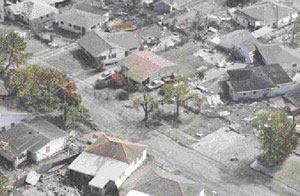
In New Orleans, floodwaters from Hurricane Katrina lifted homes off their foundations. The direction the buildings moved depended on the wind direction as well as on the ebb and flow of the floodwaters.
One year after Katrina, hurricane researchers, engineers, and disaster specialists are still grappling with this storm. Most urge that this hurricane must be understood as a flood event. While the storm reached Category 5 wind speeds of 175 mph in the middle of the Gulf of Mexico, the storm weakened to Category 3 by the time it hit land. But wind speed alone does not make a hurricane, reminds engineer Timothy Marshall, a building failure and damage consultant with Dallas-based HAAG Engineering: “The setup was perfect to maximize surge.”
As Marshall explains it, Katrina was an exceptionally large tropical storm. After gathering energy as it passed over the Loop Current — a warm, deep water flow that moves northward through the Gulf of Mexico — satellite images of the storm show a very large, symmetrical cloud shield (a perfect doughnut), which is a clear sign of a powerful storm. The large diameter displaced a wide area of water over the Mississippi Sound, the shallow water basin that extends from Louisiana’s delta across the entire coastline of Mississippi. Had the storm blown in over deep water, much of the wind’s energy would have been absorbed by the ocean. But over a wide shallow area, all of that energy is concentrated near the surface. The effect, explains Marshall, can be visualized by putting water on a dinner plate and blowing across the surface. It’s relatively easy to make the water pile up on the far side and spill over the edge, which is exactly what happened. The swell of water in front of Katrina piled up to almost 30 feet on the east side of the eye wall, where the winds were strongest. Along the entire Mississippi beachfront, most of the surge was more than 20 feet, and none was lower than 15 feet. Even in the Florida Panhandle, 200 miles away, water levels reached as high as 10 feet. And these levels did not include the height of the waves that danced above the surface of the swell.
An unwelcome visitor, Hurricane Katrina swept into Biloxi, Miss., with a 20-foot storm surge that wiped homes clean off their foundations.
In the face of such an immense water load, ordinary homes had little hope of surviving. Aerial photos of the region show a quarter-mile swath of cleared land in from the shore: Nothing but slabs wiped clean of the structures that stood above them. Most homes on ground-level foundations disintegrated under the intense impact of the oncoming water. Those that held their ground were gutted. Even elevated homes were picked up off their foundations when floor connections failed. Broken-up buildings were turned into floating debris that smashed up other homes. When Katrina was gone, the debris line extended a couple of miles inland. More than 400,000 homes along the tangled shores of the Gulf region had been destroyed, and an additional 85,000 housing units suffered major damage. This amounted to almost ten times more physical damage than any other U.S. natural disaster. Combined with the damages wrought by hurricanes Rita and Wilma, the record-breaking 2005 hurricane season caused the largest U.S. migration in the past 150 years, leaving more than one million people homeless.
FEMA Responds: Not-Your-Average Pamphlet
Faced with such an unprecedented reconstruction need, the mitigation arm of the Federal Emergency Management Agency (FEMA) has at last released its own flood of informational assistance to aid survivors in rebuilding. If this evokes visions of a series of shallow, flaccid government pamphlets, think again. These materials have a reassuring depth and forcefulness to them.
FEMA 550, Recommended Residential Construction for the Gulf Coast: Building on Strong and Safe Foundations, is an ambitious manual aimed at providing engineers and builders with the essential information needed to build house foundations that can stand up to the forces of a major hurricane. It sets a new standard for practical engineering guidelines, making it a must-have document for any coastal building professional. In five chapters, engineers and mitigation specialists have outlined the essential engineering requirements for foundations inundated by high winds and deep surge. Here’s a look at what’s included and what it means for coastal builders.
While the brunt of Katrina’s surge washed harmlessly beneath this home on Dauphin Island (top), the water scoured away the sand from the base of the piles, causing the structure to lean dangerously. Had the piling been longer and buried deeper, as on a nearby home (bottom), it would have remained upright.
Engineering calcs. Crunch time in engineering a coastal foundation begins with calculating the loads imposed by each of the identified hazards: high winds, storm surge, wave action, flood-borne debris, and tidal scour. All of these loads must be accounted for, but if tallied separately, they’d lead to unnecessary overdesign. So the next step is to determine appropriate load combinations for the building site. Load combinations are an engineer’s shorthand for computing the relevant forces from a wide range of design loads — dead, wind, wave, uplift, flotation, overturning, and so on. The load combinations used in this manual are those specified by ASCE 7-02, the standard referenced in the 2003 International Building Code (IBC).
The rationale for outlining this engineering process, explains project manager Matthew Haupt, stems from the idea that many of the engineers currently assisting in the massive rebuild effort have come from noncoastal regions. They have the design expertise but may not be familiar with the specific forces imposed by high winds and velocity waves.
Plug-and-play designs. What makes FEMA 550 unusually rich is that it goes a step beyond summarizing how engineers determine foundation design loads: It provides the designs for seven pre-engineered foundations. These are presented as foundation templates — what Haupt refers to as “model layouts.” If you stick within the design parameters — limiting the size, weight, and roof pitch of the home to a prescribed range — you don’t need to run through the engineering calcs. It’s plug and play: All the design details are included in a set of construction drawings in the document.
Homes whose dimensions, weights, or roof pitches fall outside the ranges provided in FEMA 550 should have a licensed professional engineer’s consult. (Don’t forget to bring a copy of FEMA 550 when you meet with the engineer.)
PRE-ENGINEERED FOUNDATIONS
FEMA 550 includes construction details for seven different foundation types. As long as the home is built within certain limitations for size, weight, roof pitch, and footprint complexity, and the site conditions match the assumptions engineers have assigned, the foundations can be built without engineering oversight.
Open vs. closed. The seven foundation designs offered in FEMA 550 provide a range of open and closed foundations suitable for rebuilding in different flood zones. In general, open foundations with deeply driven piles are needed for homes in V zones — beachfront sites that see direct action from breaking waves. Piles present very little face to the impact of the oncoming waves; instead, the brunt of the wave washes through. Closed foundations, which are much less expensive and much more familiar to Gulf Coast builders, are subject to the full force of a breaking wave. They should be used only inland, where the structure may see high water without wave action.
DESIGN MODULE
The foundation designs in FEMA 550 are based on a 14-foot-wide (maximum) by 28-foot-deep (minimum) “module.” While the dimensions of this module are limited, there’s still considerable design flexibility. For example, if a builder sets out to build a 30-foot-deep, 42-foot-wide home, the foundation can be designed around three 14-foot-wide by 30-foot-deep sections. A 28-foot-deep by 50-foot-wide home can be built on four 121/2-foot-wide by 28-foot-deep foundation sections.
Elevation Debate
While FEMA’s guidelines clarify the foundation design process, the water remains murky around the issue of elevation. How high a home should be raised is a question that elicits strong opinions on both sides of a growing debate.
On one side of the argument are those yelling that it’s insane to rebuild too low in a region obviously prone to severe storm surge. This party includes those calling for a limit on subsidizing substandard housing that, in all likelihood, taxpayers will have to pay to rebuild again when the next Katrina-sized storm roars ashore. On the other side of the debate are those anxious to get as many homes rebuilt as quickly and inexpensively as possible, so people displaced from their homes can put their lives back together. This party includes most of the displaced themselves and all those fearful that the local residents will be forced to give up their properties to a more gentrified populace.
Piers on discrete footings (foreground) failed by rotating and overturning, while piers on more substantial footings — in this case, a concrete mat — survived (background). However, the surge near Pass Christian, Miss., reached almost 30 feet, washing the home off of its foundation.
This debate erupted in November 2005 when FEMA issued advisory flood maps for Mississippi, and it was reignited when the advisory maps were released for Louisiana earlier this year. In keeping with long-standing policies used to administer the National Flood Insurance Program, the new maps are based on an average of recorded flood elevations for the last 20 years. The Advisory Base Flood Elevations (ABFEs) account for the surge levels from Katrina, but there’s an averaging down, so the elevations do not match Katrina inundation levels. Those on one side of the debate fret that the advisory elevations may be too low if a Katrina-sized storm blows through again, and those on the other fret the increase will drive the cost of construction too high. The advisory status of the elevations is a halfway measure that puts the onus on local jurisdictions to decide how to enforce elevation requirements. However, once the elevation maps become final (and in all likelihood the elevations will only increase on the official maps), FEMA has the option of restricting municipalities from participating in the flood insurance program if they do not enforce codes consistent with the maps.
The seven pre-engineered foundation designs (referred to by case letter in FEMA 550) cover a range of coastal flood conditions. The deep open foundations are suitable for elevating homes 10 to 15 feet above ground level, while the shallower foundation types have a practical upper limit of 8 feet above grade.
In Search of a Reasonable Compromise
Caught in the middle are the mitigation engineers who recognize immediately the design ramifications of building too high with generic foundation plans rather than with custom engineered designs. FEMA 550 offers a reasonable compromise, opting for closed foundation designs that are sufficient up to 8 feet above ground level and open foundation designs up to 15 feet.
These upper limits represent practical limitations of the materials and techniques: When faced with resisting A-zone flood forces, 8-foot-tall foundations are a practical upper limit for 8-inch-thick reinforced block walls. The open design using timber piles is limited to 10 feet above ground level primarily by the availability of longer piles. Steel-reinforced concrete columns are limited to a height of 15 feet above ground level. Above this elevation, the amount of reinforcing steel required in the piles would squeeze out the amount of concrete needed. To go much higher would require steel-pipe piling and individualized engineering. There is some consolation for these practical limits, however: While storm surges from Hurricane Katrina far exceeded these limits in many areas, the added height would have mitigated most of the disaster. FEMA’s Mitigation Assessment Teams concluded that if homes facing the brunt of Katrina’s surge had been elevated to 15 feet, 80% of the damage could have been avoided.
The issue boils down to money. If you want to save the cost of engineering and use a plug-and-play foundation design, you have to accept the elevation limits, which come with certain risks. This message offers a not-so-subtle hint for those who build high-end custom homes: The safest foundations are custom-engineered foundations that elevate homes higher than FEMA’s advisory elevations. Look not to the ABFEs but instead to the surge inundation reports (see http://www.fema.gov/pdf/hazard/flood/recoverydata/ms_overview.pdf ), and build above those levels. Unfortunately, that’s probably not a viable option for a majority of landowners who lost their Gulf Coast homes, and their fears of the land passing to a more gentrified population probably have merit. ~
Clayton DeKorne is editor of Coastal Contractor.
Gulf Coast Builder’s Review
When compiling the foundation designs for FEMA 550, engineers surveyed Gulf Coast builders for their impressions of the various foundation types presented in the manual. Highlights of this builder analysis follow.
Deep Open Foundations (Cases A, B & C)
Deep timber piles are considered a “new approach” for residential construction in many Gulf Coast areas.
- Pile-driving contractors are not abundant in all areas of the Gulf Coast.
- Timber piles are not anticipated to be widely used, but the option is available.
Shallow Open Foundations (Cases D & G)
- Foundation type similar to existing Gulf Coast building practice.
- Concrete columns are recommended where masonry has historically been used.
Enclosed Foundations (Cases E & F)
- Familiar construction technique for Gulf Coast builders.
- Common practice for elevation in A zone.
Costs Considerations
Gulf Coast contractors also evaluated the relative costs for the various foundation types. Findings include the following:
- Costs for pile driving vary widely throughout the Gulf region.
- Labor prices are rising as a result of increased demand.
- Material prices are also rising with increased demand.
- As in most markets, an economy of scale from building in quantity can help to lower construction costs.
Note: The manual includes a breakdown of costs for each design based on May 2006 prices. These prices reportedly include taxes, overhead, and profit, but the summaries do not break these out, rendering them ballpark figures at best.