In boom times and flat times, construction is a dangerous trade. And the greatest risk sometimes falls on the people doing the dirtiest physical work. From the Southampton, New York, Town News comes this sad story:
“A construction worker died in Southampton Village on Monday afternoon when a foundation wall at a work site collapsed, pinning him underneath …. Facundo Gonzalez, 33, of Farmingville was trapped beneath the fallen concrete wall shortly before 3 p.m. while he was working at a construction site at the southeast corner of North Sea Road and Willow Street.”
The Town News quotes local building official Jon Foster as saying that Gonzalez was excavating beneath a recently poured concrete wall to install footings that, according to code, should have been installed before the wall was placed. Also, said Foster, the wall lacked steel reinforcing that should have been included, and might have prevented the structural failure.
It’s worth noting that in some cases, it’s okay to pour a basement wall without footings, and with just a minimum of steel rebar. The latest authority for residential basement wall design is an American Conscrete Institute standard called ACI 332-08, “Requirements for Residential Concrete Construction,” available from the ACI bookstore for $58.50. The standard specifies footing widths based on the load-bearing strength of the soil, and on the load imposed by the foundation wall and the house. Sand or gravel soil, such as you’d find on most of Long Island, New York, may be strong enough to support some basement walls even if the spread footing is no wider than the wall itself. The same could be said of many coastal areas where sand and gravel soils predominate — although, in low coastal areas, it’s also important to watch out for spots with soft or unstable silt and clay soils, or even peat (and, of course, uncompacted fill placed by people).
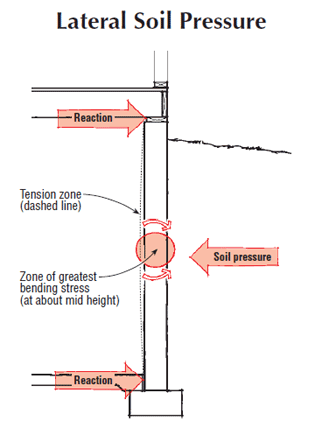
But even when the site soils are strong, it’s a different story when you undermine the wall, as happened in this case — or if the wall has to span across a small area of uncompacted fill. In such cases, the wall, with or without a footing, needs horizontal steel reinforcement (which this wall reportedly lacked).
There’s a good discussion of basement walls and footings in the archives of the Journal of Light Construction in two articles written by engineer Brent Anderson, who helped write the ACI 332 standard. Anderson explains how to properly size footings, and where to place rebar to maintain wall strength in order to span localized zones of soft soil.
Detail from “ Designing Concrete Basement Walls,” JLC April 2002
Detail from “ Footing Fundamentals,” JLC October 2000
In hindsight, most catastrophes are preventable. A series of events had to happen in order to cause the death of construction worker Facundo Gonzalez. The wall had to be placed without a footing and without reinforcement — a decision that local building officials are looking into. Then, Gonzales had to be given the dangerous task of digging underneath the wall to retrofit a footing, with no measures in place adequate to ensure his safety — an event that is under investigation by New York OSHA. And in this case, the death has also been reported to the Suffolk County, New York, homicide squad, which Southampton Village Police said is routine in any case of an unnatural death.
None of this, of course, will bring Facundo Gonzales back to life. But for the rest of us, there is still time to learn the lessons, and to be careful that the same thing does not happen on one of our jobs.