The collapse of the housing-market bubble in Florida has brought new development in the state to a grinding halt. At the same time, a slowdown in the decades-long influx of new residents to Florida, observers say, may signal an end to the population boom that has fueled long-term growth in the housing industry there. But even if population growth resumes and home values begin to rise again, Florida will still face long-term practical constraints on new development — including the problem of household water supply. A case in point: negotiations between Broward County and Palm Beach County over the water distribution plan for a proposed new reservoir. “A coalition of Broward and Palm Beach County utilities for more than two years pushed for building an additional reservoir west of Royal Palm Beach that could capture stormwater and use it to boost drinking water supplies in the two counties,” reports the South Florida Sun Sentinel (“Hurdles ahead for Broward, Palm Beach County water-sharing reservoir,” by Andy Reid). “Now, talk of cooperation switches to dealing with the touchy topics of how to pay for the estimated $363 million price tag and how to divvy up the water among thirsty communities.”
For most of the last 100 years, civil engineers worked to drain Florida’s swampy interior to make land available for agriculture and development. The latest proposal is an attempt to make use of some of the fresh water drained by those engineering projects, says the Sun Sentinel: “The new reservoir would capture stormwater that gets drained out to sea by the C-51 canal that stretches through West Palm Beach. That canal dumps an average of 270 million gallons of water a day out to sea, more than the 232 million gallons per day utilities in Palm Beach County are permitted to provide.” One solution for water supply — in coastal regions as well as inland — is harvesting rainwater directly for home use, either for a whole development, or on the scale of the individual home. Eddie Van Giesen is Policy Coordinator for BRAE, a company that supplies complete rainwater harvesting systems for commercial as well as residential applications. Van Giesen says that the industry is getting a big boost from a government mandate for federal facilities to incorporate rain harvesting into their water sources. Facilities such as public schools are also good candidates, Van Giesen says, both because they have large roof areas and because most of their water is used to flush toilets, so that harvested rain requires little if any treatment. “The perfect situation is a large roof area and a large non-potable water requirement,” Giesen notes. House by house, according to Giesen, rainwater is a plentiful source on the residential scale: BRAE estimates that as much of 60,000 gallons of water a year falls on a 2,000-square-foot roof in the Mid-Atlantic states. And Giesen argues, “Rain harvesting makes sense all the way down to a rain-barrel on an individual house. But we have package systems for homebuilders that go from just bigger than a rain-barrel, up to as big as a builder may want — pump, filtration, and treatment systems that can handle all of a house’s water needs.” BRAE systems are currently in service at showcase locations such as Mississippi’s Grand Bay National Estuarine Research Reserve, near Gulfport, and at a downtown Raleigh, N.C., earth-friendly home featured on television’s Planet Green.
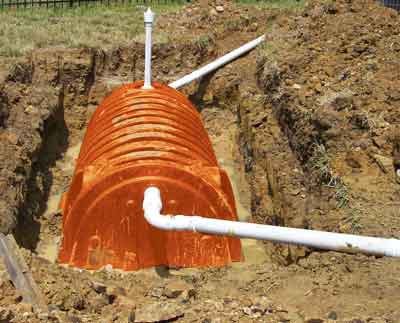
In a StormChamber water reuse system, water is transported from the roof by gutters and downspouts. It passes through a screen filtering system before entering the buried 575-gallon chamber, where it is stored for future use. BRAE, of course, is not the only player in the rainwater-harvesting game. Competitor StormChamber, for example, touts its own polypropylene underground tank storage system, scalable from single-home to industrial-size applications. In a recent study, StormChamber tanks with a soil percolation drainfield were able to manage a stormwater overflow problem in Kure Beach, N.C., sharply reducing the contamination of ocean water with harmful bacteria washed out of populated areas during heavy rain events, according to the Island Gazette (” Kure Beach Storm Water Outfall Experiment Shows Good Results,” by Willard H. Killough III). The beauty of rainwater harvesting, advocates argue, is that it addresses stormwater and pollution issues at the same time that it offers water supply solutions. And as water becomes an increasingly scarce resource, Eddie Van Giesen argues, “We can’t look at water the same way as we have been, any more. Eventually, we are going to have to look at water and treat it depending on what you are going to use it for. If you’re going to wash garbage trucks out with it, it will require this much treatment. You’re going to flush toilets? This much. You’re going to drink it? This much. We don’t need to be spending effort, money, and time in treating water to a level that is not necessary.”