Edited by Ted CushmanCONTENTS:
New Window Codes Puzzle East Coast Builders
Court Cuts Back Texas Mold Award
Time to Clean the Garage? Head to the ReStore
New Nailgun Rules Limit Bounce-Fire Option
Leaving the Grid? Pay at the Door
New Window Codes Puzzle East Coast Builders
The International Code Council’s 2000 International Residential Code (IRC), which is replacing BOCA, ICBO, SBCCI, and CABO residential codes nationwide, contains significant changes to wind-resistant construction provisions for coastal areas. As northeastern states adopt the IRC, builders near the ocean must consult redrawn wind maps to see if they have to use storm shutters or laminated-glass windows that can pass tough missile impact and pressure-cycle tests. Rhode Island adopted the IRC (with amendments) in fall 2002, but for months the state budget lacked money for code books and training. A Rhode Island contractor told JLC in October, “Nobody can tell me what I have to do. The building inspectors don’t know, the window suppliers don’t know — I went out to a window plant in the Midwest for a week of training, and they didn’t answer all my questions either. I was hoping to come back an expert, but that didn’t happen.”
Dade County, Fla., imposed tough wind codes and product testing years ago, and dozens of storm-resistant window models have Dade County labeling. “But you can’t just spec Dade County windows,” said the Rhode Island builder. “Most of them have aluminum frames and single-pane glass. They don’t meet our energy code.”
Rhode Island did make code books available late in 2002 and put its “blue book” of state amendments on the web at www.rules.state.ri.us. They also gave builders a 90-day grace period to adjust. But product is still a problem: Windows that meet both the wind standards and the energy codes are only starting to reach the market. Even South Carolina and North Carolina have struggled to find windows that can meet state energy codes and also pass impact and pressure tests. The whole east end of Long Island, N.Y., and most of the island’s shoreline fall under windborne debris rules; for builders there, finding compliant windows has become a serious challenge.
Steve Berg, an Andersen Windows product manager, told JLC in mid-February, “We just recently introduced our first products with the high-performance, energy-efficient, impact-resistant glass. We are beginning to release the second phase of products this week, and we’ll release the third phase of products in very early March.” The delays stem from technical issues, said Berg: “The later products are the ones we had to do a little more reinvention with.”
Engineer Nanette McElman, a codes specialist from the insurance industry’s Institute for Business and Home Safety, says, “To get lower U-values you need more air space within the insulated glass, and that means a thicker sash. The challenge seems to be reinforcing the frames. The sash and the glass don’t break, but it’s hard to build the frame to handle the missile test.”
New maps, new methods, new standards. Even assuming windows become available, builders subject to the new IRC face a complex design puzzle even to figure out which design pressure (DP) or impact rating their windows have to meet. The new requirements depend on more than one factor: “Actually, there are six,” says Andersen’s Steve Berg.
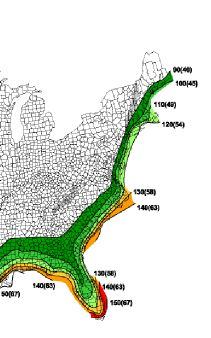
“First is the wind-speed zone: 100, 110, or 120 mph,” Berg explains. “Then there’s proximity to the shore — whether you are right on the beach or further inland. A third one is the mean roof height: How tall is the structure? Then, is the structure important to the survival of the community: Is it a residence, or is it something like a hospital or clinic? Important buildings need better windows. There is also window and door size; you don’t need as high a design pressure for the larger units as for the smaller ones. And then there is the placement of the window in the structure. A unit within 4 feet of the corner requires a higher design pressure.”
Hand-inked map from the Rhode Island Building Commission website shows how the state has redrawn new wind-speed maps to follow county lines. Areas requiring shutters or impact-proof glass have yet to be delineated.
There’s another twist, says McElman, that builders can work to their advantage. “Don’t forget that the energy codes involve tradeoffs,” she points out. “Instead of having to use windows with insulated low-e glass, you might be able to add insulation to the walls or ceiling, or use more efficient appliances. Then you can use single-pane laminated glass and have a less expensive impact-rated window.” In fact, McElman and the insurance industry are pushing for a change to the model energy codes to exempt shoreline homes from window U-value maximums. “The difficulty in finding products is stopping states from accepting the windborne debris requirements,” says McElman. “Energy conservation should never outweigh life safety.”
Back to Top
Court Cuts Back Texas Mold Award
A Texas court of appeals in December threw out most of the money damages in the now famous “mold lawsuit” brought by New York publicist turned Texas homeowner Melinda Ballard against the Farmers Insurance Group. Chopping the $32 million jury award back to $4 million, the justices noted “no more than a scintilla of evidence” that Farmers committed knowing fraud. Under Texas law, this ruled out $15 million in punitive damages and $5 million for pain and suffering. The judges left standing a consumer protection violation that occurred when Farmers waited four months to pay Ballard’s original claim for water damage to an oak floor. But they threw out any interest that accrued after Ballard refused a $382,738.69 check and held out for more money.
The appeals court turned down evidentiary appeals from both sides. The trial court had barred testimony from Ballard’s health experts on the grounds that the science was not reliable, but had not let Farmers use mediation records to show that Ballard had rejected reasonable offers. Seeing no egregious error, the appeals court deferred to the trial judge on both counts.
Either side can now appeal to the Texas Supreme Court, but that path holds risks for both. Ballard faces poor odds on the personal-injury front — courts seldom let experts peddle theories of mold-related illness. But the high court could find that the jury had some basis, however weak, for the fraud verdict, and reinstate punitive damages. However, it could also decide that Farmers did not get a fair trial because of the exclusion of the evidence from mediation; or it could even agree with Farmers that the case belonged in a different county court. Either ruling could send Ballard back to square one.
Back to Top
Time to Clean the Garage? Head to the ReStore
Building and remodeling generate a lot of “extra” stuff. Torn-out windows, doors, and cabinets that are still good, overstocked retail items, leftover lumber, and items ordered by mistake often end up in the landfill. But businessmen like remodeler Robert Criner of Criner Construction in Yorktown, Va., and David Stemler of PC Building Products in New Albany, Ind., are trying to make sure that surplus material doesn’t go to waste. Both men have helped to create local retail outlets that offer surplus construction material to the public at discounted prices, with the proceeds going to support charity.
Criner worked with his local Habitat for Humanity chapter to set up the ReStore. “I am as proud as can be over it,” he says. “We were able to do something that is a perfect win-win scenario. Builders and suppliers donate new or used building materials to the store, and the store sells the material to the public. The customers get an excellent price, and with the money, we build houses for Habitat.” Donors avoid disposal costs and in some cases may gain a tax advantage as well.
Stemler is also active with Habitat, but the store he helped to start is associated with the Salvation Army. Located in a vacated Lowe’s building supply store, the salvage and surplus building materials store shares the space with a traditional thrift shop selling clothing and household items. The store only opened for business in December, says Stemler, but as the weather starts to warm up, the supplies are coming in. “There is not a builder or remodeler out there who doesn’t have a garage full of this stuff,” he says. “One builder brought in three truckloads, and we must have sold $4,000 worth. People are bringing in windows that are still shrink-wrapped.”
Back to Top
Big Snows Bring Roof Troubles
February’s blockbuster storms — up to 3 feet of snow, followed in some areas by cold rain — hit East Coast roofs with their heaviest structural loads in a decade or more. Most passed the test, but the failures made news up and down the Atlantic seaboard. Single-family houses held up well overall. “I don’t worry much about the old houses,” said a New Hampshire building official, “because they’ve been through big storms before. And the new houses are built to better standards.”
But commercial buildings are often engineered very close to code minimums, noted a Massachusetts building commissioner — “and when we get hit by rain, what was a 20,000-pound snow load becomes a 60,000-pound load.” Some flat commercial roofs pancaked: Near Washington, D.C., the list of collapses included a strip mall rental store, a bakery warehouse, two drugstores, a Wal-Mart, a Toys R Us store, and a school. The storm also exposed critical flaws in some old or poorly built traditional structures, as several old barns and a dilapidated church reportedly fell down.
Small, flat-roofed structures like porches posed a particular risk. A Philadelphia woman was crushed by a collapsing patio roof. Dozens of flat sunroom roofs fell in at a New Jersey seniors development. (“We’re asking them to stay out of those sunrooms,” said police.) Also in New Jersey, one person was killed and four hurt when a smoking shelter collapsed without warning.
And a disabled New Hampshire man says he narrowly escaped the same fate when his collie dog, which is trained as a caretaker, physically pushed him off his porch just seconds before the 12×16-foot roof crashed down under a 4,000-pound load of snow. “I was leaning over the railing,” the man told a reporter. “It would have cut me in half.”
Back to Top
Circular Saw Recall
Makita USA, Inc., announced in December that the company is recalling about 180,000 of its popular 71/4-inch circular saws, because there is a risk that the blade guards may jam. The move is just a precaution, Makita says — the company has not received any reports of incidents.
The recall involves saws with the model number 5740NB, sold between April 1998 and November 2002. However, no 5740NB saws with an “N” before the serial number on the nameplate and a blue dot on the shipping carton are involved in the recall.
Saws can be returned to a Makita factory service center for a free repair. Details are available from Makita at 800/462-5482.
Back to Top
New Nailgun Rules Limit Bounce-Fire Option
Starting in May of this year, framers picking up a new nailgun may notice a few changes. An industry committee has agreed to new rules for the “actuation systems” (triggers and safeties) on many models. Light-duty tools aren’t included, but framing guns will now ship with one of four control systems: “single sequential actuation, full sequential actuation, selective actuation, or automatic reversion actuation.” However, the rule adds, “for purposes of functionality and utility, other actuation systems may be available.”
What this means in plain English is that most guns will not bounce-nail out of the box, but suppliers may ship alternate parts so users can modify the guns for bounce-nailing. Guns that will bounce-nail can also be specially ordered. If you want bounce-nailing, in other words, you have to ask for it.
Some companies are already ahead of the curve. Japanese toolmakers Makita and Max already ship guns with a selector that lets the user switch from single-shot to bounce-nail or off (“selective actuation”). Senco already has “automatic reversion” — guns equipped with the company’s ThinkTrac system default to sequential mode (push the nose, then fire) whenever the user stops bounce-nailing for more than a second.
“If you ship a tool that only fires sequential, they won’t buy it,” says one tool company exec. “The challenge is to keep the people happy but still make a safe tool.”
Back to Top
Back to Top
No. 2 & (Not Much) Better
If you’ve noticed a gradual decline in the quality of 2×4 framing lumber, it may not have anything to do with the trees. Visual lumber grades like Standard and Better (Std&Btr) or Number Two and Better (#2&Btr) can encompass a wide range of quality, but the Random Lengths lumber market newsletter reports that mills are increasingly pulling out the nicer sticks for special purposes.
University of Massachusetts professor David Damery explains, “Customers like Home Depot tell their suppliers, ‘We’ll pay a small premium for that prime grade, but that is all we want. Don’t give us any regular #2&Btr.'”
“In some cases the logs coming out of the woods are even better than they used to be, because we have plantation wood coming on line that is very consistent,” says Damery. “But the log only gives so much — when you pull better stuff out, the average gets lower. The remainder still meets the #2&Btr grade, but the pile looks worse.”
But Damery says builders who want quality wood can still find it. “You can look for suppliers who are stocking that prime grade. Or you can look for the lumberyards that don’t buy on price. Some sawmills still train their graders to do a little better than the floor. And certain lumberyards go to two or three chosen suppliers who they know will consistently give a better product.”
Back to Top
Leaving the Grid? Pay at the Door
California’s growing alternative power industry may be about to inherit the lingering headaches of the state’s troubled conventional power system. Regulators seeking to recover financially from recent policy fiascos are considering assessing electric customers “exit fees” if they produce some of their own juice from wind, solar, biofuels, or private generators but stay grid-connected for backup power. The proposed fees would continue until the state’s multibillion-dollar debt, built up during the recent power crisis, was retired. Money would go to help pay the state’s back bills for high-priced power bought during the 2001 crisis, help bail out the state’s private electric utilities, support existing utility capacity that no longer is economical, and help pay for any power the state has future contracts for that gets replaced by alternative sources. Fees would in effect raise the price of independent power and lengthen the payback period for wind and solar power investments.
“Distributed power” producers — the owners of small local generating facilities, many of them gas or oil powered — generate about 2,000 megawatts in California, enough to power about a million homes. “Like other residents and businesses, they will continue to pay bail-out costs for the state’s electricity system for each kilowatt they draw from the grid,” says the Environmental News Service, “but now they also would have to pay on power they generate themselves.”
But faced by protests from solar and wind producers, policymakers are considering exempting nonpolluting sources from the fees. It makes sense, observers note — state and industry sources provide millions of dollars in incentives to support solar power, and the fees would amount to taking back with one hand what they give with the other.
Back to Top
Offcuts
Need a refresher course (or a primer) on basic wood structural design? Virginia Tech wood design profs are offering a three-day wood design basics course May 12-14 in Blacksburg, Va. Aimed at people who build or design wood structures but never got university training, the course will focus on practical code-conforming design of simple wood structures. For more information, visit www.conted.vt.edu/sdww. Germany’s Ministry of Construction building is riddled with costly construction defects, according to a report by Reuters news service. The problems are said to include cracked walls, leaking windows, and faulty air conditioning. According to a ministry spokesperson, the companies responsible for the faulty work will foot the bill for needed repairs.
Modular housing is expected to capture an increased share of the market in coming years, according to a recent study by the Cleveland-based Freedonia Group. Nationwide, the study predicts, modular housing will grow 1.2% annually through the year 2005. The 33,500 modular homes built in 2001 accounted for 2% of all housing starts that year.
The Association of the Wall and Ceiling Industries has published an informational paper on mold. The AWCI commissioned the Chelsea Group, an environmental consulting and engineering firm, to write the paper, which is meant to provide builders with specific information on preventing mold as well as dealing with existing mold. The 46-page paper can be downloaded from the organization’s website, www.awci.org.
Chivalry is dead, at least among tradesmen in the United Kingdom, according to British press reports. An insurance company there hired men and women investigators to call plumbers, electricians, and carpenters for minor repair jobs. All the trades routinely charged women up to double what they charged men for the same work, often recommending complete replacements to women customers but telling men that only a small repair was needed.
A federal judge in Philadelphia has sentenced a former city plumbing inspector to 30 months in jail and two years of supervised release, on top of a $7,500 fine, after the 57-year-old man was convicted of taking cash from plumbers whose work he inspected, according to the Associated Press. The sentence was the lightest allowable under federal sentencing guidelines, which specify a 30- to 37-month jail term.
Florida lawmakers are considering lien law reforms that would leave builders, not homeowners, on the hook for unpaid bills from subcontractors and suppliers, according to a report in the Citrus County Chronicle. Current law forces some homeowners to pay subs or vendors to get a lien removed, even if they have already paid the builder. Legislators say they expect builder opposition to the measure.
New Hampshire may move to license building contractors, reports the Union Leader. The state got 223 complaints against contractors in 2002. The issue was highlighted when a couple allegedly abducted a woman from a Concord contractor’s office at gunpoint, trying to get back $8,500 they say was due to them. Passing agents from the office of the federal Bureau of Alcohol, Tobacco, and Firearms across the street promptly arrested the pair; the contractor himself was already in jail awaiting trial on a $5,500 swindling charge. Convicted of felony fraud in California in the 1990s, he also faces a state civil suit seeking $340,000 on behalf of cheated customers.
Nineteen thousand Utah contractors and vendors will have to kick in $125 each to the state’s Residence Lien Recovery Fund, established to pay off subcontractor liens on homes, in order to restore the fund’s financial health. The fund is down to just $1.5 million, after outlays of almost $4 million. Utah builders are resisting a suggestion to rebuild the fund with a fee on building permits.
Construction activity in Arizona may be linked to an illness known as valley fever. The illness causes flu-like symptoms that sicken thousands each year and occasionally leads to fatal complications. It’s caused by fungal spores native to dry areas of the Southwest, and public health officials suspect that dust from construction on previously undisturbed desert soils is responsible for a fourfold increase in reported cases over the past decade.
A new action-figure toy named Construction Jack will begin appearing in toy stores later this year. The 12-inch figure, manufactured by a company called Link Innovations, comes dressed in denim overalls, work boots, and a brown canvas jacket. Also included are a toolbox and toolbelt, hard hat, and safety glasses. A product review on one toy-industry website notes approvingly that “Jack is a bit beefier than most 1:6th-scale action figures, with bigger and more defined muscles on his arms and legs.”
New houses in much of Denver will be getting smaller, under a new zoning plan adopted by the city council in January. The new rules, which apply to teardowns and additions in about 60% of the city, reduce the maximum size of a house on a typical 50×125-foot lot from 5,500 square feet to between 4,200 and 4,600 feet. Proponents claim that the new rules were necessary to prevent “monster houses” from destroying the historic character of existing neighborhoods.
Back to Top