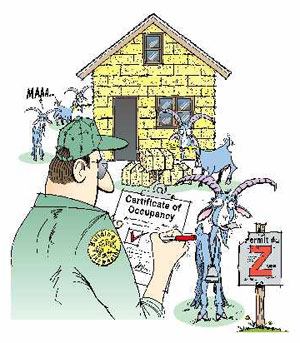
There was an interesting article in our Sunday paper the other day about houses built of straw bales.
I can just hear your response to that topic: “Code enforcement officers are hassling me because I want to use a wood composite they haven’t seen before, but they’re approving houses made of straw. Who’s running the building department, the three little pigs?”
I’m not sure how houses built of straw bales meet code — but since they get occupancy permits, they obviously do. Still, I can understand your question: “So why am I having so much trouble?”
What Building Codes Do
Think about how building codes work. They aren’t written to force you to use only certain materials or designs, or to exclude the use of straw bales or any other products as building materials. It just seems that way.
Codes are written to ensure that those straw bales — or whatever — meet the code’s health and safety standards.
For example, the code will require some level of fire resistance, so that if the building catches fire the occupants have time to get out alive.
If the people who want to use straw bales can demonstrate that the burn time of straw bales meets the code standard, it doesn’t matter if the code enforcement officer thinks straw houses are the worst idea since the Hindenburg — he should still give them a pass on the fire-
retardant issue.
What if he won’t? We’ll get to that in a minute.
You Bear the Burden of Proof
Let’s talk about that new wood composite you want to use for floor joists.
Suppose the code enforcement officer is concerned about the load-carrying capacity of those joists. If he or she waves you off, your only choice is to prove that the wood composite will carry the load — or you can use something else.
All the code officer has to do is express his concern. He doesn’t have to prove he’s right; you have to prove he’s wrong.
Evaluation reports. Since you don’t have a scientist or a lab tech on the payroll, how are you going to find that proof?
Start by contacting the manufacturer. Odds are the company already has proof in the form of an evaluation report from the ICC Evaluation Service (ICC-ES), a subsidiary of the International Code Council.
The process works like this: The manufacturer fills out an application to have the material evaluated and pays an accredited laboratory to test it. The results are given to the ICC-ES, which does a technical evaluation.
If the ICC-ES determines that the material meets code, it issues an evaluation report. The report describes the material, what it’s approved for, and the conditions under which it can be used. The report is proof that the material or method meets code.
Manufacturers, naturally, want to sell you stuff, so they make it easy to get reports. They can mail you the report for a particular product or you can download it from the Web.
When It’s Less Clear-Cut
Straw bales, of course, don’t have manufacturers. So for them you would need to look elsewhere for proof. The same holds true for any project in which you’re doing or using something really unique. Look to trade and scientific journals for articles to bolster your argument, or check the published proceedings of the code body.
If you don’t find anything helpful, you may have to hire a lab to do professional testing. First, though, check the Internet to see if someone else has already performed the test and can provide the results. The reference librarian in your local public library would be an enormous help to you in finding this information.
Design issues. Remember that the problem might not be with the materials you’re using — it might be your design.
Let’s say, for instance, that energy costs create a sudden new demand for sealed, unvented attics as a means of bringing hvac ducts into conditioned space.
If the inspector isn’t familiar with this method, he might insist you install vents. But that would defeat the purpose of what you want to do. It would be up to you to prove that your method would work.
If you plan to seal the attic with a particular material, like sprayed-in-place foam insulation, the manufacturer should be able to help. Otherwise, you need to do some research or get a stamped design from an architect or engineer.
Protect Yourself
Is any of this going to cost extra money? You betcha.
Will it be worth it? That’s between you and your clients — I assume you’re using this unusual design or product because they asked for it. If that’s the case, there are two provisions you should write into your contract.
Contract provisions. First, the contract needs to say that the cost of meeting code is part of the building cost. This is important because proving that you met code might wind up costing more than you anticipated. After all, engineers, architects, and lab techs make a nice living.
Second, make it clear in your contract that you’re using this new material or this unusual design at the customer’s request, and you’re advising the customer that new materials and designs can carry unforeseen risks. That language will be your protection if the straw bales — even after being approved by the code enforcement officer — do turn out to have a big fire problem.
Wouldn’t the fact that you met code requirements get you off the hook for using a dangerous material?
It couldn’t hurt, but trust me: You still need to get that sign-off from your customer.
There’s One Last Resort
Suppose you’ve done everything I’ve advised and the code enforcement officer is still objecting. Although you think your evidence is convincing, he doesn’t. What then? Should you appeal to the building department?
If the building department is big enough and the inspector who’s objecting isn’t in charge — or isn’t the only one there — you could try appealing. But in many towns, there isn’t a neutral party for you to appeal to, which means your only recourse is to go straight to court.
Does the court have the authority to overturn a code enforcement officer? Yes, it does.
Remember, though, that in court you will still have to prove that your design or material meets the health and safety standards of the code.
Quenda Behler Story, author of The Contractor’s Plain-English Legal Guide, has practiced and taught law for more than 25 years.