
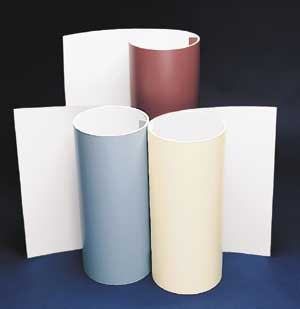
by Martin Holladay Aluminum coil stock, which has been used for years to cover trim on re-siding jobs, is becoming standard on new homes, too Ñ part of the trend toward low-maintenance exteriors. Manufacturers of aluminum trim coil offer two types of finish: smooth and striated. Smooth trim coil, which has been on the market the longest, is a thin aluminum flashing finished with polyester or acrylic paint. Striated coil has a textured finish, providing a better visual match to vinyl siding. Some manufacturers refer to striated coil as PVC-coated coil. Jerry McKie, national sales and marketing manager at First American Coil, notes that striated trim coil, like smooth coil, is basically painted aluminum. “All it is, is paint,” says McKie. “It’s paint with vinyl chloride in it.” The PVC paint used for striated coil is thicker than the paint used for smooth coil. The dry film thickness of the paint on striated coil measures about 3.5 mils, compared to the 1-mil paint film on smooth coil. Because the PVC coating is applied so thickly, it forms striation patterns as it dries. “The striations depend on the speed of the roller as well as the properties of the paint,” says Dan Hawk, metal products manager at Alcoa. From a distance, the striations look a little bit like wood grain.
Nominal vs. Actual Thickness
In the U.S., the gauge of almost all aluminum trim coil sold, whether smooth or striated, is nominal 0.019 inch. Many people in the coil industry acknowledge that actual measurements of aluminum coil products are often less than their nominal sizes. “The coil is referred to as nominal .019 inch, but most of the time it is thinner,” says Mike Lohuis, product manager for Gentek Building Products, a trim coil manufacturer. “There’s a plus or minus tolerance for aluminum trim coil. The .019 can be as thin as .0175 before paint and still be within the specifications. The aluminum industry is able to manufacture to closer tolerances than some other industries, and because of price pressures, manufacturers are making the material thinner and thinner.” For installers who prefer a heavier coil, most manufacturers also offer a heavy-duty trim coil with a nominal measurement of 0.022 or 0.024 inch, at an upcharge of about 15% to 20%.
Which Should You Use?
Nationwide, manufacturers sell about the same amount of striated trim coil as smooth, although there are regional differences in sales. Siding installers in the Northeast have always preferred smooth coil, while buyers in the South prefer striated. Fans of smooth coil say that it resists marring from tools better than striated coil. “The vinyl-coated coil marks up a little easier, so you have to be careful with it,” says John Fiderio, a remodeler and siding installer from Meriden, Conn. Mike Lohuis agrees. “The PVC-coated will take more abrasion than the smooth coil, but it mars easier,” he says. Where aluminum trim is subject to degradation from air pollution, the striated trim coil may be a better choice. “PVC is known to be very chemical resistant, so if an application is near an industrial site, or a highway, or acid rain, the PVC coating will protect the surface better than the smooth,” says Dan Hawk from Alcoa. A third alternative to smooth or striated aluminum coil is an all-vinyl bendable trim coil called Pro-Trim. Pro-Trim, which has been on the market for nine years, is a true match for vinyl siding. One of its advantages, compared to painted aluminum, is its resistance to dents and scratches. However, Pro-Trim has a much greater coefficient of thermal expansion than aluminum has, so it needs to be installed with special slotted fasteners and double-sided tape.
Most manufacturers of aluminum trim coil offer a variety of colors in both smooth and striated finishes. |
Installers who are used to the sharp creases of aluminum trim may not like the softer look of vinyl bends. Finally, Pro-Trim is available in only five colors, far fewer than aluminum coil. Pro-Trim has won converts among siding installers offering all-vinyl exteriors, but it represents a small fraction of the trim coil market.
Watch Out for PT Lumber
Many builders don’t realize that aluminum trim coil is incompatible with pressure-treated lumber. Aluminum flashing in contact with pressure-treated lumber can disintegrate completely in just two years. “The corrosion arises from the copper in the pressure-treated lumber and generally occurs in extremely wet locations,” says Dan Hawk. “If you need to cover a pressure-treated post, wrap the post first with tar paper or housewrap and use stainless-steel nails to minimize the potential for corrosion.”
Although most aluminum trim coil is used on re-siding jobs, its use in new construction is growing. In the Northeast, most siding installers prefer smooth aluminum trim coil to striated trim coil. |
Installation Details
If trim coil is fastened too tight, it will ripple when the weather gets hot. Jobs with rippled trim have given aluminum trim coil a bad reputation with some builders. But conscientious installers can avoid the wavy look. Rippling is caused by expansion, not contraction. “If you install in hot weather, there is relatively little trouble,” says Dan Parks, metal product manager at trim coil manufacturer Napco Building Products, who spent years installing trim coil. “But if you face-nail when the weather is cold, you’ll get rippling. The warmer the coil, the better. It helps to put the coil in a heated garage or on the south side of the roof for a while.” Other tricks for a quality trim coil installation:
- Use a heavy-duty trim coil (nominal 0.022 or 0.024 inch).
- Hem the material to stiffen it.
- Drill or punch an oversized hole in the aluminum before nailing.
- Don’t nail too snugly.
- Use only aluminum or stainless-steel nails.
- On rakes and fascias, install a 1×2 at the top of the trim to provide a stepped profile. This stiffens the trim and limits rippling.
- Reduce face-nailing to a minimum. To avoid face-nailing a fascia, insert the top of the trim coil under the drip-edge or into a piece of undersill trim and install a 1 1/4-inch bend at the bottom toward the soffit. Nail up through the bottom leg every 18 to 24 inches.
If trim coil is fastened to a fascia with face nails, the aluminum can ripple when the weather warms up. Nailing up from the bottom leg of the trim helps minimize rippling. |
For more information on installing trim coil, see ” Durable Details for Vinyl Siding,” 6/97, and ” Aluminum Trim for Vinyl Siding,” 4/99.
Price
Trim coil is sold in 2×50-foot rolls. Most smooth coil sells for about $50 a roll, while striated coil sells for about $70. All-vinyl Pro-Trim costs about $63 a roll.
Manufacturers of aluminum trim coil include Alcoa (800/962-6973), Gentek Building Products (800/548-4542), First American Coil (800/327-2645), Kaycan Building Products (514/694-5855), Napco Building Products (800/786-2726), Owens Corning Metal Systems (800/231-9333), Quality Aluminum Products (734/783-0990), and Rollex (800/251-3300). Pro-Trim all-vinyl trim coil is manufactured by Alum-A-Pole (800/421-2586).


