See Sidebar: Colored Concrete Cautions
When you hear the word “concrete,” you probably picture structural elements like footings, foundations, and slabs. And whatever you picture, the material is probably smooth and gray. Yet there are lots of ways to transform this common structural material into an impressive decorative element.
Most decorative techniques involve changing the color and texture of the concrete surface. These methods allow concrete to be used for nontraditional applications like countertops but are most frequently used for flatwork, which is the focus of this article.
The most common treatments make concrete look like more expensive materials such as brick, flagstone, and slate. Skilled finishers can produce stone or tile-like surfaces that are hard to tell from the real thing. But techniques aren’t limited to copying other materials. Color and texture can also be used to produce abstract or painting-like effects that are not possible with other materials.
In researching this article, I talked to a number of suppliers and spent time visiting job sites with Tom Ralston of Tom Ralston Concrete in Santa Cruz, Calif. With the exception of stenciling, his company has done just about every kind of decorative concrete there is.
Changing Color
There are a number of ways to color concrete. One of the older methods is to color the surface by exposing attractively colored aggregate. Other methods involve dying or staining the cement that’s in the concrete.
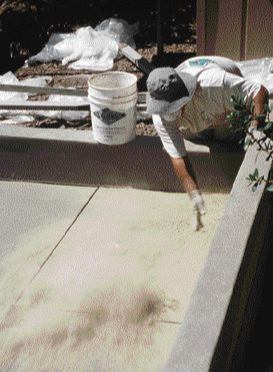
After scoring a damp exterior slab to suggest stone pavers, workers sprinkle on color hardener to change the tint (see photo at top of article). Latex molds taken from actual stone are pounded into place to provide the texture.
Integral color. The easiest way to color concrete is to have the supplier add color pigment at the batch plant. You can also add pigment to the mix after the truck arrives on site. Either way, the concrete is colored before it’s poured, so placing and finishing aren’t much different than usual. Concrete prices vary widely from area to area, but depending on who you talk to, using integral color may add 10% to 50% to the cost of the material. The labor to finish is about the same as for a standard mix.
Pigments are usually powdered and come in a wide range of hues. You can get reds, greens, yellows, blues, browns, tans, grays, and black. The color will go all the way through the crete, so chips and dings will not be noticeable.
Adding integral color is a simple way to color concrete, but there are ways to mess up. The most important thing is to be consistent, especially for jobs that require more than one load. Each batch should contain the same materials and the same amount of pigment and arrive at the recommended slump — typically 4 or 5 inches. Each batch should be mixed, placed, finished, and cured exactly the same way. Change anything and you can end up with areas that don’t match.
Pigment should be measured by weight and added in proportion to the amount of cement that’s in the mix. Intense colors are more expensive than subtle ones because it takes more pigment to get them. It might take 3 pounds of pigment to color a yard of light tan concrete and as much as 24 pounds to produce a deep brick red.
Watch out for cold weather. It’s common practice to use calcium chloride to speed setting in cold weather. But you shouldn’t add it to concrete that’s getting integral color because chloride-based accelerators can discolor the slab or cause efflorescence. If you need to pour in cold weather, ask your supplier to use hot water or to increase the cement content of the mix. Other options include using a more expensive nonchloride accelerator or concrete containing fast-setting type III cement.
Hot days.
Dark colors absorb heat, so a dark mix may set faster than you expect when it’s sunny and dry. That can make the concrete hard to finish and may lead to thermal cracking. If you can’t avoid pouring dark colors on hot sunny days, you should tent the slab or use extra curing compound to keep the concrete from drying out.
Using Color Hardener
Another way to color concrete is to add pigment after it’s placed. This is done by heavily dusting the surface with a dry-shake color hardener after the crete is floated and the bleed water has disappeared. The moisture in the slab activates the hardener, which is incorporated into the surface by floating, troweling, or stamping with textured mats. The color typically goes about 1/8 inch into the slab.
The main ingredients in color hardener are pigment and Portland cement. The pigment provides color, and the Portland enriches the surface and makes it harder than the concrete below. You could pour material that’s 3,000 psi and end up with a surface that’s 6,000 psi. The extra hard surface helps the slab wear better and makes it more resistant to freeze-thaw cycles.
Skilled labor needed. Using color hardener takes more skill and labor than using integrally colored concrete. Color hardener is applied in stages. The first two thirds are broadcast on the slab and worked in by trowel or float. The final third is worked into areas that didn’t get enough color the first time. The slab is then ready for finishing.
Color hardener comes in a wide array of colors. There’s more design flexibility than with integral color because the finisher controls the process. He or she decides how much color to apply and is able to create highlights by using more than one color.
It takes between 60 and 120 pounds of color hardener to color 100 square feet of concrete. Lighter colors typically require more. Most color hardener costs between 35¢ and $1.00 per square foot. But blues and greens are more, costing between $1.20 and $6.50 per square foot. As with integral color, you should avoid using chloride-based accelerators with this product.
Acid Stain
Cured concrete can be colored by treating it with acid stain. The stain, which is made from water, acid, and inorganic salts, can be applied with a roller, brush, or garden sprayer. It’s applied to the surface but does not form a coating like paint. Instead, it soaks in and reacts with the free lime that’s in the concrete. Free lime is not evenly distributed, so the treatment produces an attractive mottled effect.
You can use a single color, multiple colors, or mix colors on the surface. Geometric patterns can be created by using a diamond blade to score the slab prior to staining. The kerfs can be grouted later on to create a surface that looks like it was tiled. Free-form patterns can be created by masking off portions of the slab and selectively staining the surface.
Manufacturers recommend allowing new concrete to cure for two to four weeks before staining. The slab should be carefully cleaned before treating because surface contamination by oil or drywall dust can mask the surface and keep the stain from soaking in evenly. Check with the stain manufacturer before using any cleaning solution on the slab. And whatever you do, don’t acid-etch it first because the acid will react with and “use up” the free lime that’s in the slab. The stain won’t take if there’s nothing in the concrete for it to react with.
It’s possible to acid-stain old concrete, but the results are unpredictable because there’s no telling what has gotten onto or into the slab in the years since it was poured. In general, colors are likely to be more intense on new material than on old.
Acid stain can be used indoors or out. But it works better on those smooth, hard finishes that are more commonly used indoors. Stain is typically applied in two coats and should be sealed after it dries. A gallon of stain costs about $50 and will color between 100 and 200 square feet. Acid stain is available in many hues of blue, green, black, tan, and red. That said, the range of color is much narrower than what’s available with other coloring methods. Acid stain can produce deep colors, but they are usually somewhat muted.