The use of welded wire mesh in residential slabs has been on the decline for the last ten years as more contractors switch to synthetic-fiber-reinforced concrete. Synthetic fibers — which are often called Fibermesh, a well-known brand — have been marketed as a substitute for wire mesh in residential slabs.
Most contractors are eager to avoid the hassle of wrestling with wire mesh, and prefer the easier option of ordering synthetic fibers from their ready-mix supplier. Jon Hanson is the vice president and estimator at Walker Construction, a concrete contractor in Stowe, Vt. “We used to buy bundles and bundles of rolls of wire mesh, but we don’t do that anymore,” says Hanson. “Now we use Fibermesh in just about all our slabs, unless it is a structural slab with a rebar mat.”
Wire Mesh versus Fibers
Although often seen as a substitute for wire mesh, synthetic fibers, at least at manufacturers’ recommended dosages, don’t perform the same function. Properly placed wire mesh helps hold together a hardened slab, even if the soil settles slightly. Unlike most synthetic fibers, wire mesh also controls drying shrinkage cracking — the type of cracking which can occur during a period of several weeks after the pour.
At typical dosages, the benefits of synthetic fibers occur only during the first few hours after the concrete is placed; after that time, they provide no real benefits. Many studies have verified that synthetic fibers, unlike wire mesh, reduce plastic shrinkage cracking. Plastic shrinkage cracking occurs as the concrete makes the transition from liquid to a hardened slab. “Synthetic fibers help with avoiding plastic shrinkage cracks, but they don’t do much after the concrete hardens, in terms of providing a lot of strength for the slab later on,” admits Hal Payne, marketing services manager at Synthetic Industries, the manufacturer of Fibermesh.
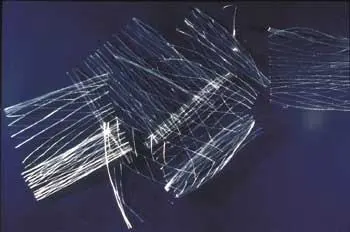
These bundles of fibrillated polypropylene fibers open up as the concrete is mixed, forming a more tenacious bond with the cement paste than monofilament fibers. |
Plastic shrinkage cracking occurs only in weather conditions that encourage premature drying of the concrete surface. Although it is definitely a concern on a hot, dry, windy day, there is probably no danger of plastic shrinkage cracking when concrete is poured in cool, cloudy, windless conditions.
The reason that synthetic fibers have been successfully marketed as a substitute for wire mesh is that most nonstructural residential concrete slabs don’t need much reinforcement. Barring unusual soil conditions, if a residential slab is being placed on a well-compacted subbase, wire mesh — or, for that matter, synthetic fibers — can be safely omitted. Depending on whether you want to control either plastic shrinkage cracking or drying shrinkage cracking, either synthetic fibers or wire mesh may be used. And if a residential slab actually needs reinforcement — either because it is partially unsupported or because it is load-bearing — then what you need is rebar, not wire mesh or synthetic fibers.
Hairy slabs? Some concrete contractors worry that fiber-reinforced concrete will produce a difficult-to-finish, hairy slab. “When synthetic fibers first came on to the market, we had these real long, real thick fibers,” says Payne. “Finishers didn’t like them, because it was hard to get the fibers mixed in and the concrete was hard to finish. Since then the whole industry has changed. We now use a mix of fiber lengths and diameters, and the product gets mixed in easier.”
Hanson, who has installed a lot of fiber-reinforced concrete, hasn’t had any finishing problems. “The power trowels go right over it, and lay the fibers down,” says Hanson. “Many of the fibers will pop up later, but ultraviolet light burns them off, as long as they are exposed to daylight. After a year you don’t see them anymore.”
Fiber Options
Polypropylene is the most commonly used synthetic fiber, but other types of fiber, including nylon and polyolefin, are also available. Polypropylene fibers come in two different formats: fibrillated and monofilament. Fibrillated fibers have been deformed and shredded to form a net-like mesh that engages more tightly with cement paste than monofilament fibers. The main disadvantage with fibrillated fibers is their tendency to protrude from a slab.
Contractors who don’t want to wait for protruding fibers to wear off can burn them off with a torch, or specify monofilament polypropylene. Although monofilament fibers are less tenacious, they are less likely to stick up than fibrillated polypropylene. Another alternative is to specify nylon fibers, which also lay down better than fibrillated polypropylene.
Permeability. Although some synthetic fiber manufacturers have claimed that fibers make concrete less permeable, there is no evidence that this is true, at least at common dosage levels. “A few years ago, we claimed, along with other companies, that the use of synthetic fibers reduced the permeability of concrete,” says Fibermesh’s Payne. “We have changed that claim. Fibers really don’t affect permeability.”
Neal Berke, principal scientist at Grace Construction Products, a manufacturer of polypropylene fibers, agrees. “In good quality concrete, fibers have no effect on permeability,” he says. “To reduce the permeability, you’d be better off adding a water reducer and lowering the water-to-cement ratio.”
What’s the best dosage? The recommended dosages provided by synthetic fiber manufacturers are not necessarily the optimal dosages for fiber concrete. Most ready-mix suppliers charge an extra $7 or $8 per cubic yard to add 1 1/2 pounds of polypropylene fibers to their concrete, amounting to an upcharge of about 10%. This dosage level has been chosen by the fiber manufacturers to make synthetic fiber’s price competitive with wire mesh.
“Fiber concrete is a wonderful technology with many good uses, at the right dosage,” says Parviz Soroushian, professor of civil and environmental engineering at Michigan State University. “But the manufacturers’ recommended dosages are not really sufficient to improve the hardened concrete properties. At 0.1% by volume, which is equivalent to the typical manufacturers’ recommendations of 1 1/2 pounds per cubic yard, the benefits are marginal in hardened concrete. You need about 3 pounds of fiber per cubic yard. Once you double the dosage, you have much to gain — improvements in impact resistance, toughness, and control of drying shrinkage cracking.”
Bob Cruso, president of Nycon, a manufacturer of synthetic fibers, doesn’t dispute Soroushian’s points. “We would love to be able to promote higher dosage levels, and we do for some applications,” says Cruso. “But we have to look at what we can offer at a price that is somewhat equal to welded wire mesh, because that’s what we are competing against. That’s unfortunate, but that’s the way it is.”
Contractors interested in achieving the best possible performance from synthetic fibers should consider the option of doubling the normal fiber dosage recommended by the fiber manufacturers. Before adjusting the dosage, though, be sure to consult with your ready-mix supplier and the fiber manufacturer’s technical experts, since higher fiber dosages may require less aggregate and more cement paste in the concrete mix.
Fiber Manufacturers
In addition to Fibermesh (Synthetic Industries; 800/635-2308; www.fiber-mesh.com), several other manufacturers make polypropylene fibers, including Columbian Fibersource (800/821-4391; www.fibersource.org), Forta (800/245-0306; www.fortacorp.com), and Grace Construction Products (877/423-6491; www.graceconstruction.com). Nylon fibers are available from Forta and Nycon (800/456-9266; www.nycon.com), while polyolefin fibers are available from 3M (888/364-3577; www.3M.com/corrosion).