- Q. I’m renovating a condominium that shares a wall with the adjoining unit. Sound from the neighboring unit — the ringing telephone, the dishwasher, and especially the TV — travels right through the double 2×4 common wall, which has fire-rated drywall sheathing on one of the interior surfaces. Only the neighboring wall has fiberglass batt insulation, and as far as I know, the two walls do not touch. The condo is on a slab foundation. Is there any way to reduce the sound transmission through this wall?
A. Fernando Pagés Ruiz, a contractor in Lincoln, Neb.,and the author of Building an Affordable House, responds: According to Appendix K of the IRC (which, of course, might not be locally adopted), dwelling-unit separation walls must have a minimum sound-transmission class rating of 45 (at which loud speech can be barely heard through the assembly). In your case, the double-wall construction you describe should meet this requirement, but I suspect that construction defects are still allowing considerable noise to seep through. So the first thing you need to do is find the sound leaks, which are reducing the wall’s effectiveness.
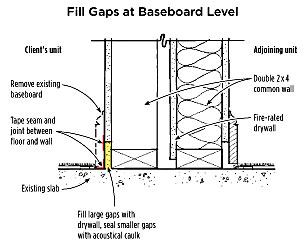
Start by getting down on your hands and knees and listening. You may discover that most of the sound is filtering in at baseboard level. Drywall hangers often leave a gap between the bottom sheet of drywall and the floor, which allows air and noise infiltration. After removing the baseboards, fill any large gaps with drywall and tape the seams, allowing the tape to mask the joint between the floor and the wall (see illustrations). Smaller gaps should be sealed with an acoustical caulk.
Next, check the sidewalls for “flanking paths” that allow sound to come through the corners. Improperly built corners transmit noise, and the solution involves removing drywall and adding framing and blocking as necessary so that the wall goes through the adjacent corners to the exterior sheathing. Check the attic or ceiling, too. Sound travels around these joints when they’re built improperly.
If all of these steps fail to reduce sound levels adequately, you can buy resilient channel at the drywall supply shop and apply it horizontally to your wall at 16- or 24-inch centers. Then hang 5/8-inch drywall vertically over the channels, making sure your screws do not go all the way through the channel into the framing, since this would defeat the spring action provided by the channel. Also, be sure to tape the new drywall to the ceilings, adjacent walls, and floor, which will help seal the leaks that permit sound transmission. Of course, it would be even better if you could get the neighbor to take the same steps.
Fixing a Noisy Condo
2 MIN READ