Although the term “green building” is relatively new, I’ve been an environmentally conscious builder since the mid 1970s, when I started a business building solar greenhouses and sunrooms in eastern Rhode Island. My original one-man enterprise has since expanded into three separate but closely linked companies: RemodelWrights, a design-build green remodeling business; SolarWrights, which installs solar electric and solar domestic hot water systems; and Earth Friendly Homes, which designs and builds new custom homes.
I’m strongly committed to environmental building, but I’m also a businessman. I’ve found that positioning myself as a green builder is a sound business strategy as well as a way to do work that I feel good about.
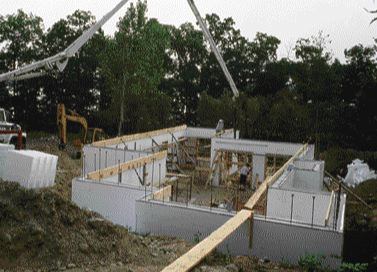
Energy-efficient ICF walls and foundations are long lasting and use less concrete than conventionally formed walls — two traits that kick them into the green category even though polystyrene and concrete aren’t obviously green materials.
What Is Green Building, Anyway?
Basically, green building is a way for homeowners to minimize the environmental impact of their home improvement and construction projects. To qualify as “green,” a project must satisfy four key criteria:
* Reduced energy use. Green buildings are frugal in their use of energy. This is accomplished through proper design, a well-insulated building envelope, and efficient appliances and lighting fixtures that cut down on water and electricity consumption. Making the most of natural daylight with thermally efficient and well-placed windows and skylights not only reduces electricity use but also enhances the quality of the living space. This is especially important in northern areas, where natural light is at a premium during the fall and winter.
House size is another important consideration. Not all green builders would agree, but I believe that a green house shouldn’t be unnecessarily large. Even if it’s very efficient, a 10,000-square-foot house will consume a lot of energy and material. In our design work, we emphasize comfortable but modest-sized living spaces. With skillful design, even a small house can be made to feel spacious.
* Energy production. Where possible, green buildings use solar energy in place of oil, gas, or utility-supplied electricity from non-green sources such as coal and nuclear power. Depending on the situation and the budget, this can mean using the sun for passive space heating, providing domestic hot water with solar collectors, or generating clean photovoltaic electricity.
* Providing a healthy indoor environment. Green buildings avoid products and finishes that outgas harmful chemicals, and natural or mechanical ventilation provides good interior air quality.
* Environmentally friendly materials. Finally, green buildings use materials with at least one of the following characteristics:
— they’re made from recycled materials
— they’ll have a long and useful life with minimal maintenance
— they were manufactured without dangerous materials
— they’re made from sustainably harvested wood
— they don’t require a lot of energy to manufacture and deliver
— they can easily be recycled at the end of their useful lives
Selecting Green Materials
It isn’t always easy to tell whether a given material qualifies as green. I’ve been active in the field for long enough to have a good feel for this, but new materials are constantly emerging. To keep up with them, I rely heavily on the GreenSpec Directory, which is a nearly 400-page guide to green materials from hundreds of manufacturers (BuildingGreen, Inc., 800/861-0954, http://www.greenspec.com). In addition to product information, it includes guideline specifications for everything from site work to doors and windows, interior and exterior finishes, furnishings, and mechanical systems. We use an extensive list of green products and materials — the following are some of our favorites:
Foundations and exterior walls. We’re the regional distributor for Reward Walls ICF wall systems, which have worked well for us because they’re easy for our carpentry crews to install. When we’re using a slab-on-grade foundation, ICFs allow us to pour the walls and the floor at the same time, reducing labor and pump-truck charges. The resulting concrete walls are much more durable than stick-framed walls and have an adjusted R-value of 33.
Floor framing and decking. For spans under 16 feet, we use Boise Cascade All-Joist floor trusses because they’re cost effective and easy to use, and they make efficient use of trees. For longer spans, we use the Boise Cascade BCI 90XL Series joists. If we’re making a concrete floor heated by radiant coils, we pour a 4-inch concrete deck over the BCI joists, using galvanized corrugated steel decking. When we make a traditional floor system, we use 3/4-inch tongue-and-groove AdvanTech subflooring. Because our houses are very tight, we use non-solvent-based GE-400L subfloor and deck adhesive to avoid possible outgassing.
Insulation. Bonded Logic UltraTouch insulation is a batt insulation made from scraps produced in the manufacture of blue jeans. It’s easy to install, and unlike fiberglass it doesn’t cause itching or respiratory irritation. It’s more expensive than fiberglass, but we think it’s worth the extra cost.
Cotton batt insulation made from recycled blue-jean material has a thermal performance similar to that of fiberglass, although at a higher cost.
Exterior siding. For lap siding, we use WeatherBoards fiber-cement siding from CertainTeed. Natural wood shingles are popular in our coastal area, and here we use white cedar shingles from Maibec, which are certified by the Forest Stewardship Council (FSC) as coming from sustainably managed woodlands.
Outdoor decks. The framing lumber we prefer is PreservePlus from Chemical Specialties, Inc., because it’s pressure treated with a safe, arsenic-free preservative. For the decking itself, we use Trex or SmartDeck, both composite materials made largely from recycled plastic and reclaimed hardwood sawdust. For some high-end projects, we use Pau Lope decking, which is a sustainably harvested, naturally durable hardwood from Brazil.
Interior paint and stain. On painted interior surfaces, we use Dulux’s LifeMaster 2000 low-VOC paint. We also use water-based EF series wood stains from General Finishes.
Finish floors. For projects with poured radiant floors, we use a variety of ornamental flatwork techniques to provide a stone or tile effect, which we then finish with Patina Stain from QC Construction Products. We also use a range of other flooring products, including natural cork, linoleum, bamboo, and several types of recycled or certified wood.
Cork floor tiles are glued to the subflooring with a non-solvent-based adhesive. In addition to being durable, warm, and resilient underfoot, cork is considered a green material because it’s sustainably harvested from the bark of a European oak tree.
Decorative concrete floors, finished with a low-VOC stain, meet several key green criteria: They’re highly durable; they minimize use of material by serving as both structure and finish; and they can absorb and retain heat in passive solar applications.
Design
We try to incorporate solar energy strategies into our projects whenever practical. When the site meets the requirements for solar energy, we incorporate passive solar energy strategies as well as solar thermal systems and solar electric systems (photovoltaics).
Planning ahead. In some cases, the project budget doesn’t allow us to install the solar equipment at the time of construction. We will incorporate the solar equipment in the design and label it “future solar collectors” or “future photovoltaic modules.” Before closing up the walls, we run insulated copper tubing or install a wire chase from the attic to the basement to make it easier to install the equipment at a later date. More often than not, the customer will “find” the extra money to have us come back and finish the installation.
Thoughtful design is a key element of green building. The orientation of this waterfront house, built with ICFs, funnels summertime breezes into the living space through the doors and window that face the angled deck. In winter, the attached garage blocks the prevailing winter wind. The passive solar sunspace heats the whole house on sunny winter days; a separately zoned radiant floor provides supplementary heat in cloudy weather.
Business Advantages
One of the biggest benefits to positioning yourself as a green builder is that it moves you into a profitable niche market where there is relatively little competition. Instead of competing with every other all-around builder or remodeler in the area for customers who are shopping for a low price, you’re dealing with people who sought you out because they want the specific products and services you provide.
Working with customers. I’ve found that green customers are generally a pleasure to deal with. They tend to be thoughtful, well-educated people who are eager to work with a builder who shares their values, and they are often willing to pay the extra costs that an environmentally friendly project may involve. You probably can’t fake a green commitment, though: Your customer will quickly figure out your ruse, and the trust you’d hoped to establish will be gone for good. In other words, you’re unlikely to succeed as a green builder unless you’re also an environmentalist.
One way to show customers that you “walk the talk” is to run a clean and green building site. We take pains to prevent erosion and protect existing on-site trees (see “Saving Trees During Construction,” 9/01). Instead of mixing all our job-site waste in the dumpster, we separate glass, plastic, metal, cardboard, roof shingles, and reusable wood. Our town’s recycling center is near our office. When I stop by job sites to check on progress, my crews load my truck, and I stop at the recycling center on the way back to the office. This takes a little extra time, but it also reduces the number of dumpsters needed on our jobs.
Spreading the word. Marketing and advertising are two different things. Because of the success of our marketing efforts, we have not needed to spend money on paid advertising. That’s partly because word of mouth seems to travel readily through the green community, but also because green building generates some publicity of its own. Green projects are often unusual enough that local newspapers and other media will cover them as news, providing exposure that’s more effective than paid advertising.
Local newspapers and other print media often see green building projects as news, increasing name recognition and generating favorable word of mouth at no cost.
Certification programs. Some state and local governments sponsor programs that allow builders to certify that their houses or remodels comply with specific green criteria. A list of these community green building programs is available from the U.S. Department of Energy at http://www.sustainable.doe.gov/buildings/gbprogrm.shtml; the site also contains lots of additional information on green building practices.
There aren’t any local certification programs in our area, so we haven’t been able to participate so far. But we do take part in the Energy Star program, which has some similar marketing benefits. Because most green clients are concerned about energy efficiency, they often start their search for a builder with a list of local Energy Star builders. If the customer installs Energy Starapproved appliances and the completed project passes a blower-door test, the homeowner is eligible for up to several thousand dollars in rebates.
Bob Chew’scompanies are located in Barrington, R.I.
| Resources | |
Boise Cascade 208/384-3639 All-Joist floor trusses, BCI 90XL Series joists Bonded Logic 480/812-9114 UltraTouch insulation CertainTeed 800/233-8990 WeatherBoards fiber-cement siding Chemical Specialties, Inc. 800/421-8661 Preserve Plus General Finishes 800/783-6050 http://www.generalfinishes.comEF series wood stains ICI Paints 800/984-5444 LifeMaster 2000 low-VOC paint | J.M. Huber Wood Products 800/933-9220 AdvanTech subflooring Maibec 800/363-1930 white cedar shingles Pau Lope 800/783-7220 sustainably harvested decking QC Construction Products 905/760-0566 Patina Stain Reward Wall Systems 800/468-6344 Trex Company 800/289-8739 U.S. Plastic Lumber 866/272-8775 http://www.usplasticlumber.com SmartDeck |