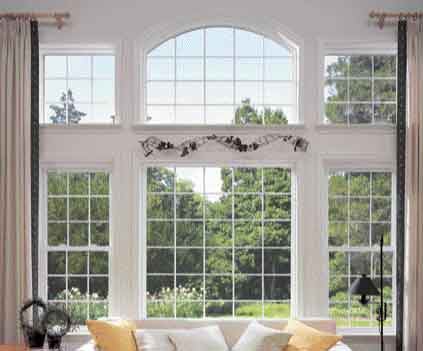
Vinyl windows first showed up in the U.S. in the 1960s, but they didn’t gain widespread acceptance until the 1980s. Recently, vinyl overtook wood as the most common window material in the U.S. Vinyl windows now account for about 40% of total window sales and around 60% of the replacement market.
Some products combine wood and vinyl, but all-vinyl windows have sash and frames made from hollow pieces of polyvinyl chloride (PVC). Glazing and hardware vary by brand and model but are comparable to what you’ll find on wood and metal units.
The main selling points for vinyl windows are price and durability. All things being equal, vinyl windows cost about a third less than comparable wood or clad-wood units. The installed cost is even lower because there’s no need to paint the window after it’s nailed to the building. Eliminating painting can also reduce overhead by allowing you to finish the job sooner.
Besides never needing paint, vinyl windows won’t rot, and vinyl doesn’t swell or warp when it gets wet. As with any product, quality varies by brand and model, however. To understand the differences, it helps to know how vinyl windows are made.
Making Vinyl Windows
Vinyl window parts start out as powdered PVC resin. The resin is mixed with additives to form a vinyl compound, which is melted and forced through dies. What comes out is a hollow extrusion that’s divided into separate chambers by a series of internal walls.
The extrusions are then cut into 16- or 20-foot lengths and shipped to the fabricator. In most cases, fabricators outsource extrusions, but a few of the larger manufacturers produce their own.
At the fabrication plant, extrusions for sash and frames are cut to length, mitered, and joined at the corners. The frames on low-end windows are sometimes joined with screws. But on most windows, frames and sash are joined by fusion welding, which involves melting the ends and pressing them together. This produces strong corners that are airtight and watertight. Assembly is completed by installing glass, weatherstripping, and hardware.
Additives Make the Difference
Most vinyl compounds are 80% PVC resin and 20% additives. But it’s the additives that determine the physical properties of the material. The compounds used in early windows weathered poorly, which led to problems like brittleness, yellowing, and surface pitting. As compounds improved, those problems became less common. Today’s windows contain UV-stabilizers to resist the sun and modifiers to enhance toughness and flexibility.
Many companies that make vinyl windows also make vinyl doors. It’s easier to gang doors and windows that come from the same manufacturer.
Dimensional stability. Excessive thermal expansion was a problem with earlier windows. As the temperature changed, vinyl parts expanded and contracted more than surrounding materials. This differential movement led to broken glass seals, poorly fitting sash, and failed caulk joints between frame and exterior trim. Modern compounds are much more stable, but vinyl still moves more than wood, metal, or glass.
Vinyl movement today is unlikely to affect the window, but it’s a reason to be careful about the joints between windows and exterior walls. Special vigilance is required with stucco or any other installation that relies on caulk to keep the water out. Don’t assume that the methods you use to install wood or metal windows will work equally well for vinyl. Ask the window manufacturer and the vendor what they suggest. It might mean using backer rod and high-performance sealant instead of cheap latex caulk. But that’s a small price to pay for an installation that doesn’t leak.
Strength and Durability
The walls of vinyl extrusions are typically 1/16 to 3/32 inch thick. Sounds thin, but the interior walls reinforce the exterior in much the way that chords reinforce a roof truss. Another benefit of this chambering is decreased thermal conductivity, because the air pockets act as insulation. Before buying windows, make sure you see a picture or, better yet, samples of the extrusions. In general, the thicker the vinyl and the more chambers in the extrusion, the better.
Like most vinyl windows for new construction, this one comes with an integral nailing flange. Some manufacturers offer windows with an optional attached vinyl brickmolding.
Vinyl is a thermoplastic, meaning that when it gets hot enough, it will start to melt. In hot, sunny climates it’s not unusual for surface temperatures to reach 160 degrees. In theory, that poses a problem for vinyl windows. The concern is that the vinyl will soften enough to deform under the weight of the glass. But in practice, the air-pocket insulation keeps the inner walls cool, allowing them to maintain their strength.
Reinforcing. Windows should be strong enough to withstand heavy wind loads, attempts at forced entry, and normal wear and tear. Even though extrusions may be strong enough to stand up to those things on their own, manufacturers sometimes reinforce them by putting steel or aluminum stiffeners in the chambers.
Vinyl parts have multiple inner chambers and, as is the case with these sash, can be reinforced with metal stiffeners. This particular window is a replacement unit, which is why it has no nailing flange. The bigger the window, the more likely it is to be reinforced. Metal is frequently used in the perimeter of large sash and in the stiles and rails of vinyl doors. It’s also placed in strategic areas in windows of all sizes. Typical locations include meeting rails, sills, and the side jambs of mulled units. It’s worth asking when and where the manufacturer reinforces windows. Some companies do a lot of reinforcing, and others do almost none.
Shopping for Vinyl Windows
Window manufacturers come in all shapes and sizes. Some are large national and regional companies that build with wood, metal, and vinyl. Others are small to medium-size companies that make only vinyl windows. There are lots of local window shops. Some sell well-known brands, while others sell their own private label. While it’s possible to do small-scale production, many companies outsource production to larger manufacturers. One such manufacturer is Republic Windows & Doors, which produces private-label windows for window shops and for builders and remodelers looking for a way to differentiate themselves in the marketplace.
Vinyl windows start out as 16- or 20-foot PVC extrusions. The pieces in this stack of frame parts are about to be cut to length.
In most cases, the same kinds of windows are available in vinyl as in wood. You can’t get true-divided lites, but you can get windows with grids sandwiched between the glass. Other options include snap-in wood jamb extensions and channels for drywall returns. Units are also available with vinyl brickmold or J-channel to accept vinyl siding. One of the more unusual products on the market is Polybau’s tilt-pivot window. Common in Europe, this type of window is seen in the U.S. rarely and usually as a high-end mahogany unit.
Product offerings vary by region and company. Double-hungs are especially popular in the eastern half of the country, while sliders and replacement units are more popular in the West. One thing to consider when choosing a brand of windows is the breadth of the product line. In addition to windows, many companies make hinged and sliding vinyl doors. Getting all the windows and doors for a project from the same vendor is a plus. The units will match and are more likely to show up at the same time.
Replacement windows. Vinyl windows have been especially popular as replacement windows because it’s easy to get them in custom sizes. Manufacturers have designed vinyl windows that can be installed in or over the existing jamb, so there’s no need to remove or damage the existing trim. This lowers the cost of replacement by reducing the time, mess, and labor that go into the job.
In most cases, the replacement unit screws into the existing opening and is caulked in place. You can also get replacements with something called a stucco fin. The fin, which looks like a wide, thin exterior casing, overlays the existing window and laps onto the stucco. That allows you to replace windows without patching stucco or repainting anything on the exterior of the building.
Color. Although vinyl comes in every color of the rainbow, most vinyl windows are either white or beige. A few are brown or bronze. Because dark colors absorb more heat, windows are usually light colored. Choices are limited because of the need to standardize extrusions.
Sash and frame extrusions are cut to length and mitered with automated chop saws.
The mitered ends of these frame parts are being heated to the melting point in a fusion welding machine. If you look closely, you can see that the ends have started to curl from the heat.
Pneumatic clamps hold the melted ends of extrusions together until they cool and harden into a single piece.
There’s no denying that from up close, vinyl windows look like they’re made from plastic. On the other hand, the color goes all the way through the material, so scratches and dings are hard to see. It is possible to paint vinyl, but you should avoid painting vinyl windows because in most cases it will void the warranty. Some companies offer windows with wood grain interiors or interior surfaces that have been clad with real wood veneer.
Quality Standards & Energy Ratings
The American Architectural Manufacturers Association (AAMA) sets minimum quality standards for vinyl windows. Manufacturers submit sample windows for independent lab testing, which includes testing corner welds for strength, testing the windows against forced entry, and testing extrusions for strength, impact resistance, color retention, and heat resistance. If the windows pass, the manufacturer can put an AAMA sticker on that type of window to verify that it and all its components meet certain strength and durability standards.
Warranties. Many vinyl windows come with a lifetime warranty on the sash and frame. In most cases, “lifetime” means for as long as the current occupant owns the house.
Insulated glass units are usually warranted against seal failure for 15 to 25 years. And hardware is normally covered for 2 to 10 years. Those coverages are typical for windows that go into single-family homes. Stricter terms apply to windows in commercial and multifamily units. Be sure not to do anything to void the warranty. Many companies void the warranty, for example, if you install the window with expanding foam, because it can exert enough pressure to deform the frame.
The fused corner joint of this sample sash is strong and watertight. The finished joint would be completely invisible were it not for the small amount of excess vinyl that remains from the welding process.
Energy efficiency. All things being equal, vinyl windows are as energy efficient as windows made from wood. Vinyl is a good insulator and works with the air pockets to slow the transfer of heat. Because windows are mostly glass, minor differences in the U-values of different sash and frame materials are not significant.
Glazing has a huge effect on the performance of any window. The most efficient windows have gas-filled insulated glass units with warm-edge spacers and low-e coatings. A variety of configurations are available; the one you select should be based on the local climate and sun exposure of the building.
The simplest way to determine the efficiency of a window is to look at the label. The better ones will have an Energy Star label from the Department of Energy (DOE) and a label from the National Fenestration Rating Council (NFRC).
Energy Star. The Energy Star label certifies that the window meets minimum DOE standards for your climate. In some areas, homeowners who install Energy Star windows are eligible for tax credits or utility company rebates.
NFRC. The NFRC label contains test data for the size and type of window you’re buying. It shows the insulation value, or U-factor of the window, along with an air-leakage (AL) rating. The lower the numbers, the better. The label also covers glazing and includes the solar heat gain coefficient (SHGC) and visible transmittance (VT). SHGC measures how well the glass blocks heat caused by sunlight; low numbers of it are better as well. VT measures how much visible light passes through the unit. Tinted glass has a lower VT than untinted glass.
NFRC ratings are helpful, but you shouldn’t use them to compare different sizes or types of window. You can use them to compare two vinyl casements or a vinyl casement with a wood casement, for example, but not to compare double-hungs with sliders or to compare units of greatly differing sizes.
David Frane is a finish carpenter and contributing editor to The Journal of Light Construction. Special thanks to Polybau for allowing us to photograph the production process at its facility.
Vinyl Window Manufacturers |
|
CertainTeed Corporation 800/233-8990 Crestline Windows 800/552-4111 http://www.crestlinewindows.com Harvey Industries 800/942-7839 Hurd Windows and Patio Doors 800/223-4873 Milgard Windows 800/645-4273 Polybau 877/765-9228 Republic Windows & Doors Inc. 800/248-1775 http://www.republicwindows.com Silver Line Windows 800/234-4228 http://www.silverlinewindow.com Simonton Windows 800/542-9118 |
Summit Window and Patio Door 800/877-9482 Superseal Window and Door Company 800/521-6704 http://www.supersealwindows.com Timeline Vinyl Windows & Doors 800/967-2461 http://www.timelinewindows.com Weather Shield 800/477-6808 For More InformationAmerican Architectural Manufacturers Association (AAMA) 847/303-5664 Energy Star 888/782-7937 National Fenestration Rating Council 301/589-1776 Window and Door Manufacturers Association (WDMA) 800/223-2301 |