
In 1986, the FAA initiated the Regulation “Part 150” Airport Noise and Land Use Compatibility Planning Program for homes, schools, health-care facilities, and other “sensitive noise receptors” located in the thunderous shadows of the nation’s ever-growing airports. Many of these airports have received funding to implement the largest part of that effort, The Residential Sound Insulation Program. The architectural and program management firm I work for has participated in over 20 sound-insulation programs across the country over the course of 15 years, including the local program for Boston’s Logan Airport.
|
Typical Noise Levels
|
|
Audible sound threshold |
3 dB |
Normal conversation |
30 to 50 dB |
Sound begins to be painful |
90 dB |
Gas-powered lawn mower |
90 dB |
Working table saw |
100 dB |
Jet engine at take-off |
140 dB |
The effectiveness of the sound insulation programs is tested by acoustical engineers in representative participant houses, both before and after treatment. The acoustical engineers set up a loudspeaker in front of the subject house and broadcast a soundtrack that simulates the noise event and frequency spectrum of a jet taking off. Microphones placed 3 feet away from both sides of the door or window being tested capture the difference between the inside and outside noise levels (see Figure 1).
Figure 1. Recreating a “noise event” and measuring the sound levels on either side of a residence’s window provides a before-and-after evaluation of the effectiveness of the sound-insulation treatment. |
The recorded difference, expressed in decibels (dB), is the total amount of noise reduction that is provided by the door or window (see “Sound Terminology” below). If we’ve done our job, the same test repeated after the sound-insulation treatment will show noise levels reduced by a minimum of 5 dB (25%).
|
Sound Terminology
|
The decibel (dB). Scientifically speaking, sound is nothing more than a change in air pressure. Air pressure is measured in Pascals (Pa), a unit so small that the ratio of the softest sound to the loudest is 10,000,000:1. To represent the same scale using smaller numbers, Bell Labs came up with the Bel. A Bel expresses the logarithm of the ratio between two pressures, or powers. To express sound measurements in single Bels would be similar to representing mileage in feet, so these measurements are called out in 1/10-Bel chunks, or decibels (dB). A 10 dB increase in sound pressure increases the noise level by 100%; a 10 dB decrease cuts the noise by 50%. A decibel reading represents a comparative number; when we say that the sound pressure level of a jet take-off is 140 dB loud, it really means that the sound pressure is 140 dB greater than the softest sound pressure we can perceive with our ears. Decoupling is the physical separation of elements, which decreases noise transmission. It requires a 2-inch gap at the minimum. Sound transmission class ratings (STC-ratings) are derived from sound transmission loss values, measured in decibels in a prescribed manner. STC-ratings provide a simple reference for determining sound-transmission properties and express the noise reduction (NR) that may be expected of a given building assembly or component. The higher the STC-rating, the better the sound-insulation performance. — Dave Holbrook |
At an average treatment cost of $25,000 per home, and with tens of thousands of homes potentially affected, environmental-noise abatement has become a real niche industry. Several large construction firms currently specialize in this type of work, bidding on sound-insulation contracts for up to 100 or more residences at a time in municipalities across the country. In this article, we’ll look at some of the techniques we apply to create a quieter indoor environment.
Underlying Principles
In concert with manufacturers and acoustical engineers over the past 15 years, my firm has developed sound-insulation techniques for homes that need to meet the FAA-mandated average noise reduction (NR) of 5 dB. The subjective experience of decibel values is due to the unique ability of the human ear to reduce its sensitivity as sound pressure increases. Therefore, although a 10-decibel increase in sound represents a threefold increase in pressure, it only doubles the appreciable sound level.
The principles involved in these sound-insulation techniques are straightforward:
• The more airtight the product or installation, the more resistant it will be to airborne noise.
• The denser the material, or the more mass it has, the more resistant it will be to airborne noise.
• Decoupling, or the physical isolation of interior and exterior surfaces, reduces the transmission of noise.
• Insulation, in certain cases, will help reduce noise energy by absorption.
These four principles form the basis for our acoustical treatment recommendations. Because noise acts like water — if it finds a hole, it will leak through — the primary focus of most programs is on treating noise paths through exterior openings, like doors, windows, and vents.
Window Treatment
Windows are a prime source of noise transmission. Most of the homes that we treat are older, with single-glazed sash and retrofitted combination storm/screen windows applied to the exterior. In terms of noise-resistance, these windows amount to little more than a hole in the wall (Figure 2).
Figure 2. Without special glazing, frame, and sash properties, a window isn’t much more than a hole in the wall where noise will enter freely. An acoustical window, capped by a high-performance triple-track storm window, can reduce sound transmission by 50% compared to conventional windows. |
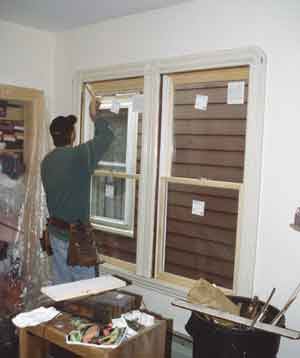
Window remediation commonly requires complete replacement of the old units. Although not the intent of the program, reduced heat-loss through the replacement windows also benefits the homeowner.
Ordinary windows, whether single-glazed or insulated, provide little barrier to noise. When field tested, ordinary wood windows without a storm panel yield an average noise reduction (NR) performance of 22 dB. The same type of window with a secondary storm unit applied yields an average NR performance of 25 dB. By contrast, the acoustical window combinations typically used in sound-insulation programs result in an average NR performance of 35 dB.
Airtightness. The additional noise reduction achieved by the acoustical window is due to its airtight construction (air infiltration typically less than .10 cfm at 25 mph) and the wide air space (2 inch minimum) between the prime and storm windows. To effectively address the windows as a noise path, we replace all the existing windows with high-performance acoustical units.
Vinyl acoustical windows are popular with many homeowners, given their easy maintenance, tilt-in operation, and the range of colors and grille patterns available. The window we use most commonly, from Harvey Industries (see “Sources of Supply”, page 3 of article), is a vinyl unit with a sound transmission class rating (STC-rating) of 29. By adding a high-performance triple-track storm window on the exterior, STC-ratings of between 39 and 45 can be achieved.
Laminated glass is typically required in order to achieve the higher range of these STC-ratings. Laminated glass consists of two or more layers of glass bonded together by a transparent plastic interlayer. The increased mass of the glass and the dampening effect of the plastic interlayer both contribute to its superior sound-insulation characteristics.
Wood windows. Acoustical window treatment options are not limited to vinyl windows; wood and aluminum units are available as well. Wood windows are the preferred acoustical window treatment for homes where the aesthetic of the home requires it, or for homes where there are historic considerations.
With wood windows, STC-ratings of up to 40 can be achieved by installing a high-performance wood replacement sash and high-performance storm window or secondary glazing panel separated from the primary unit by a 2-inch airspace. “High performance” is defined here as having an air infiltration rate of less than .25 cfm at 25 mph for a primary window and less than .33 cfm air infiltration at 25 mph for a storm window.
Homes that are on historic registers may be compelled to use a secondary glazing panel on the interior of the prime sash rather than an exterior storm. Such interior panels are acoustically equivalent to an exterior storm as long as they are well gasketed, tight fitting, and maintain a 2-inch air space between the secondary and primary windows. Glazing in the wood replacement sash is typically 1/2-inch insulating glass.
Aluminum acoustical windows are preferred for most commercial, institutional, and high-rise installations, but they’re also available for residential use. They are typically a dual window configuration; that is, two sets of parallel sashes separated by a minimum 2-inch air space in a single master frame. By varying the type and thickness of glazing in the sash and the width of the air space between the two sets, the window can easily be configured to create much higher STC-ratings than those available in vinyl or wood windows.
There are a couple of drawbacks to using aluminum acoustical windows. First, the frame depth of the aluminum units used in residential construction is 5 1/2 inches, which can create tricky detailing in a typical wood-frame wall. Also, their sash are typically single-glazed and are “side-loading” — the double-hung sash must be slid sideways within the jamb and physically lifted out to clean it. These two features make them less popular with many homeowners who have come to expect insulated glass and convenient maintenance. However, the windows do come in a variety of colors and offer various grille configurations.
Aluminum acoustical windows work well where higher STC-ratings are required, wind loading is a design issue, and wall depth is not a controlling factor.
Shutting the Door on Noise
Doors that lead directly from the exterior to the interior without an intervening air space or vestibule are major noise paths. As it happens, solid-core wood doors are highly effective at reducing noise energy by virtue of their mass. We typically install 1 3/4-inch wood raised-panel doors with a panel thickness of no less than 11/8 inches. The maximum area of any glazing in the door can be no more than 50% of the total door area and should be 1/2- or 5/8-inch insulating glass. The expected STC-rating of the prime door is 34.
Secondary door. The noise-reduction properties of the prime door are significantly enhanced by adding a high-performance storm door outside. “High performance” for leaf-type storm doors is defined as having an air infiltration rate of less than 1 cfm per square foot at 25 mph. There should be a minimum 2-inch air gap between doors, which may require a special build-out of the existing door’s casing. The storm door helps reduce noise by virtue of its mass, with the core consisting of 3/4-inch-thick flakeboard or laminated fiberboard. The door has an aluminum or vinyl skin with various color and applied trim styles. As with the primary door, the maximum size of any glazing should be no more than 50% of the total door area. The expected STC-rating for the storm door is 28.


