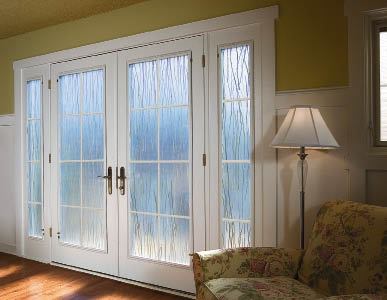
Sun, wind, rain, snow — it just doesn’t matter. Because a French door gets installed where the view is, regardless of weather conditions. Fortunately, manufacturers have spent the 50 or so years that pre-assembled patio doors have been on the market figuring out how to build some pretty airtight units.
In fact, if a patio door from one of the major door and window companies leaks at all, chances are that the fault lies with the installation — not the door. Gene Summy of TLS Laboratories, a window and door testing company in Laguna Niguel, Calif., says the single biggest factor in door performance is how well it was installed. “Most installation problems stem from rough openings that aren’t plumb, level, and square,” he notes. “When the wall on one side of the rough opening is more out-of-plumb than the wall on the other side, it’s impossible to install a wide patio door so that the panels seat properly against the weather-stripping.” To avoid this problem, he recommends cross-stringing every opening when checking for plumb and level, and correcting as needed.
Summy is also a strong proponent of sill pans, whether they’re made from rigid materials or a combination of flexible flashing tapes and sealants. (Some manufacturers now offer flashing packages to help with installation.) But he cautions that pan systems aren’t a panacea. “Pans that don’t fit the opening can be crushed by the door and leak; sealant under the door needs to be installed in a special way to allow water to drain out,” he says.
Longtime JLC contributor Bill Robinson agrees with Summy about framing issues and sill pans, but he also estimates that 70 percent of exterior doors aren’t flashed properly. If he’s right, that means that a lot of French doors — no matter how well they’re made — are still going to leak. Because installation is so critical, a future JLC article will cover that topic in depth; meanwhile, here’s a closer look at how those expensive, high-performance doors are put together.
Setting the Standard
Most builders are familiar with Energy Star, the government program that uses National Fenestration Rating Council (NFRC) performance ratings to set energy efficiency guidelines for windows and doors. While all patio doors aren’t Energy Star–rated, they should all have an NFRC label, which clearly indicates the level of energy performance that you can expect from the door (see sidebar, below). In warm climates, look for doors with a low SHGC (solar heat-gain coefficient) to limit heat gain and reduce the load on the home’s cooling system. In cold climates, look for units with a low U-factor to limit heat loss.
Many doors also are labeled as conforming to AAMA/WDMA/CSA 101/ I.S.2/A440, the structural performance standard referred to in the 2006 IRC. Published by the Window and Door Manufacturers Association (WDMA), the American Architectural Manufacturers Association (AAMA), and the Canadian Standards Association (CSA), A440-08 (the latest edition) sets guidelines for testing and rating windows and doors. Even though certification and labeling is voluntary for side-hinged patio doors (it’s mandatory for windows), most manufacturers build and test their patio doors to this standard.
The key number to know on the AAMA or WDMA label is the door’s performance grade (PG) or design pressure (DP) rating. Used interchangeably (manufacturers who test to older versions of A440 still use DP), both indicate a door’s ability to withstand specified uniform wind loads and meet related standards for resistance to air infiltration, water penetration, and forced entry.
Reading the LabelAll patio doors are labeled with National Fenestration Rating Council (NFRC) ratings for U-factor, solar heat gain (SHGC), and visible light transmission (VT), making it easy to match the door’s energy performance to the climate where it will be installed (right). In addition, most doors from major manufacturers carry an optional American Architectural Manufacturers Association (AAMA) or Window and Door Manufacturers Association (WDMA) label indicating the door’s performance class and performance grade (PG) or design pressure (DP) rating. Doors with higher PG or DP ratings are more resistant to wind and water. The label shown below certifies that a sample side-hinged door (SHD) with a maximum size of 36 inches wide by 80 inches high (or 900mm by 2,100mm) has a design pressure of 25, which meets minimum AAMA A440 requirements in the light-commercial performance class (LC25). There are five performance classes, ranging from residential (R) to architectural (AW), each with an increasingly stringent set of “gateway” performance standards. The “R” classification is suitable for most residential projects. |
Structural testing. A door’s DP rating is based on ASTM E330 structural testing, in which static pressure is applied to the doors’ interior and exterior surfaces to simulate sustained wind loads. The results, measured in either pascals or pounds per square foot, represent basic wind pressure. Most areas of the country are in a 90-mph wind zone and have a basic wind pressure of 20.7 psf. Because of a safety factor (structural test pressures are 50 percent higher than design pressures), an R (residential) class door with the minimum PG/DP15 rating would meet most local codes.
In Wind Zone 4, which includes parts of Texas and Florida, winds can exceed 140 mph, and wind design pressures can range up to 110 psf. In Florida’s Dade County, which has some of the most stringent requirements, up to DP70-rated doors and windows may be required, depending on the project’s exposure and the location of the door.
Impact testing. Impact resistance is a big concern in coastal areas, since a broken door can depressurize a house during wind storms — with catastrophic consequences. So in addition to minimum DP ratings, most codes in hurricane-prone areas specify impact-resistant glass that meets ASTM E1886/E1996 large-missile impact testing.
Air leakage. Another test measures the amount of air infiltration that occurs when the door is subjected to static pressure equivalent to a 25-mph wind, or 1.6 psf. Maximum allowable leakage for an R class door is 0.3 cubic feet per minute per square foot of the assembly.
Water resistance. Most door and window assemblies undergo testing that exposes them to the equivalent of an 8-inch-per-hour rainfall, applied at a pressure that is 15 percent of the product’s DP rating. But because accessibility requirements can make it difficult to meet this standard (the ADA prohibits sill heights greater than 1/2 inch and vertical steps greater than 1/4 inch), a “limited water” — or LW — classification is permitted for side-hinged doors. This means that hinged patio doors aren’t expected to have the same water penetration resistance as a sliding patio door with the same performance grade.
Construction
For the most part, homeowners want their windows and doors to look like they’re made of wood. But while wood is thermally efficient, it can warp and rot and requires frequent maintenance. Therefore, most French-door manufacturers use other materials as well, to get just the right combination of energy efficiency, wind and water resistance, and durability.
All-wood construction. Some makers, of course, still produce all-wood doors, which occupy a small but stable niche in the high-end residential market. To give the units stability, the cores are typically finger-jointed and edge-glued, with solid-wood veneers applied to the interior and exterior surfaces for appearance. This technique gives the doors a traditional look without too much sacrifice in performance, but it requires a paint finish and frequent maintenance.
There’s a WDMA specification for virtually every material and component that goes into a patio door; for treated lumber, that spec is WDMA I.S.4-07A. Although treatment procedures vary according to manufacturer, most use a dipping process, which means that only the surface of the wood is treated. If the millwork is cut or damaged after delivery, the exposed wood needs to be retreated to maintain the manufacturer’s warranty. Jeld-Wen uses a proprietary vacuum-pressure process called AuraLast, which the company says does a better job of impregnating the wood with its water-based repellent and preservative.
Often, wood doors are spec’d because they can be finished to match existing architecture. Some units, though, come prefinished with a urethane- or polyester-based paint, an industrial finish that is weather-resistant but not always easy to repaint. When doors are only primed, they should be painted within a short time after installation (typically less than 30 days) to maintain the warranty.
Clad doors. For a more protective exterior finish, vinyl or roll-formed aluminum skins can be applied to a wood patio door. But as Milgard product manager Kevin Vilhauer points out, cladding a door’s exterior with aluminum or vinyl and its interior with wood creates an unbalanced sandwich, because the different materials have different rates of expansion and contraction. “We still manufacture an aluminum-clad door, but we’re selling fewer and fewer of them as we shift toward production of our new fiberglass doors, which are less susceptible to warping,” he says.
Pella tackles the unbalanced-sandwich problem through its manufacturing methods. Instead of glue-bonding aluminum cladding to the core block, the company forms the aluminum into a structural extrusion. Thicker and more expensive than rolled aluminum cladding, extruded aluminum adds strength to the door frame, resists denting, and provides a more consistent paint substrate than rolled aluminum, Pella says.
Vinyl extrusions — window and door manufacturers call it “solid vinyl” — are used mostly by companies that already have extensive vinyl window lines. As Mark DeSimone of Simonton notes, hinged patio doors are a cantilevered weight, which puts a lot of stress on the frame and jamb — and extruded vinyl isn’t a particularly strong or stiff material. Even when reinforced with tubular aluminum, extruded vinyl frames just aren’t well-suited for hinged patio doors in sizes that exceed the standard 6-foot-wide by 6-foot-8-inch-tall opening.
Fiberglass. Most manufacturers seem to agree that fiberglass offers a hard-to-beat combination of strength, thermal performance, and durability. Consumers are taking notice, too: the WDMA expects fiberglass’ total share of the residential window and door market to rise to 30 percent in 2012, compared with 2 percent in 2007.
Fiberglass has roughly the same coefficient of thermal expansion as glass, meaning that it expands and contracts with changes in temperature at the same rate. This is important, because glass makes up about 80 percent to 85 percent of the total area of a typical 3-foot-wide door panel. Aluminum’s coefficient of expansion is roughly three times that of glass, and vinyl’s is about seven times that of glass. (Wood expands and contracts with changes in humidity, not temperature). As a result, fiberglass doors do better in cold weather than vinyl or aluminum, because they experience less torsion and stress between the frame and the glass, and therefore less air leakage and stress on the locking mechanism.
Fiberglass doors can be built a couple of different ways. Some manufacturers use the pultrusion process, whereby continuous strands of glass fibers are saturated in a thermoset resin and pulled (rather than pushed, or extruded) through a heated die. But doors made of pultruded fiberglass — though very strong — have disadvantages, says Todd Kippel, patio product manager at Therma-Tru. For example, their mechanically joined corners are a potential weak link, and they may contain hollow areas within the pultrusions that can’t be insulated.
For that reason, Therma-Tru and several other manufacturers build fiberglass doors similarly to how steel doors are built, cladding engineered-wood or foam cores with molded fiberglass skins. While molded fiberglass (made from layers of glass mat and resin) isn’t as strong as pultruded fiberglass, the doors’ core and wood or composite stile and rail edges provide reinforcement.
Although fiberglass skins can be molded with a grain pattern and painted or stained, their gel-coat finish is more vulnerable to UV degradation than the industrial acrylic/urethane finishes used on pultruded fiberglass.
Steel. The patio-door market — unlike the entry-door market — isn’t dominated by steel, probably because it’s hard to stamp a steel sheet to look like wood. But steel — despite its tendency to dent and rust — is strong and economical. Look for units made with the thicker 24-gauge metal, which resists dents better than thinner 25-gauge or 26-gauge steel.
Jambs and Sills
Door jambs are made using the same techniques as door panels, with a few twists. For example, some manufacturers marry fiberglass or aluminum extrusions to a wood core, combining a weather-resistant exterior finish with a wood interior.
Another approach is clad jambs, but Therma-Tru’s Kippel warns that the seams of clad jambs often break down, allowing water into the joints. Several manufacturers avoid this problem by using treated wood jambs, in some cases providing a composite or cellular PVC on the bottom 16 inches or so for added rot resistance.
Sills. Most manufacturers offer several sill options with their doors. For example, many sills are built with extruded aluminum, which — though a tough material — is not particularly energy-efficient. So, to create a thermal break, the metal extrusion is usually part of an assembly that may also include a solid wood interior, a fiberglass pultrusion, or a composite subsill.
Some sill assemblies with hollow channels have weep holes to drain water to the outside. But weep holes can clog up with dirt and debris and are not particularly energy-efficient, since they can let air in as well as water out. Sills without weeps typically have a self-draining mechanism built into their design.
Weeps and effective weatherstripping are important for water management, but so is the actual height of the sill. Sills with a high riser prevent water from getting blown inside; in some coastal areas and other extreme applications, where doors may need a minimum DP40 rating, sill heights may need to be 11/2 inches or higher for the door to meet code. (Simply switching from an inswinging to an outswinging style may also allow the door to meet code).
Job-site protection. As Marvin product planner Jeff Siverhus points out, an installed door’s sill can be difficult to replace. He recommends protecting sills during construction with job-site sill covers, which are available from some manufacturers but also can be easily assembled from scrap material on site.
Glass
To satisfy the IRC, the glass used in patio doors must be tempered, a thermal process that strengthens the glass while ensuring that it shatters into tiny fragments with rounded edges rather than large, sharp shards. In coastal areas, local codes often require glass that can withstand multiple impacts from wind-blown debris. To meet impact-resistance standards in high-wind areas like Florida and Texas, glass manufacturers laminate a plastic interlayer between outer layers of glass. The most common interlayer is PVB, or polyvinyl butyral, a soft, flexible membrane often used in car windshields. In larger panels, some manufacturers use an interlayer of SGP — or Sentry Glass Plus, made with DuPont’s Surlyn — a rigid plastic.
Besides being tough, laminated glass is quieter than standard glass. PVB IG units from the major glass supplier Cardinal, for instance, have an STC (sound transmission class) rating of 36, compared with 28 STC for standard 1/2-inch IG units.
Laminated glass can also make people feel safer. Because the interlayer remains intact even when the outer layers have shattered, patio doors with laminated glass may allay homeowner concerns about security. (By the same token, though, laminated glass may prevent egress in the event of a fire, according to the WDMA.)
High-performance options. In very mild climates, single-pane glass — tinted to reduce solar heat gain, or SHGC — can be a reasonable choice. But for most of the country, insulated low-e glass has become the standard. It keeps homes cooler in the summer and warmer in the winter, helps prevent fading on interior surfaces, and reduces condensation.
For colder climates, more and more manufacturers are offering triple glazing — but the improvement in R-value (from about R-3.3 for standard low-e IG units to R-3.8) comes at a price: Triple-glazed units cost 25 percent to 30 percent more than standard ones. Still, as building codes and the Energy Star program continue to upgrade their requirements, this option is bound to become both more affordable and more widely available.
Meanwhile, the most cost-effective way to enhance energy performance probably lies with the various low-e coatings, gas fills, and warm edge spacers now available. (For more information on efficient glass technologies, see efficientwindows.org.)
Hardware
If you look at the edge of the lock stile on most patio doors, you’ll see that it’s been mortised along its length to accept the locking mechanism. This standard 16mm-by-12mm hardware “Eurogroove” is compatible with the European multipoint locking mechanisms that have become an integral part of most French doors. With at least three engagement points to distribute loads across the full length of the door panel — instead of just at the middle — multipoint locks help seal the door against air and water infiltration, provide extra security, and minimize warping by holding the stiles securely against the jambs.
Multipoint lock designs vary, but most feature shoot bolts that extend vertically up into the head jamb and down into the sill in the passive panels. Sometimes the active panel also has hooks or tongues that operate horizontally, engaging with the passive panel above and below the lockset. For extra strength in high-wind applications, the two functions can be combined into five-point closing mechanisms. The shoot bolts, hooks, and tongues are connected to the center lock body and are engaged by lifting the lockset handle.
Although multipoint locking is an improvement over the single-point locking still found on many entry-level doors, it limits trim choices to the options offered by the door maker’s hardware supplier.
Hinges. While some customers still want standard butt hinges, most patio doors are now equipped with adjustable hinges. These allow doors to be moved up and down and in and out at each hinge location so that the fit can be fine-tuned during installation, and they accommodate settling and seasonal movement.
Screens. Patio doors can be equipped with either sliding or hinged insect screens, but neither is a perfect solution. The rollers on bottom-mounted sliding screens tend to get dirty and wear out, making the screen hard to operate. The rollers on top-mounted screens stay cleaner and seem to operate more smoothly for a longer period of time.
Hinged screens open more easily and more completely than sliding models, but they also take up a lot of floor space.
Some companies offer a third option, retractable screens. They can be used for both in-swing and out-swing doors.
French-Door ManufacturersAndersen, 800/426-4261, andersenwindows.com Endura (door components), 800/334-2006, enduraproducts.com Gorell, 724/465-1800, gorell.com Jeld-Wen, 800/535-3936, jeld-wen.com Marvin, 888/537-7828, marvin.com Milgard, 800/645-4273, milgard.com Peachtree, 800/732-2499, peachtreedoor.com Pella, 800/374-4758, pella.com Simonton, 800/746-6686, simonton.com Therma-Tru, 800/843-7628, thermatru.com Weather Shield, 800/222-2995, weathershield.com |
Cost
Prices for patio doors range widely, from less than $1,000 for a basic vinyl unit to more than $3,200 for a stripped-down version of Marvin’s Ultimate clad door (the standard hinged screen alone tacks another $500 onto the price). In general, says TLS Laboratories’ Summy, you get what you pay for. “In my area, many builders use French doors built by local shops, because they can get a 6-foot-wide door system installed for $400 or so,” he says. “Pre-assembled systems are easily twice that much, but in the long run, shop-built doors end up costing more, once they start to leak.”
Andrew Wormer is a JLC associate editor.