by Martin
Holladay
Although I used to be a builder, I now work as a reporter for
an energy-efficiency newsletter. Joining the tribe of energy
nerds has altered my perspective, making me single-minded and
opinionated. Watching new-home builders in action, I can often
be heard to mutter, "Why do they always build it that
way?"
Of course, I realize that many of the builders I grumble about
are actually familiar with energy-efficient construction
techniques — they just can't convince their clients that
energy efficiency is worth the extra investment. Most builders
are accustomed to juggling several balls at once: They need to
satisfy their clients, keep the local building inspector happy,
and make a profit.
Sometimes, however, a builder gets lucky and lands a client who
insists on a high-performance home and is willing to pay for
it. To help you get ready for that day, here's a list of dos
and don'ts from an energy nerd's perspective — starting
with the don'ts.
Don't Design a Complicated
Roof
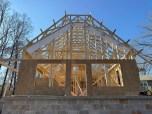
For those who espouse the principle "form follows function,"
the ideal roof is a simple gable over an unheated attic, much
like the roof on the house we all drew in kindergarten.
Unfortunately, designers these days are fond of complicated
roofs — ones with enough valleys, dormers, and
intersecting planes to make the home look from a distance like
an entire Tuscan village.
Such roofs are difficult to insulate without resorting to spray
polyurethane foam. Though spray foam is effective, it's also
expensive. In most cases, simple roofs are easier to insulate,
easier to ventilate, and far less prone to ice dams than
complicated roofs.
Don't Install a Hydronic Snow-Melt
System
Snow can be removed from a driveway with a shovel, a
snow-blower, or a plow. It can also be removed by burning great
quantities of fuel to heat water circulating through buried
pipes.
In rare cases — for example, at the home of a handicapped
client — a hydronic snow-melt system makes sense. In most
homes, however, such systems are uncalled for.
In 60 years, when global climate change has made snow rare,
history books will explain to our grand-children how hydronic
snow-melt systems used to work. Our descendants will shake
their heads, astonished that their ancestors burned fossil
fuels so wantonly.
Don't Build a Poorly Insulated
Slab
In a hot climate, an uninsulated slab in contact with cool soil
can lower cooling costs. In a cold climate, though, slabs
should be well-insulated.
Some cold-climate builders, having learned that heat rises,
install thick attic insulation while leaving their slabs
uninsulated. But heat actually moves from warm to cold in all
directions. While it's true that in winter the soil beneath a
slab is warmer than the outside air, a slab can still lose a
significant amount of heat.
In cold climates, a basement slab should be insulated with at
least 2 inches of extruded polystyrene (XPS) under the entire
slab. For a slab-on-grade home in a cold climate, specify 3 or
4 inches of XPS under the entire slab, with additional vertical
foam at the slab's perimeter.
Foil-faced bubble pack (R-1.3) is no substitute for adequate
insulation; under a slab, it's virtually useless.
Don't Insulate Rim Joists With Unfaced Fiberglass
Although fiberglass insulation is a thermal barrier, it is not
an air barrier. If unfaced fiberglass is used to insulate a rim
joist, moist indoor air can filter through the batt, leading to
condensation at the cold rim joist. The result, eventually, is
mold and rot.
There are several acceptable ways to insulate a rim joist.
Rigid foam insulation can be installed on the exterior of a
recessed rim joist; small pieces of rigid foam can be inserted
in each joist bay from the inside; or spray polyurethane foam
can be used to seal the entire rim-joist area.
Don't Install Recessed Can Lights on the
Top Floor
Despite their tendency to cast strange shadows on people's
faces, recessed can lights retain an inexplicable popularity.
Ignoring the pleas of lighting experts — who note that it
makes more sense to light the ceiling than the floor —
many customers still request recessed cans.
When installed in an insulated ceiling, these fixtures are an
energy disaster.
Some builders have switched to "airtight" cans. But airtight
cans are not completely airtight. The amount of leakage depends
on the care exercised when installing the gasketed trim kit,
and any future trim changes can affect the fixture's
airtightness.
It is much easier to air-seal electrical boxes installed for
surface-mounted fixtures than to air-seal a recessed can. Just
say no to recessed cans.
Don't Install Oversized Hvac
Equipment
Compared with homes built 30 years ago, today's houses are more
airtight and better insulated, so their heating and cooling
loads are smaller.
Yet many hvac contractors continue to use old rules of thumb to
size furnaces and air conditioners, often throwing in a
generous safety factor for good measure.
Oversized furnaces and air conditioners cost more than
right-sized units. Oversized equipment frequently operates less
efficiently, too, because it suffers from short cycling. An
oversized air conditioner often shuts down before it's had a
chance to wring much moisture out of the air, compromising
comfort.
Although hvac contractors usually claim to have performed
detailed load calculations, you should insist on seeing written
evidence. Heating and cooling loads should be calculated for
each room and must be based on accurate specifications for
window sizes, orientation, and U-factor, and for the installed
glazing's solar heat coefficient. Don't let your contractor
talk you into adding a safety factor to a calculated
load.
Experience has shown that builders who want right-sized hvac
equipment need to educate themselves on this issue and
double-check the work of their hvac sub.
If you don't feel qualified to verify your sub's calculations,
at least specify two-stage equipment that can operate at
partial load most days of the year.
Don't Install Hvac Equipment Or Ducts in
an Attic
An attic is almost as cold as the exterior in winter, and can
be much hotter than the exterior in summer. While attic floors
are often insulated to R-38, attic ducts are usually insulated
to a measly R-4 or R-6.
During the summer, the difference in temperature between the
cool air in the ducts and a hot attic is much greater than the
difference in temperature between the indoor and the outdoor
air. So why does attic ductwork have so much less insulation
than a wall or a ceiling?
Moreover, the air in a supply duct is at a much higher pressure
than the air inside a house. Since most duct seams leak, a
significant portion of the volume of air passing through attic
ducts usually leaks into the attic. Any leaks in return ducts
allow the blower to pull hot, humid attic air into the air
handler.
Installing a furnace or air handler in an attic causes even
more problems than merely installing ductwork there. A recent
study found that the leakage of a typical air handler, coupled
with the leakage at the air-handler-to-plenum connection,
amounts to 4.6 percent of the airflow on the return side. If
the air handler is installed in an attic, a 4.6 percent
return-air leak can produce a 16 percent reduction in cooling
output and a 20 percent increase in cooling energy use. Any
duct leakage would make the situation even worse.
In most homes, hvac equipment and ductwork belong in the
basement or crawlspace. If it's absolutely necessary to build
on a slab, include a utility room for hvac equipment and
install ducts in air-sealed interior soffits.
Don't Install a Powered Attic
Ventilator
Many builders assume that hot attics are a problem. If soffit
and ridge vents don't keep an attic cool, they may decide to
install an exhaust fan in the attic to improve attic
ventilation. This is almost always a mistake.
If an attic has no ductwork or hvac equipment and its floor has
a deep layer of insulation, high attic temperatures don't
matter much. In fact, high attic temperatures can help lower
winter heating bills.
Several studies have shown that a powered attic ventilator
often draws its makeup air from air leaks in the attic floor,
pulling conditioned air out of the house instead of in from the
soffits. This, of course, increases the homeowner's energy
bills.
Don't Use a Standard Furnace Fan To
Distribute Ventilation Air
Most new homes include some type of whole-house mechanical
ventilation system — for example, a passive outdoor-air
duct connected to a furnace's return-air plenum. Some builders
provide ventilation by connecting a heat-recovery ventilator
(HRV) to the home's forced-air ductwork.
Both methods have an Achilles heel: They depend on the furnace
fan to distribute ventilation air. In homes equipped with air
cleaners, homeowners may leave the furnace fan running
continuously.
This can carry a substantial energy penalty. Furnace fans are
designed to move a lot of air — up to 1,400 cfm —
yet most homes require only 50 or 100 cfm for ventilation. In
fan-only mode, certain furnaces can draw as much as 700 to 800
watts.
One solution is to specify a furnace with a blower powered by
an electronically commutated motor (ECM) that draws 200 to 250
watts in fan-only mode. Another is to choose a different type
of ventilation system — a simple exhaust-only system or
an HRV with dedicated ventilation ductwork.
Don't Install a Humidifier
Homes with very dry indoor air during the winter are usually
leaky. Make the building more airtight, and it won't be as
dry.
Installing a humidifier is so risky it should be avoided like
the plague. In cold climates, almost all moisture problems are
worsened by elevated indoor humidity. High levels of indoor
humidity are associated with wet walls and wet roof
assemblies.
If homeowners want a humidifier, warn them about the dangers of
humidification. If they insist, let them install it themselves
after you leave the job.
Address the Basics First
The design of an energy-efficient house begins with a
well-insulated, air-sealed shell and very efficient hvac
equipment, which means a minimum 90 percent AFUE (annual fuel
utilization efficiency) furnace and 13 SEER (seasonal energy
efficiency ratio) air conditioner.
Anyone intending to build an energy-efficient house needs to be
sure these basic requirements are met before considering exotic
(and expensive) components like photovoltaic modules.
Do Orient the House Properly
Passive-solar design does not need to be complicated; a few
simple steps can save significant amounts of energy. Yet most
new-home builders still pay almost no attention to
orientation.
If the lot size permits, a house should always be oriented with
its long axis aligned in an east-west direction. In most
climates, about half the home's windows should be facing south.
In hot climates, it's important to minimize the number and size
of west-facing windows.
Do Install Basement Wall
Insulation
According to the prescriptive requirements of the International
Energy Conservation Code, basement walls should be insulated in
climate zones 4 and higher.
Basement walls can be insulated from the exterior or the
interior. Most builders find that installing interior basement
insulation is easier and cheaper than installing exterior
basement insulation; far too often, however, they get the
details wrong.
Interior basement insulation is effective only if the work is
properly detailed and meticulously installed. The rim-joist
area must be air sealed (either with sprayed polyurethane foam
or very careful caulking), and the rim-joist area and walls
must be carefully insulated with rigid-foam sheets or sprayed
polyurethane foam. Never use fiberglass batts to insulate
basement walls.
Exterior basement insulation usually performs better than
interior basement insulation. It locates the wall's thermal
mass within the building's thermal envelope; if installed
properly, it can be used to protect the rim-joist area. Also,
by keeping the concrete warm, it prevents the condensation and
moisture problems often associated with interior basement
insulation.
Do Install Better Windows
Windows represent the weakest thermal link in most building
envelopes. Unfortunately, the U.S. Department of Energy has
chosen to set a very low bar for Energy Star windows, so Energy
Star labels provide little guidance to builders. In most parts
of the country, in fact, an Energy Star window is equal to a
code-minimum window.
Specifying windows can be complicated, but a few general
principles apply. Casement windows usually have less air
leakage than double-hung windows. In heating climates, the best
windows will have a lower U-factor than windows minimally
complying with Energy Star standards (U-0.35). Consider
investing in windows with argon-filled triple glazing and two
low-e coatings; such windows are available with a whole-window
U-factor as low as 0.17.
In south central and southern climate zones, Energy Star
specifications call for windows to have a maximum solar
heat-gain coefficient (SHGC) rating of 0.40. In these zones,
consider purchasing windows that beat this standard —
that is, windows with an SHGC below 0.40. Specifying glazing
with a very low SHGC is especially important for west-facing
windows, since these are the ones most likely to contribute to
overheating.
Do Install Rigid Foam Wall Sheathing
Many cold-climate builders still cling to the belief that foam
sheathing creates a wrong-side vapor retarder and therefore
contributes to wall rot. In fact, the inside surface of foam
sheathing will be much warmer than the inside surface of OSB or
plywood sheathing, and will therefore be less likely to support
condensation. Foam-sheathed walls, if built correctly, are less
likely to have moisture problems than walls sheathed with OSB
or plywood.
Foam sheathing wraps a home's walls in a warm jacket, keeping
the framing warm and dry and greatly reducing thermal bridging
through studs. Furthermore, if foam sheathing is held in place
with vertical strapping, a rain screen is created behind the
siding.
Builders making the switch to foam sheathing must choose one of
three strategies for bracing walls against racking. They can
install traditional 1x4 let-in braces, diagonal steel strapping
(for example, Simpson TWB straps), or, at the corners, sheets
of well-nailed 1/2-inch plywood. The plywood can then be
covered with 1/2-inch rigid foam to match the thickness of the
1-inch foam installed everywhere else.
Of course, before settling on a bracing method you should make
sure your local building inspector approves of your plan.
Do Install a Drain-Water Heat-Recovery System
One of the simplest and most cost-effective ways to reduce
energy used for domestic hot water is to install a drain-water
heat-recovery device.
The best-known such device is the GFX, which consists of a
length of 3- or 4-inch copper drainpipe surrounded by a
spiraling cocoon of 3/4-inch copper tubing (see Notebook,
3/97). Designed to be installed vertically in a plumbing waste
line, a GFX unit transfers about 55 percent of the heat energy
in the drain water to the incoming supply water. In homes where
residents prefer showers to baths, a GFX can save 20 percent to
25 percent of the energy used for water heating.
The best thing about a GFX unit is its indestructibility:
Having no moving parts, it is likely to last as long as the
house in which it's installed. Model S3-60, the whole-house
model (a 3-inch copper drain 60 inches long), costs $520.
Do Install a Solar Hot-Water
System
Rising energy prices have made solar hot-water systems a good
investment in most parts of the country. At sites beyond the
reach of natural gas pipelines — where conventional water
heaters must be fueled by either propane or electricity —
an investment in a solar hot-water system will usually have a
fairly quick payback.
A substantial fraction of the hot-water needs of most families
can be met by two 4-foot-by-8-foot collectors. It's almost
always better to have an oversized storage tank than an
undersized tank; if the budget permits, install a 120-gallon
stainless-steel indirect water-heater tank from Amtrol,
Bradford White, Burnham, Heat Transfer Products, Triangle Tube,
or Viessmann. An instantaneous gas water heater can be used for
backup.
Do Upgrade the Mechanical Ventilation
System
Because an energy-efficient house has a well-defined air
barrier and very low air-leakage rates, mechanical ventilation
is essential.
Ventilation can be provided with a simple exhaust-only system
(a timer-controlled bath exhaust fan, for example) or a passive
supply system (such as a passive fresh-air duct, controlled by
a motorized damper and connected to a furnace's return-air
plenum).
But the most efficient way to provide fresh air to every room
is with an HRV or an energy-recovery ventilator (ERV).
Currently, the most energy-efficient ERV available is the
RecoupAerator 200DX from Stirling.
Do Install Dedicated Ventilation
Ductwork
Every HRV deserves dedicated ventilation ductwork. Ducts
designed to distribute air for heating or cooling are not
optimal for distributing ventilation air, so don't try to use
the same ducts for both purposes.
A forced-air heating system usually draws its return air from a
big grille in the hallway. An HRV, on the other hand, should
draw its exhaust air from bathrooms, utility rooms, and the
laundry room. Unlike forced-air heating ducts, ventilation
ducts are sized for low airflow; usually they measure only 4
inches or 6 inches in diameter.
Do Install a Better Lighting
Package
Installing compact fluorescent instead of incandescent bulbs is
probably the most cost-effective energy upgrade in any home.
Now that the quality of compact fluorescent bulbs has improved
and prices have dropped, make sure all your houses are
incandescent-free.
A good source of information on energy-efficient lighting, the
"High Performance Lighting Guide," is on the Web at
www.ibacos.com/hpl1.html .
Do Arrange for Blower-Door
Testing
Do you know how much air leaks under your rim joists or bottom
plates? If you're still a blower-door virgin, you haven't yet
earned the right to brag to customers about construction
quality. Most blower-door contractors can recount stories of
proud builders humbled by the revelations of a door-mounted
fan.
Once you're familiar with the lessons taught by whole-house
depressurization, you'll probably be more conscientious with
gaskets and spray foam on your next house.
Tweaking the Recipe
It goes without saying that it's possible to build a
high-performance house that deviates from these guidelines. The
recommendations are based on logical principles, but they
inevitably reflect my own biases. Furthermore, specifications
for an energy-efficient house depend greatly upon local
climate.
Before settling on any construction details, you should always
investigate methods used by other energy-efficient builders in
your region.
Martin Holladayis the editor of Energy
Design Update.