- Q. My clients have a garage with a conventionally framed 4/12 roof that they want to convert to living space. They like the idea of a vaulted ceiling but not the expense of the new structural ridge it would require. As a compromise, can I replace the existing ceiling joists with rafter ties?
A.Jordan Truesdell, a structural engineer in Blacksburg, Va., responds: In a simple gable roof, the rafters carry live and dead loads that push both down and out against the top of the supporting walls. This horizontal load — or thrust — can be considerable, especially on a low-pitched roof. To resist thrust, the IRC calls for a structural ridge (required for any roof with a pitch less than 3/12) or for each pair of rafters to be securely connected to each other by a continuous ceiling joist (R802.3, 2006 IRC).
Code does allow joists to be installed above the top plate, but only under certain conditions. Previous building codes permitted rafter ties to be placed as high above the plate as two-thirds the distance between the top plate and the ridge, but the 2006 IRC now limits this height to one-third the distance between the plate and the ridge (see Footnote A, Table R802.5.1, 2006 IRC). If your garage is 24 feet wide and has a 4/12 roof, the new rafter ties can be placed no more than 16 inches up from the plate without additional engineering.
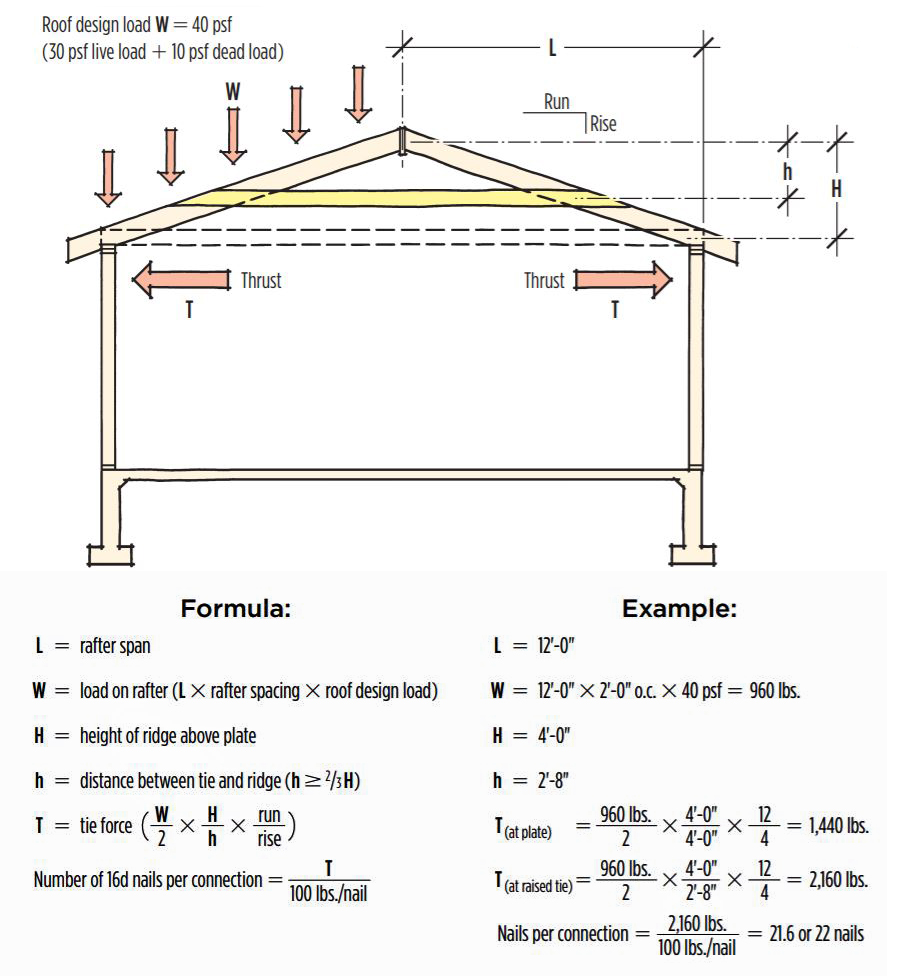
From a practical perspective, it’s difficult to use high rafter ties on a low-pitched roof because the force in each tie increases with the inverse of the pitch. And when rafter ties are used above the plate, the rafter span must be reduced by as much as 33 percent compared with the span allowed when the ties are at the plate. Here’s a formula I use to determine tie force: T = W/2 x H/h x run/rise, where W equals rafter load, H equals height of ridge, and h equals distance from ridge to center of tie (illustration, below).
In this example, when W = 960, the tie-force tension at the plate when there are rafters 24 inches on-center with a 4/12 pitch and a 12-foot span is 1,440 pounds. Moving the rafter ties up only 16 inches from the plate (the maximum allowed by code) increases the tie force from 1,440 pounds to 2,160 pounds. Compare this with a similarly framed 12/12 roof that has similar loads: The tie force at the plate is 480 pounds — and only 720 pounds when the ties are 4 feet up from the plate (again, the maximum allowed by code).
It’s easy to underestimate the number of fasteners needed for each rafter-to-rafter-tie connection (and at any center splice in this assembly). To find the number of fasteners per connection, divide tie force by 100 pounds per nail (typical capacity of a 16d nail). As you can see, even at the plate, 15 nails are required for each connection in your 4/12 roof; move the rafter ties up and you’ll need 22 nails per connection. Another option that would require fewer fasteners would be to use bolts instead of nails (see Practical Engineering, 5/96, for a bolt-and-nail schedule).
Unless the rafters are significantly overdesigned and you can find a way to nail the new ties in place without splitting the existing lumber, it’s unlikely you’ll be able to raise the ceiling by more than about 15 percent of the total roof height without the help of a structural engineer.
Rafter Ties and Shallow-Pitch Roofs
3 MIN READ