If you don’t know much about boatbuilding, start by welding rebar together to frame the gunwales and keel. Then form the hull with layers of chicken wire, and trowel a stiff 1/2-inch-thick mortar mix onto the mesh. This simple technique was used by engineering students at the University of Illinois back in 1971 to build the winner of the first concrete-canoe race. Though it weighed 360 pounds, the ungainly boat managed to defeat its closest (and only) competitor, a craft that was sleeker and lighter by 235 pounds but had trouble staying afloat.
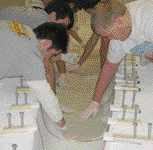
However, if you have a few thousand spare man-hours of labor available, plus boatbuilding software and access to computerized routing equipment, you’re ready to build a state-of-the-art concrete canoe. Settle on a design, then cut the female mold out of foam blocks. After assembling the blocks, line the mold with plaster of Paris, sand it smooth, and coat it with latex primer (which will act as a form release). For a thickness gauge, lay in speaker wire when the concrete is applied.
You may need to experiment a bit to formulate a concrete mix both light enough to float and strong enough to support a crew and survive collisions. Omit stones and gravel in favor of lightweight aggregates; seasoned builders recommend hollow glass microspheres or fabricated shale. For admixes, consider superplasticizers, pozzolans, shrinkage agents, and latex for flexibility. Instead of rebar reinforcement, use carbon fiber or even fiberglass mesh. Enlist a few dozen friends armed with trowels, rolling pins, and sanders to place and finish the concrete.
The final step is presentation: What good is a fast, light boat if it looks homemade? A custom tile appliqué looks better than paint and provides an artistic touch.
After the concrete has cured properly and you’ve applied sealer, your concrete canoe will be ready to race at the national or international level. — Andrew Wormer