
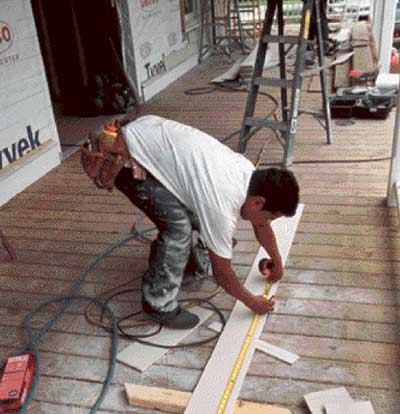
I’ve been a carpenter for more than 20 years, but I only recently installed fiber-cement siding for the first time. When JLC asked me to try out some of the portable tools for cutting fiber-cement siding and trim, it was an opportunity too good to pass up: a chance to check out the tools without risking a bad purchase.
Cutting fiber cement with a circular saw blade is like producing your own personal dust storm — definitely not the most pleasant environment to work in. I’m not afraid of getting dirty, but fiber-cement particles are very small and especially irritating to sinuses, skin, and eyes. So it’s natural that manufacturers would be keen on developing tools that cut cleanly and quickly, without the dust.
Two Schools of Thought
Two types of dust-busting portable tools have emerged: circular saws with a dust collection system and electric shears that cut fiber cement the way aviation snips cut metal (see Figure 1).
Figure 1.With a cutting action similar to that of scissors, shears crush the material between hardened steel blades. Replacement blades cost about $65, and makers claim that the blades will last for about five 2,000-square-foot houses.
Dust-collecting circular saws are similar to the circular saws we use every day, with one major difference: The blade is covered by a plastic shroud with an exhaust port that connects to a portable vacuum. I tested Makita’s 7 1/4-inch model 5057. (Makita also makes a similar 4-inch saw, model 5044KB.)
Shears come in two platforms: large, relatively stationary, guillotine types and hand-held portable shears powered by electric drill bodies. I didn’t test the guillotine-type shears. They may well be the best tool for cutting fiber cement, but unless you’re a full-time siding subcontractor, the $1,200 investment wouldn’t be practical. I tested portable shears from Kett, Snapper, and Porter-Cable.
Fiber-cement shears have their origin in the electric shears used by sheet-metal fabricators. However, you can’t use fiber-cement shears to cut metal: The cutting head on fiber-cement shears won’t accept metal cutting blades, and vice versa. If you want to use your shears for both materials, the best option is to buy another cutting head designed for metal ($60 to $100) and swap the heads back and forth.
Makita 5057KB Dust-Collecting Saw
Based on Makita’s venerable model 5007 circular saw, the 5057KB dust-collecting saw looks similar to a typical sidewinder except for the plastic housing enclosing the blade (Figure 2). I found that the saw worked better in theory than in practice. The blade enclosure quickly filled with dust, reducing visibility, and retracting the guard was cumbersome.
Figure 2.Makita has addressed the dust problem with a vacuum-connected saw. A plastic housing encloses the blade, capturing the majority of airborne particles.
But perhaps my biggest obstacle to using the saw was that it’s a sidewinder, and I happen to be accustomed to wormdrives. Switching platforms proved difficult for me — a sidewinder fan would probably be more comfortable with this saw. When a pin securing the shoe fell out, rendering the saw unusable, I happily set it aside. Despite my experience with the saw, it produced an excellent cut. Plus, unlike the shears, the saw can be used for cutting other building materials. The street price is $222, without the diamond blade.


