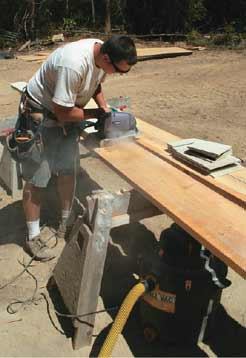
Our company has been using fiber-cement siding for more than 10 years. While we like its durability, we don’t like breathing the dust generated by cutting it — not to mention the potential for developing silicosis or lung cancer.
Health Recommendations
OSHA has established permissible exposure limits (PEL) for silica and other types of dust. Because levels are measured in milligrams of dust per cubic meter of air, there’s no practical way for carpenters to determine their exposure, so it’s best to avoid breathing the dust altogether. In Washington state, where I work, the Department of Labor and Industries suggests the following rule of thumb: If you are breathing air that contains visible silica dust, you are almost certainly over the PEL.
Fiber-cement manufacturers are aware of the dust problem and make some recommendations: Work in a well-ventilated outdoor area; cut with shears or by scoring and snapping; and if you have to saw, wear a NIOSH-approved respirator or use a dust-collecting saw — preferably one connected to a HEPA vac so that no dust escapes with the exhaust air.
We tried cutting fiber cement with electric shears, but ultimately we switched to sawing because shears are slow, leave rough edges, and can’t be used to gang-cut pieces. Respirators are only a partial solution; they don’t always fit properly and anyone on site who walks by not wearing one ends up breathing the dust.
About a year ago we began to seriously deal with dust collection. We did it both to protect our health and because we got news of a nearby site where the state fined the siding contractors for exceeding the PEL while cutting fiber cement.
Get a Good Vacuum
After considering a number of vacuum systems, we purchased the 16-gallon wet/dry model from Dustless Technologies (800/568-3949; dustlesstechnologies.com). I chose this machine after seeing it at a trade show: It was very quiet and I could see that dust did not escape with the exhaust air.
To fully comply with the fiber-cement manufacturers’ recommendations we’d have had to buy the HEPA version. But because we work outside, we bought the less expensive standard model, which is designed for drywall and general cleanup and collects nearly as well as the HEPA model.
Anyway, in most cases, the weakest link is not the vacuum; it’s the inability of the saw to direct all of the dust into the hose.
Cut Station
Our cut station consists of a pair of sawhorses with a work surface — a couple of sacrificial planks — on top. The vacuum and saw plug into an I-socket 110m (DGC Products, dgcproducts.com), a switch that activates the vac when the saw comes on. In order to clear the hose, the switch runs the vac for several seconds after the saw cuts off.
The addition of the vac and hose makes the cut station harder to move, so we cut as much siding as possible — an entire side of a house, for example — before changing locations. To save time we stack the material and gang-cut multiples.
Saw Muzzle
The Saw Muzzle (Dust Collection Products, 877/223-2154, dustmuzzle.com) is an ABS plastic shield that bolts to the front of a worm-drive saw. For $60, this is an economical way to adapt a saw you already own for dust collection. I had high hopes for this attachment because we much prefer to use worm-drive saws.
We put a Saw Muzzle on the Bosch worm drive that we normally use to cut siding. Attached to our vacuum, the muzzle captured most of the chips and dust we generated. The problem with the Saw Muzzle, however — at least for us — is that it blocks the view through the base of the saw. This isn’t a problem if you use the cutting guide on the base of the saw, but we prefer to see where the blade hits the cut line.
Other than obscuring the blade, the device does a good job of collecting dust — in addition to allowing you to use a worm-drive saw.
Makita 5057KB
The 5057KB was clearly designed for collecting dust: Without obscuring the cut line, its plastic shroud almost completely covers the blade, kicking the particles and dust to a compartment in the rear that can be emptied through a flip-up door. The saw can be used with or without a vac. Connected to a good vacuum, it captures probably 90 percent to 95 percent of the dust. You can use it without a vac by covering the port with the included cap, but you’ll mainly collect only the heavier particles; the finer stuff still gets into the air.
Ergonomics. Compared with a worm drive, this saw is small and light, but for a sidewinder it seems somewhat bulky. For plunge-cutting, you have to push a lever near the front grip of the saw to retract the blade shroud. At first this seemed awkward — it’s not what I’m used to — but after a while I hardly noticed it.
Most 7 1/4-inch fiber-cement blades have four teeth to cut down on dust: Fewer teeth means larger chips and less respirable dust. The Makita comes with a 24-tooth blade designed for fiber cement. In this case, the number of teeth is not an issue because with a vac the saw does an excellent job of collecting dust.
Although I would prefer to cut with a worm drive, I can’t cut effectively with the Saw Muzzle in place. So for now the Makita is my favorite saw for cutting fiber cement.
Hitachi C7YAK
Except for the unusual dust port on top of the blade housing, the C7YAK is a conventional looking saw. The port can be connected to a vacuum or to a dust-collection bag.
Among the qualities that I like about this saw are that it’s more compact and slightly lighter than the Makita. An oversize lever makes it easy to retract the guard for plunge cuts, and there’s no blade shroud to obscure the cut line.
Unfortunately, though, it collects only about 80 percent of the dust — even when it’s connected to the vac. That’s noticeably less than either the Makita or a worm drive equipped with a Saw Muzzle. When used with the bag instead of the vac, only the heaviest dust particles are captured; most of the fine dust escapes. Based on the amount of material collected in the Hitachi’s bag vs. the amount collected in the Makita’s dust compartment, the Makita is also more effective at collection than the Hitachi when the saws are used without a vac.
Miter Saws
Recently we began cutting fiber cement with a miter saw equipped with a 12-inch HardiBlade (Hitachi, 800/706-7337, hitachipowertools.com). This method is faster than cutting with a hand-held circular saw, but dust collection is problematic. With the vacuum attached, we are able to trap at most 70 percent of the dust — far less than I expected.
Our current practice is to use the Makita saw, connected to the vac, for ripping, notching, and any other cuts that aren’t simple 90-degree crosscuts.
For crosscuts, we use the miter saw and set up a powerful fan to blow dust away from the sawyer and crew (Figure 4). Although this technique probably would not be acceptable in an urban setting, it works for us because we build in a semirural area with large lots. It’s not perfect, though: While the fan is a plus in hot weather, it will be a different story when it turns cold.
Tim Uhleris a lead framer for Pioneer Builders in Port Orchard, Wash., and a JLC contributing editor.