
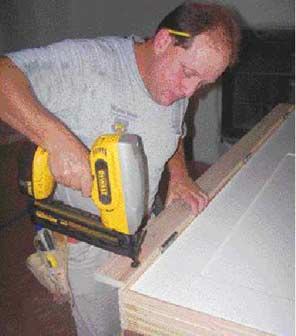
I remember when pneumatic finish nailers moved from factory floors and industrial workshops to residential construction sites. Their superiority over hand-nailing was unquestionable when I was trimming a new house, but on smaller remodels I found the time saving was frequently offset by the extra setup time.
Everything changed when Paslode introduced its Impulse cordless trim nailers in 1991. Powered by a disposable fuel cell and rechargeable battery, these tools eliminated the hassles of hooking up a compressor and dragging out the hoses. For many years, Paslode’s trim nailer was the only worthwhile cordless on the market, but recently a couple of others have arrived on the scene.
To see if Paslode is still king of the cordless, my crew and I tested a 16-gauge Paslode cordless angled finish nailer against two relative newcomers, Senco’s 15-gauge AirFree 41 and DeWalt’s 16-gauge DC618. We used these nailers on the site for more than two months and also set up head-to-head tests to compare power and speed. While all three manufacturers also offer straight-magazine guns, we chose tools with angled magazines because we think it’s a better design for the tight spaces we often encounter in our work as finish specialists.
Gas vs. Flywheel
Each manufacturer uses its own mechanism for driving nails. Paslode uses a unique internal-combustion engine powered by liquid hydrocarbon fuel and a 6-volt rechargeable nicad battery. According to the maker, each fuel cell will drive approximately 1,200 nails, while a fully charged battery will last for up to 4,000 fasteners.
The Paslode’s firing sequence begins with depressing the safety against the work surface, which starts an electric fan inside the housing. At the same time, fuel is injected into the combustion chamber and mixed with air from the fan. Pulling the trigger creates a spark that ig-nites the fuel mixture and forces down the driver. It’s a tried-and-true system, but at $6 each the fuel cells can get expensive. You need to make sure the tool is kept clean, too; otherwise, it can be unreliable. Also, temperatures near or below freezing can cause misfires. If you work at high altitudes (above 4,000 feet), you may need a special fuel-metering valve to compensate for thinner air.
Flywheel power. DeWalt and Senco both use a spinning flywheel as a source of energy, but the tools operate differently. Powered by a 14.4-volt nicad battery, Senco’s flywheel starts spinning when you depress the safety and pull the trigger. When it reaches enough speed to drive the nail, an internal electronic control engages a mechanical clutch that transfers the power to the drive pin with steel cables. As the driver descends, it creates a vacuum inside an attached cylinder that pulls the driver back into position for the next nail. Because the depth setting determines when the clutch engages the flywheel, reducing the depth setting decreases the cycle time. When you’re using the Senco, you can actually hear the flywheel getting up to speed before it fires the nail. The manufacturer claims the gun can fire 750 nails on a fully charged battery.
The DeWalt’s flywheel starts spinning when you depress the safety or pull the trigger (in bump-fire mode). With the flywheel turning, squeezing the trigger or depressing the safety activates an electromechanical switch that brings the driver blade in contact with the spinning flywheel, which forces the driver into the fastener. After the nail is fired, a mechanical spring returns the driver to the “up” position. Because the flywheel doesn’t stop spinning between nails, it doesn’t take as long for it to get back up to speed, so it cycles faster. But if you don’t shoot another nail, the flywheel times out after five seconds to conserve the battery.
According to DeWalt, the gun can shoot five nails per second; the model I tested, the 18-volt version, is said to have enough battery power for 800 nails. The tool is also offered in a similar model that accepts both 12-volt and 14.4-volt packs.
Power Test
How a gun feels and how it handles the kind of work you do are somewhat subjective, so to get a more objective measure we set up a head-to-head shootout using 3/4-inch-thick dressed red oak and 21/2-inch nails (see photos, previous page). First, we fired nails through 3/4-inch stock, then we added a second thickness of stock, and finally we added a third layer, for a full 2 1/4 inches of material. We marked off a field for each gun and fired off three nails per section to provide a fair representation of its driving power. It should be noted that the Senco gun was the only one shooting 15-gauge nails; the others were driving thinner, 16-gauge nails that offer less resistance.
All three nailers handled the 3/4-inch oak with ease, driving and setting each nail to an acceptable depth without misfires. At 1 1/2 inches thick, the DeWalt and Paslode nailers performed about the same; the DeWalt left one nail that could arguably have been set a little deeper. The Senco, however, left the nails slightly proud; in the real world, you’d need to finish them off with a nail set.
The biggest differences showed up when we stepped up to the 2 1/4-inch thickness. The DeWalt left two nails flush with the surface and one nail proud by about 1/16 of an inch. The Paslode countersunk two nails and left one flush. The Senco left all the nails proud. While you probably won’t be driving nails into 2 1/4-inch-thick oak very often, this seemed like a good way to simulate what might happen if you hit a knot in a stud while fastening trim.
Cycle Time
To see whether these nailers could keep up with a fast-moving carpenter, we decided to see how many nails they could drive into a 3/4-inch piece of red oak during a 10-second trial. Again, it’s important to consider that the Senco was driving larger nails; it drove a total of six nails in the 10-second test. The Paslode was next, with 15, while the DeWalt managed a surprising 40. It’s unlikely that anyone would ever need to drive 40 nails in 10 seconds, but it demonstrates DeWalt’s impressively short cycle time.
The Verdict
For sheer driving power, the Paslode holds a slight lead over the DeWalt, and we liked its lighter weight, good ergonomics, and the belt clip. The gun’s small size makes it especially handy in cabinets and other tight places. While the expensive fuel cells and frequent maintenance are drawbacks, we think it deserves consideration. It has a one-year warranty.
The Senco wasn’t our favorite, but when you need 15-gauge fasteners, it’s the only choice. And at just under $300 (on the Web), the AirFree 41 is presently the lowest-priced cordless finish nailer with an angled magazine. It also has a one-year warranty.
Overall, the DeWalt was our favorite tool. It was easy to load, provided consistent nail penetration, and seemed to operate all day on a single battery charge. The two headlights that we first saw as being just a cute gimmick quickly showed their value: They not only illuminate the workpiece but can be used to read a level in a dark closet. Even though this nailer is a half-pound heavier than the Senco, we found it was better balanced, making its significant weight less of an issue. We also like its three-year warranty.
Derrell Dayis a finish carpenter and general contractor in Panama City, Fla.
DeWalt DC618 16-Gauge Angled Finish Nailer
Weight: 8 1/2 pounds
Length and height: 13 1/2 inches and 12 1/2 inches, respectively
Nail capacity: 1 1/4 to 2 1/2 inches; 16-gauge
Magazine: Rear load; 120-nail capacity
Power source: 18-volt nicad battery (two included)
Case: Blow-molded plastic
Street price: $399 ($300 without batteries)
DeWalt • 800/433-9258 • www.dewalt.com
DeWalt’s depth adjustment is a little hard to see on the right side of the housing, but its numeric markings make it easy to reproduce a previous setting.
Testers’ Comments
DeWalt has only recently entered into the nail-gun arena, and this nailer is its first attempt at a compressor-free tool. We think the company’s done quite well. The balance and feel are good, and the 20-degree magazine is easy to load.
Rubberized panels on the handle improve grip. The gun also has twin headlights that illuminate the workpiece when the trigger is pulled. You shift from sequential to bump modes by flipping a switch; depth adjustment is handled with a six-position thumb-wheel on the right side of the housing.
Gripes
As much as we liked this nailer, it is one big, hefty gun: It will pull on your belt so hard you may have to cinch up another notch just to keep your pants on. It also has a wide housing, so we hit more than one door opening while wearing it on our waists.
In bump mode, we found we could move so fast that the gun would occasionally fail to set a nail, but slowing down a bit took care of the problem. This gun is certainly capable of nailing crown molding, but its weight makes this task more tiring.
Paslode IM250A 16-Gauge Angled Finish Nailer
Weight: 5 pounds
Length and height: 11 7/8 inches and 10 7/8 inches, respectively
Nail capacity: 1 1/4 to 2 1/2 inches; 16-gauge
Magazine: Rear load; 100-nail capacity
Power source: fuel cartridge and 6-volt battery (one included)
Case: Blow-molded plastic
Street price: $339
Paslode • 800/222-6990 • www.paslode.com
Paslode uses a reliable mechanical thumb-wheel to set depth of drive.
Testers’ Comments
My coworkers and I agree that you can use this gun all day long, even overhead, and never feel hampered by its size. At about 5 pounds, it’s the lightest and smallest of the nailers tested. It has a plastic housing with a comfortable rubberized grip.
The lock-out feature requires reloading whenever the 100-nail magazine gets down to 10 fasteners. Depth of drive is adjusted by a thumb-wheel located on the right side of the gun near the nose. Jams are cleared by grasping both sides of the nose and lifting up.
Gripes
This nailer requires fuel from the canister and power from the battery; if either’s spent, you can’t work. The tool also has severe dust allergies that can knock it out of commission if you forgo regular maintenance. Paslode recommends cleaning the air filter with soap and water every two days; a more thorough cleaning process — which is described on the company’s Web site and takes about 15 minutes — is necessary when the tool starts acting up.
While we recommend ear protection with any nailer, it’s truly a necessity with this gun. Nailing baseboard in a small closet can be almost painful without protection. Odor from the exhaust gases is another issue: A source of fresh air is a good idea if you’re using this gun in an enclosed space. Nails for the gun come in irritatingly short strips of 50. We often found ourselves wishing for more magazine capacity.
Senco AirFree 41 15-Gauge Angled Finish Nailer
Weight: 7 1/2 pounds
Length and height: 14 3/4 inches and 13 inches, respectively
Nail capacity: 1 1/2 to 2 1/2 inches; 15-gauge
Magazine: Rear load; 110-nail capacity
Power source: 14.4-volt nicad battery (two included)
Case: Blow-molded plastic
Street price: $299
Senco • 800/543-4596 • www.senco.com
Senco’s large depth adjustment is on the back of the housing, where it’s easy to get to.
Testers’ Comments
The Senco AirFree 41 nailer was the only 15-gauge nailer tested. Depth adjustment is controlled by a large knob on the back of the driver housing. Nail jams are cleared by pulling on the large clamp located above the driver. The gun has a tough plastic housing with rubberized inserts for improved grip. The well-designed magazine holds 120 nails (most 15-gauge nails come in racks of 100).
Gripes
This tool’s slow cycle time is a disappointment. We tried to give the nailer extra consideration because of the larger fasteners, but we still found the cycle time agonizingly slow. The gun may be acceptable for bench work, but given the stiff competition, we don’t consider it a good choice for job-site use. Senco plans to reintroduce an upgraded model with quicker cycle times; we look forward to testing the new gun when it’s available.


