
Pouring a New Foundation
Unfortunately, sometimes the foundation isn’t stable
enough to hold bolts, so we have to pour a new concrete stem
wall. A recent retrofit job illustrates the point. When I first
visited this residence, I was pleased to find two rare
conditions for a retrofit — a very comfortable clearance
and a lighted crawlspace. The owner wanted recommendations for
strengthening the subfloor framing and a labor-and-materials
bid for bolting his cripple walls to the existing concrete
foundation.
This particular house sat on a sloped lot, but instead of
stepping the foundation, the builder simply sloped the stem
wall to follow the grade — making it much more vulnerable
to slipping in a quake. The cripple walls were inadequately
bolted and unbraced. Even worse, the foundation concrete had
been mixed with unwashed aggregate and beach sand and was in
very poor condition. It was obvious the existing concrete would
not hold an anchor bolt, let alone hold up under seismic
stress.
One alternative was to raise the house on large steel
I-beams, remove the existing foundation, then form and pour a
new one — an expensive proposition. But once we
determined that the existing floor was level, we decided
instead to pour a new stepped foundation tight to the inside of
the existing one (Figure 3).
Figure
3. In cases where the old foundation is too weak to hold
anchors, it’s necessary to pour a new wall. In the case
shown here, a new stepped stem wall was poured tight to the
existing one, with new cripple walls built on top. Simpson A35F
clips secure the cripple wall to solid blocking between the
floor joists above (see photo).
We first excavated for a new footing, slightly "undermining"
the existing footing. Then we drilled and placed #4 rebar
dowels in the old stem wall on 4-foot centers. In the new
footing trench, we installed continuous #4 rebar around the
perimeter, and attached it to the dowels with short vertical
pieces of rebar.
After pouring the new foundation, we plated and framed new
cripple walls around the perimeter. These were bolted to the
new foundation with standard 5/8-inch J-bolts. To connect the
floor to the new cripple wall, we blocked between the existing
floor joists directly over the cripple wall and used Simpson
A35F metal brackets to connect the blocking to the double top
plates. We covered the cripple wall with 1/2-inch structural-1
plywood edge-nailed 6 inches on-center, with 12-inch centers in
the field.
Posts and Piers
Many of the houses we work on have a center girder supported by
a series of posts and piers. The posts are typically resting on
the piers with no mechanical anchor and are attached to the
girders above with nails only. In that case, we install new
2-foot-square by 1-foot-deep pier footings between existing
posts. We also replace any posts located under girder
splices.
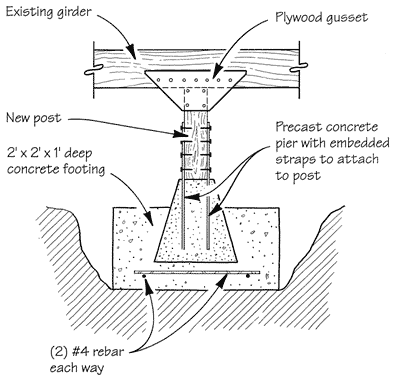
To form the new pier footings, we lay a grid of four #4
rebar pieces beneath a precast block that comes with embedded
straps for attaching to the post (Figure 4).
Figure
4. New post-and-pier supports are built in place using
precast pier blocks set in a 2-foot-square concrete footing.
Note how the original post, at right in the photo, has no
mechanical anchorage.
After pouring the new piers, we install new posts, strapped
at the bottom and connected at the top with a plywood gusset.
Finally, we use Simpson H-series clips to tie the floor joists
to the girders.


