
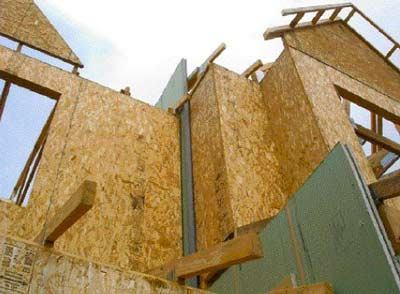
Gypsum-Board Firewalls, continued
Once the wood-framed wall that adjoins the firewall on one
side is in place, the bottoms of the 2-foot-wide gypsum panels
are inserted into the base channel and tilted up to vertical
(Figure 3).
Figure 3.After inserting the bottom edges of the
gypsum-board panels into a metal track fastened to the
foundation, a carpenter installs the steel H-stud that will
connect the vertical edges of the panels where they butt
together. The base of the H-stud fits into the base channel and
will be fastened in place with pan-head screws (left). Two
lengths of channel are screwed together back to back atop the
panel edges that extend above the second floor, serving as a
base for the next course of panels (right).
The edges of successive panels are joined where they butt
together with 2-inch metal H-studs. Special L-shaped aluminum
clips are screwed to the H-studs where they pass by the top
plate or floor plate; the other leg of the clip is screwed or
nailed to the plate itself (Figure 4).
Figure 4.The double layer of gypsum board at the
center of the area separation wall assembly is fastened to the
adjacent framing with aluminum "breakaway clips." In the heat
of a fire, the clips soften and melt, allowing the burning unit
to collapse without pulling down the firewall or the
neighboring unit on the other side.
It's important to maintain a 3/4-inch to 1-inch air space
between the gypsum panels and the wood-framed walls on either
side — no direct contact between the gypsum board and
surrounding combustibles is permitted.
Hot clips, cool clips. At
normal temperatures, the aluminum clips hold the gypsum-board
core of the area separation wall in an upright position. But in
a fire, when one side of the system is exposed to temperatures
in excess of 1,100°F, they soften and break away. (On
the job site, in fact, the aluminum clips are generally
referred to as "breakaway clips.") This allows the fire-side
structure to collapse without pulling down the fire-resistive
separation wall. The clips on the opposite side of the area
separation wall remain intact, since temperatures on that side
will be far below the point at which the clip will
soften.
Moving up. The gypsum-board
area separation wall is extended upward a floor at a time as
the framers continue their work. As each floor is completed,
the top edge of the previous course of gypsum panels is capped
with an upside-down piece of steel track. A second piece of
track is screwed back to back on top of it, and the next row of
panels is erected and fastened to the framing with more clips.
The area separation walls we build are usually limited to two
stories and an attic, but walls up to four stories high are
permissible if the first story is a basement.
Fireblocking and Roof
Junctions
To slow the vertical spread of fire between floors on the same
side of an area separation wall, the code requires fireblocking
of the space between the gypsum panels and the adjacent floor
joists. In most cases, the fireblocking consists of strips of
the same 1-inch gypsum board used in the firewall itself. The
gypsum-board fireblocking is fastened to the H-studs with
screws.
The 2-inch gypsum core of the firewall is required to be
continuous, with no openings or penetrations that could allow
fire to pass through it. But the framing of the walls on either
side can accommodate plumbing and wiring just like any other
partition.
Sound control. The dense,
continuous area separation walls also provide an effective
barrier to sound transmission between units of a townhouse or
apartment complex. To reduce transmitted sound even more and
improve thermal performance, we insulate the adjacent walls
with fiberglass batts. When the plumbing, electrical, and
insulation subs are done, the walls and ceiling are finished
with drywall in the usual way.
Where roof meets firewall.
Building codes ordinarily require area separation walls to be
constructed with a parapet — a vertical segment of the
wall that extends through the roof to a specific height,
usually 30 to 36 inches above the roofline. But for townhouse
construction, the code in our area also accepts a method that
doesn't require a parapet (Figure 5). We use this method in
applications where we want to avoid the appearance of a
roofline interrupted by one or more parapets.
Figure 5.Where the area separation wall meets the
roof, sheets of 5/8-inch type X gypsum board protect the
underside of the roof sheathing in the two adjoining rafter
bays on each side.
This involves installing a code-approved roofing material and
adding a layer of 5/8-inch type X gypsum board for 4 feet on
either side of the area separation wall. The gypsum-board
underlayment sits directly beneath the sheathing, where it's
supported by ledgers nailed to the top chords of the adjoining
roof trusses. A similar detail can be used where an area
separation wall meets an exterior wall (Figure 6).
Figure 6.A carpenter installs a strip of
fireblocking to close the gap where a short section of exterior
garage wall will butt against the area separation
wall.
It Works
We're confident that gypsum-board area separation walls
perform every bit as well as masonry. About 12 to 15 years ago,
we encountered a local township that had no history of working
with gypsum-board area separation walls, and town officials
were skeptical of our intention of using them. To show them how
reliable the gypsum-board walls are, we built an 8x16-foot
building and divided it in half with an 8-foot-high
gypsum-board area separation wall. Under the watchful eye of
the local fire department, we set the test facility on fire.
The gypsum-board wall system performed well beyond expectation,
and we were able to sell the project to town authorities as
planned. The test wasn't completely scientific, but it
confirmed our belief and convinced local fire officials that
gypsum-board area separation wall systems work as designed.
Robert Brownis vice president of construction for the
Barness Organization in Warrington, Pa.


