
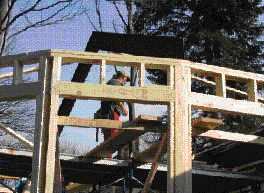
by Dan Kolbert In most stick-framed roofs, ceiling joists or collar ties prevent the rafters from pushing out against the walls. With cathedral ceilings — which have no joists or collar ties — a structural ridge is necessary to support framing members like rafters, hips, and valleys. The ridge is usually carried by gables, walls, or posts.
But what do you do when there is nothing there to support one end of the ridge?
Late last year, our company framed an addition that had a cathedral ceiling and a roof with hip rafters. The main wall of the house supported one end of the structural ridge, but because of the hips, the other end stopped short of the addition’s exterior wall.
Luckily, the engineer on the project came up with an elegant solution: a pair of steel I-beams welded together off-site in the shape of two opposing rafters (1). We installed this angle-shaped I-beam at the end of the ridge where the king-common rafters would normally go, and had a plate site-welded onto it to catch the one hip that carried a significant load (2). The beam supports the ridge and hips while still allowing for a cathedral ceiling (3).
Since the rafters were deeper than the I-beam, there was room to create a thermal break by installing a small amount of rigid insulation above and below the steel.
Dan Kolbert owns Dan Kolbert Building & Renovations LLC in Portland, Maine.
Rock-Breaking Tip
by David Dobson
First, heat the rock with a torch.
Pour cold water over the rock where it’s been heated.
Hit the rock with a hammer where you want it to split.
The broken rock.
Back when I was a young intern architect, one of the projects I worked on was the renovation of a building on St. Thomas in the Virgin Islands. The centuries-old structure — the house where the French Impressionist painter Camille Pissarro was born — had rubble walls up to 20 inches thick, and our client wanted to cut niches in them for display cabinets. Unfortunately, there was a large rock extending the entire width of the wall, and the contractor could not figure out how to cut or remove it without damaging surrounding areas.
When he came to our office with this dilemma, I suggested that he split the stone by heating it with a torch, throwing ice-cold water on it, and then hitting it with a hammer.
The contractor and I had already had some disagreements, so when he heard this he looked at me as if I were crazy and said there was no way it would work. But since he couldn’t come up with anything better, our boss told him to give my method a try the following morning.
When we arrived on site, the contractor had his whole crew assembled so that they could have a laugh when my method didn’t work. He heated up the rock with an acetylene torch and threw water on it; then he looked at me and said, “See? Your idea doesn’t work.”
“I also said that you need to hit it with a hammer,” I replied.
So he instructed a young laborer to hit the stone with a hammer. After three hits, the contractor glanced at me and was about to say something; on the fourth, the stone split right along the back plane of the niche exactly where we wanted it to.
It seemed best at the time to keep the source of the trick — a filmstrip I saw in fifth grade — to myself. The movie showed how workers built Stonehenge by heating the large stones, throwing water on them, and hitting them with smaller rocks.
David Dobson is an architect and licensed general and glazing contractor in San Diego.
Ice Supports
by William Dillon Cool thinking saved the day recently when our design/build firm hit a snag moving a 200-year-old house onto a new foundation on Martha’s Vineyard, Mass. Ordinarily, we leave pockets in a foundation so that once the structure is in place we can remove the beams we used to lift and move it. But since this house was going on a structural slab — with no basement or crawlspace — that approach wasn’t going to work.
Fortunately, house-mover Mike Reid had an ingenious solution: He temporarily supported the building on blocks of ice while he pulled out the beams. As they melted, the blocks lowered the house about 1/8 inch per hour, giving him plenty of time to remove the cribbing. We had to shade one of the blocks because it melted faster than the others, but otherwise the plan worked great.
This wasn’t the first time Reid had used the technique. He told us he once filled an elevator shaft with ice so that he could lower a 10-ton piece of equipment in an elevator with a one-ton capacity. A few days later, when the ice had melted, he pulled the machine out of the elevator car and collected his check.
William Dillon is a job supervisor with South Mountain Co., an employee-owned design/build firm on Martha’s Vineyard, Mass.


