
Q. When I-joists are cantilevered over the foundation wall rather than directly supported at the sill plate, can a deck ledger be safely attached to the engineered rim joist?
A. Frank Woeste, P.E., professor emeritus in the Department of Biological Systems Engineering at Virginia Tech University, Blacksburg, responds: While most I-joist companies publish fastener schedules and details for attaching deck ledgers to code-approved engineered rim boards, these details assume that the I-joists and rim boards are continuously supported and bear directly on a sill plate. But to my knowledge, no I-joist manufacturer has a detail for connecting a deck to an I-joist cantilever, for two main reasons. First, design loads from both the entire structure and the deck that loads the cantilever have to be accounted for when specifying I-joists and calculating their load-bearing capacity at the foundation wall. But since it’s impossible to publish design tables and other design rules without knowing actual deck loads, I-joist industry literature is based on the assumption that decks (and other structures) are not connected to cantilevers. Second, nail and screw connections into the end grain of I-joist flanges don’t provide adequate strength in this critical application.
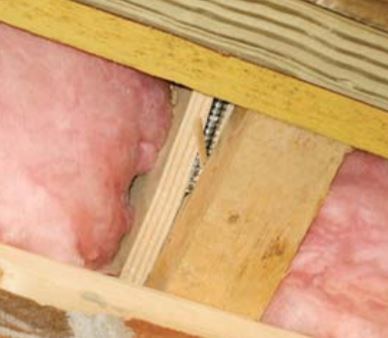
Whenever floor framing projects beyond the sill, deck loads that would otherwise be carried by the supported rim joist and sill plate are carried instead by the fasteners that connect the rim joist to the ends of the cantilevered I-joists. Hence the loads are strictly limited by those fasteners’ capacity. As the photo at left shows, even when blocking has been used to beef up that connection, end-grain fastening is a woefully inadequate method for transferring deck design loads.
Of course, the problem occurs with dimensional lumber as well, which is why the Prescriptive Residential Wood Deck Construction Guide (awc.org) prohibits attachment of decks to house overhangs and other dimensional lumber cantilevers. As with code-approved rim board and I-joists, an engineered solution would be required for a safe deck connection.
Another option in both cases would be to design the deck so that it is freestanding.


