- Q. Can laminated veneer lumber (LVL) be used to strengthen existing wood beams? I’ll soon be working on a remodeling project where the existing floor system is supported by an undersized built-up wood beam, and I would like to stiffen the existing beam by bolting LVL material to it.
A.Phil Westover responds: LVL can be used to strengthen or stiffen existing beams, but the manufacturer’s load tables will generally not apply, and engineering analysis will likely be required to assess the member and connection capacities. The final design will depend on the geometry of the structural assembly, the design properties for the LVL, and the design properties of the existing framing.
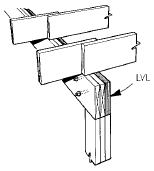
In the case of a typical “top-loaded, “simple-span” beam (see Figure 1), the manufacturer’s tables and installation guidelines may be used to size the LVL if the following conditions are met: The supported members will bear on the top of the LVL, positive and adequate-bearing supports are provided to support the beam-end reactions, and the LVL is sized to carry the total load on the assembly. In these situations, the bolts used to fasten the LVL to the existing beam generally have little structural demand and are only required to provide lateral support to the LVL members.
If any of the assumptions mentioned above are not true, as in side-loaded beams (Figure 2), then the bolted connections must be engineered based on the structural geometry and the design properties of the LVL and the existing framing. The bolts must be sized and spaced to direct the loads into the LVL along its length, ultimately reaching the end supports. Bolted connections (and the new and existing wood members) must be engineered according to the National Design Specification for Wood Construction (available from the American Wood Council; 800/890-7732).
When the existing framing shares in the load-carrying capacity, then the relative stiffness of the existing framing and the new LVL members must be evaluated to assess the proportion of the loads carried by each member. The design of the members and bolted connections for this situation can become very complicated and should only be done by an engineer.
Phil Westover, P.E., is a consulting engineer in Winchester, Mass.
Q&A: Using LVL to Reinforce Existing Beams
2 MIN READ