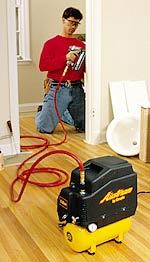
A catalog of features and specifications to look for when choosing a job-site air compressor
There’s a huge number of small compressors on the market. That’s because portable air compressors are used for everything from running jackhammers and sand blasters to air wrenches and paint guns. They’re used by nearly every industrial trade, as well as by homeowners. However, in our industry — residential construction — most compressors are enlisted into active duty for running nail guns on site. With this in mind, I will focus here on directing builders and remodelers towards the features and specifications to look for on smaller hand-carry models (those with 11/2- to 4-gallon tanks and electric motors in the 3/4- to 2-hp range), and on typical wheelbarrow models (those with 8-gallon tanks and 11/2- to 5-hp electric motors or 4- to 8-hp gas-powered engines). Tank configurations.
Portable compressors come in a variety of different configurations. Single tank designs include the pancake (top left) with a single oval-shaped tank, and the more conventional shop-style design (top right). Twin-tank models come with horizontal tanks or a vertical stack (bottom left & bottom right). These are differences of convenience, not of performance.
Compressor Pumps
A compressor is a very simple machine. It’s essentially a piston under power that pushes air into a tank. Simple valves — no more than flaps that open or close in one direction — allow air into the cylinder on the piston’s downstroke. As the piston returns on the upstroke, this trapped air is forced into a storage tank. Each piston stroke sends another gulp of air into the tank until the tank reaches a maximum operating pressure (about 120 psi on portables). At this maximum, a pressure switch turns the pump off. The faster the piston moves, the faster pressure builds. The time from when a compressor kicks on to when it reaches maximum operating pressure and cuts out is the recovery time. As the pressure in the tank builds, the piston must have enough force to push against the increasing backpressure. Piston rings provide a seal to prevent air from blowing back through the cylinder. But as a compressor wears, this seal breaks down, and it takes longer and longer for pressure to build in the tank. For job-site compressors, the recovery time can be from 10 to 30 seconds. Any machine that takes longer than this is underpowered or in need of a rebuild. Single-stage vs. two-stage.
Nearly all hand-carry portable compressors made for running nailers (those with a maximum operating pressure set at around 120 psi) have simple single-stage air pumps, with a single cylinder and piston as described above. Some larger wheelbarrow models (as well as many shop-sized stationary rigs) have a twin-piston pump, known as a two-stage compressor. This type of pump pushes air from a large cylinder into a smaller cylinder, where it is further compressed by a second, smaller piston. Between the two cylinders (compression stages) the air passes through an intercooler — a pipe with cooling fins. Compressing air causes it to heat up and expand, so the cooler the air, the more easily it is compressed. Two-stage compressors are used whenever a system needs operating pressures above 150 psi. While this is excessive in a portable, a two-stage pump will be able to compress air in large storage tanks with quicker recovery times. If you need lots of air for running many framing or roofing nailers at once, opt for a two-stage pump. Oil-less vs. oil-bath.
Less than a decade ago, almost all job-site compressors were built with oil-bath pumps. As the piston crank in these pumps turns through a pool of oil, the oil splashes up on the cylinder walls. The bottom-most ring on the piston is corrugated to capture this oil and spread it around. This not only lubricates the piston, but provides an airtight seal around the upper two piston rings. Oil-bath compressor pumps are typically built with cast-iron cylinder heads that can be machined to close tolerances. As long as the pump is topped off with oil (and kept near level so the piston properly splashes in its bath), an oil-bath model will provide years of trouble-free service. It’s not uncommon for a well-maintained oil-bath compressor to run 8 to 10 years before needing an overhaul, even with continuous use. In the last decade, oil-less compressors have taken a foothold in the compressor market. These pumps have a piston ring impregnated with Teflon (or similar type of material). This “self-lubricating” piston rides against an aluminum cylinder. Oil-less pumps don’t have a crank shaft. The piston rides on an eccentric wheel that comes straight off the motor shaft. And the piston arm doesn’t have a wrist pin. Instead, the arm rises through the cylinder at an angle, so the piston wobbles from side to side as it pumps. By design, oil-less pumps are built to looser tolerances than oil-bath pumps, and need to be rebuilt more often. Most are rated for about 2,000 hours of operation. Oil-less compressors can be rebuilt fairly easily, using kits provided by the manufacturer. The first time I did it, it took me about 40 minutes. Once I knew what I was doing, I got it down to about 20 minutes. Each time, the parts cost about $45. Rebuilding an oil-bath unit, however, is a job for a tool repair shop. It’s a messy job, on account of all the oil, and in most cases, the cylinders will need honing. It’s a 1- to 2-hour job at a cost of $25 to $35 per hour. New rings will cost about $25 to $30 per cylinder and new bearings about $35.