
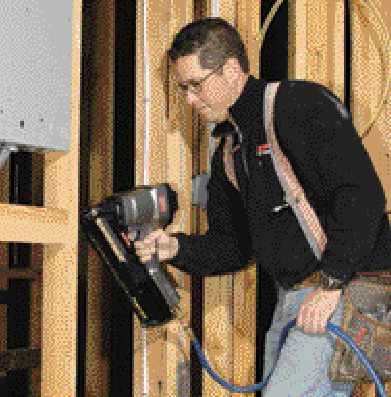
As a framing contractor, I use nail guns just about every day, so it’s hard not to notice the way these tools have changed over the years. Today’s nailers work better than the ones I’ve used in the past: They are smaller and lighter and have features that make them easier to use.
For this article, my crew tested 11 stick nailers. We limited ourselves to models that drive 30- to 34-degree paper-collated nails, the fastener we normally use. (Clipped-head nails also come with 28-degree wire or plastic collation, a Bostitch standard that fits guns from a number of other manufacturers.)
We tested tools from DeWalt, Fasco, Hitachi, Makita, Max, Paslode, Porter-Cable, and Senco.
Durability and Power
The tools arrived in the summer of 2004 and we used them into the fall. My crew is hard on tools, so the guns got a good workout. We didn’t use them long enough to evaluate long-term durability, but during the time we had them they took all the punishment we could give. In fact, I was surprised by how well-made all these guns seemed to be. The only differences I noticed had to do with small details, like the materials used for rafter hooks and triggers.
Nail guns have had to become more powerful over the years, mainly because the newer engineered materials are harder than regular framing lumber. Some of the nailers we tested were more powerful than others, but all of them had enough power to do the job. For our company, that means being able to drive 3 1/4-inch spikes into LVLs. (Almost all of the guns will drive longer fasteners, but 3 1/4-inch-long, .131-inch-diameter spikes are about all we ever use.) We didn’t use the guns to nail off plywood, because codes in our area prohibit the use of clipped-head fasteners for sheathing.
Size and Weight
Ideally, a framing gun should be light, powerful, and compact. In reality, there are always trade-offs. Hitachi’s NR 90AA feels more powerful than the other guns, but at 8.8 pounds it’s also much heavier. Most of these tools weigh right around 8 pounds, though a couple are significantly lighter: The DeWalt weighs 7.5 pounds and Hitachi’s NR 90AD weighs only 7.0 pounds.
Recoil. The first time I picked up the NR 90AD, it was so light I expected to feel a lot of recoil. But after using it for a while, I realized there was almost no recoil. Likewise, the Makita produced remarkably little kick. The other guns produced more recoil, but nothing out of the ordinary.
Compact shape. All things being equal, I prefer a more compact gun because it’s easier to get into tight spots. It’s not an issue when we’re nailing walls together on the deck, but it does come up when we toenail or work between rafters and joists. The Sencos and the Porter-Cable are significantly more compact than the other tools, mostly because they have shorter magazines. Even though the Hitachi NR 90AD has one of the longer magazines, it feels compact because it’s not as tall as other models.
Firing Modes
Framing nailers have two firing modes, sequential and bump. On some models, you change modes by flipping a switch; on others, you have to replace the trigger. This feature means very little to me: Because none of our framers use sequential firing, there is no advantage to being able to switch modes. If I like a gun that comes with a sequential trigger, I’ll buy it, change triggers, and use the bump-fire mode from then on.
No dry-firing. Many of these guns have a lock-out mechanism that prevents them from firing when the magazine is empty. If a gun dry-fires, it leaves a small indent in the lumber that looks like the head of a nail. When you realize the gun is empty, you have to go back and look for missing fasteners. I much prefer the models that won’t dry-fire. It’s a bit maddening when the gun won’t shoot those last few nails, but it’s much better than thinking you have a wall nailed together when you really don’t.
Magazines
Some guns load from the top of the magazine and others load from the rear. As long as the gun is easy to load and unload when we switch between standard fasteners and stainless or hot-dipped-galvanized nails, it doesn’t matter to me how the tool loads.
Capacity. The more fasteners a gun holds, the more work you can do without having to stop and reload. The trade-off is a longer magazine, which can be tough to maneuver in tight quarters.
Unfortunately, the manufacturers’ specs make it difficult to determine the magazine’s effective capacity — the number of nails the tool will hold if I load full strips. (Years ago, I would break strips of fasteners to top off the load, but I stopped doing that because it was a hassle to load the short leftover pieces.)
The specs may show a capacity that cannot be achieved without breaking strips, or they may list a range of capacities. For example, Paslode says its gun holds 74 to 84 nails. This means it holds 74 of the larger .131-inch fasteners or 84 of some smaller size. But you could never drive 74 .131-inch nails without reloading, because — as with all the other tools that prevent dry-firing — this gun will not allow you to shoot the last few nails.
There’s no industry standard for the number of nails per strip, but .131-inch clipped-head nails typically contain between 28 and 34 fasteners per strip. The nails I use come 30 to a strip, and most of the guns I tested for this article hold two full strips. Two of the guns, the Fasco and Hitachi’s NR 83AA3, will hold three strips.
Of course, all the guns hold more nails if you use smaller fasteners — but that’s not an issue for us, because we use these guns only to fasten framing. We use a coil nailer to drive the smaller round-head nails we use for sheathing.
Added Features
When I first started framing, nail guns were simpler. There was no such thing as a rafter hook, directional exhaust, or adjustable depth of drive. The new guns have many more features, but the value of any one feature depends on the kind of work you do.
There are four carpenters on my crew. One guy does all the low work, building headers, jacks, and walls, so to him a rafter hook is no big deal. But he does want a directional exhaust port because he doesn’t like sawdust blowing up in his face.
Those of us who work up high really care about rafter hooks because a hook makes it easier to put down the tool. We can roll joists or haul up rafters without having to worry that the gun will fall.
The DeWalt, Paslode, and Senco FramePro 701XP all have hooks. I prefer Senco’s hook because it’s made from metal and folds tight against the magazine when it’s not in use (see Figure 1). Paslode’s hook is a substantial piece of metal, but the spring-loading makes it awkward to retract with one hand. DeWalt’s hook is made from some kind of plastic; I’m concerned that it will not hold up, especially in very cold weather.
Depth of drive. These days, every framing nailer has an adjustable contact element that can be raised or lowered to change the depth of drive. With most models, you can change depth settings without using tools, usually by turning a thumb-wheel located on the nose or just below the trigger. DeWalt’s mechanism is adjusted by sliding an indexed button below the trigger. The Senco FramePro 601 and Paslode PowerMaster both require tools to change the depth of drive.
In most cases, the front of the gun is less cluttered and the mechanism is less likely to get banged if it’s mounted away from the nose of the gun. Still, the nose-mounted wheels on the Max and Senco FramePro 701XP are less exposed than others because they’re tucked in fairly tightly.
Nonmarring tips. Many of these guns come with a plastic tip that installs over the teeth of the contact element. The idea is to prevent the teeth from marring visible surfaces. As a framer, I have very few opportunities to take advantage of this feature, though I have used it when nailing exterior deck members that will be at eye level. On some models, the tip stores on a clip on the magazine. It’s a clever idea, but if you do a lot of framing, the tip is likely to fall off and get lost.
Generic Nails
I normally use Senco nails because that’s what the nearest supplier sells. For this test, we also tried some generics to see if that made any difference. It did: The guns seemed to jam more with generic fasteners. The Hitachis — especially the NR 90AD — seemed more sensitive to the type of nail than the other guns did. They worked absolutely fine with brand-name nails, but the generic fasteners tended to bend or jam.
There was a time when my crew regularly used generic fasteners. We stopped because it just wasn’t worth it. We use about 100 boxes (3,000 nails per box) of fasteners per year. Even though the generics are a few dollars less per box, the savings were offset by the time spent clearing jambs and by fasteners that were wasted because the paper collation broke.
Favorites
When it comes to features, it would be hard to beat the Senco FramePro 701XP. This tool has good power, it’s compact, and it won’t fire when empty. The rafter hook is convenient for working up high, and it folds completely out of the way when you’re not using it.
My next-favorite guns are the DeWalt D51823, Hitachi NR 83AA3, and Makita AN942. I like the DeWalt because it’s light and has a rafter hook. The NR 83AA3 holds three strips of nails and comes from a series that has a reputation for durability. The Makita is comfortable to use because it’s well-balanced and has very little recoil.
John Harmanis a roof cutter and framing contractor in Northumberland, Pa.
| Clipped-Head Nailer Specs | ||||||
| Brand | Model | Height (in.) | Length (in.) | Weight (lb.) | Nail Length (in.) | Nail Diameter (in.) |
DeWalt | D51823 | 12 3/4 | 18 5/8 | 7.50 | 2 to 3 1/2 | .113 to .131 |
FASCO | F5C HHN 31-90A | 13 11/16 | 17 11/16 | 8.20 | 2 to 3 1/2 | .113 to .131 |
Hitachi | NR 83AA3 | 14 3/16 | 18 1/8 | 8.40 | 2 to 3 1/4 | .113 to .131 |
Hitachi | NR 90AA | 14 1/16 | 16 15/16 | 8.80 | 23/8 to 3 1/2 | .113 to .148 |
Hitachi | NR 90AD | 12 11/16 | 18 3/8 | 7.00 | 2 to 3 1/2 | .113 to .148 |
Makita | AN942 | 14 3/4 | 17 3/4 | 8.40 | 2 to 31/2 | .113 to .131 |
Max | SN890CH/34 | 14 3/4 | 17 | 8.00 | 2 to 3 1/2 | .113 to .148 |
Paslode | PowerMaster F-350S | 13 5/16 | 19 1/2 | 8.40 | 2 to 3 1/2 | .113 to .131 |
Porter-Cable | FC350a | 14 | 14 1/4 | 7.96 | 2 to 31/2 | .113 to .131 |
Senco | FramePro 601 | 13 1/2 | 14 13/16 | 8.00 | 2 to 3 1/2 | .113 to .148 |
Senco | FramePro 701XP | 13 1/4 | 14 1/2 | 8.00 | 2 to 3 1/2 | .113 to .148 |
| Clipped-Head Nailer Specs – Continued | ||||||
| Brand | Model | Fastener Capacity | Fires Empty | Adjustable Exhaust | Includes Nonmarring Tip | Street Price |
DeWalt | D51823 | up to 80 | no | no | no | $289 |
FASCO | F5C HHN 31-90A | 75 | yes | no | yes | $325 |
Hitachi | NR 83AA3 | 86-94 | yes | no | no | $349 |
Hitachi | NR 90AA | 56-84 | yes | yes | yes | $349 |
Hitachi | NR 90AD | 50-74 | yes | no | no | $299 |
Makita | AN942 | 60-84 | no | no | yes | $329 |
Max | SN890CH/34 | 90 | no | yes | yes | $332 |
Paslode | PowerMaster F-350S | 74-84 | no | yes | no | $279 |
Porter-Cable | FC350a | 66 | no | yes | yes | $229 |
Senco | FramePro 601 | 56-80 | no | no | no | $259 |
Senco | FramePro 701XP | 56-80 | no | yes | yes | $299 |
DeWalt D51823
Pros: This is the second-lightest gun we tested. It has a rafter hook, a trigger lock, and an anti-dry-firing mechanism. It’s well-balanced and fits into tight spots because it’s not very tall. The magazine pops off, making it easy to clear jams.
Cons: The exhaust doesn’t adjust and the rafter hook is made from plastic. We didn’t break the hook, but I’m concerned about how well it will hold up over time. The shape of the head makes it somewhat hard to see the tip.
Fasco F5C HHN 31-90A
Pros: The Fasco has good driving power, holds three strips of nails, and is easy to load and unload.
Cons: There is no rafter hook, the gun will fire when empty, and the direction of the exhaust does not adjust.
Hitachi NR 83AA3
Pros: The NR 83AA3 is an updated version of the nailer I used 20 years ago. The earlier models in this series proved to be very durable. This latest version has good power and an adjustable depth of drive, and it holds three strips of nails.
Cons: The gun is somewhat heavy and is less compact than many models. There’s no rafter hook, the exhaust doesn’t adjust, and it will fire when empty.
Hitachi NR 90AA
Pros: The NR 90AA feels more powerful than any of the other guns. The adjustable exhaust port is indexed, so it won’t vibrate to another position.
Cons: This was the heaviest gun we tested; after a day of using it my arm was really tired. A metal piece over the magazine makes the tool harder to load and unload than other models. The NR 90AA feels top-heavy and will shoot when it’s empty.
Hitachi NR 90AD
Pros: This unusual-looking gun is brand-new. On first impression, it seemed like a toy, but after using it I decided it was a very good tool. It’s compact, powerful, and extremely light. It’s also comfortable to hold and has almost no recoil.
Cons: There is no rafter hook, the gun dry-fires, and the exhaust does not adjust. One of the reasons this gun is so light is that it contains a lot of plastic, which raises questions of durability. The NR 90AD worked fine with brand-name nails but had trouble driving generic fasteners.
Makita AN942
Pros: The AN942 is well-balanced, has very little recoil, and is easy to load and unload. A single knob controls the firing modes and can be used to lock the trigger. This gun does not dry-fire.
Cons: This tool is heavier than average and does not have adjustable exhaust or a rafter hook. The magazine is not quite long enough to hold three strips of nails.
Max SN890CH/34
Pros: This nailer is well-balanced and comfortable to hold. Though it never jammed during testing, jams should be easy to clear by opening a “door” on the nose. The adjustable exhaust has indexed stops and there is a large wheel for changing the depth of drive. The tool comes with a swivel hose connection.
Cons: The Max doesn’t have a rafter hook and is a little more expensive than average.
Paslode PowerMaster F-350S
Pros: The F-350S is well-balanced, has a substantial rafter hook, and won’t fire when empty.
Cons: The oversized two-finger trigger is a good idea but takes some getting used to. The spring on the rafter hook is very stiff, so it’s somewhat difficult to adjust when you’re in the air. You have to use an Allen wrench — which stores on the tool — to adjust the depth of drive and exhaust direction.
Porter-Cable FC350a
Pros: The FC350a is light, well-balanced, and compact. It has adjustable exhaust, and the magazine is easy to load and unload.
Cons: I know you’re not supposed to use the contact element to tap joists and studs into position, but every framer does. When we did it with this gun, it bent the nose piece. This tool does not have a rafter hook and the trigger seems cheaply made.
Senco FramePro 601
Pros: The FramePro 601 is a relatively inexpensive gun with good power, a cushy grip, and an anti-dry-firing mechanism.
Cons: This is a watered-down version of the FramePro 701XP (see below). There isn’t a rafter hook, the exhaust is fixed, and it requires tools to adjust depth of drive. There’s no reason for a pro to buy this gun — not when you can get a 701XP for only $40 more.
Senco FramePro 701XP
Pros: The FramePro 701XP is powerful, well-balanced, and compact. It has adjustable exhaust, an anti-dry-firing mechanism, and a rafter hook that folds completely out of the way.
Cons: This tool has a bit of recoil and holds a smaller load than other guns.
| Nailer Manufacturers | |
DeWalt Industrial Tool 800/433-9258 | Max USA Corp. 800/223-4293 |
Fasco America 800/239-8665 | Paslode 800/222-6990 |
Hitachi Power Tools 800/829-4752 | Porter-Cable 800/487-8665 |
Makita USA 800/462-5482 | Senco Products 800/543-4596 |


