
As most energy-conscious builders know, a tight house needs a reliable source of fresh exterior air. This is particularly true of houses with fireplaces, high-powered exhaust fans, and other appliances that tend to depressurize the living space. A house that doesn’t have enough natural air leaks to make up for the loss will draw the necessary makeup air from somewhere else. That’s a potentially dangerous situation because it can lead to backdrafting and fume spillage from furnaces, water heaters, or other atmospherically vented fuel-burning appliances.
Several strategies can be used to admit makeup air in a more systematic way. The simplest method — leaving a window partially open — is simple and effective, but it has significant drawbacks: It often creates chilly drafts that cause the homeowner to cut off the air supply by closing the window. And when the living space is under positive pressure — when a strong wind is blowing, for example — an open window provides an unobstructed path that allows expensively heated air to flow to the outdoors.
A more sophisticated approach is to install a heat-recovery ventilator, or HRV, which recovers most of the heat in a fan-driven stream of exhaust air by passing it through an incoming stream of cold air in a heat-exchanger core. While thermally efficient, HRVs have filters that must be changed several times a year, and they typically add at least a thousand dollars to the cost of a home.
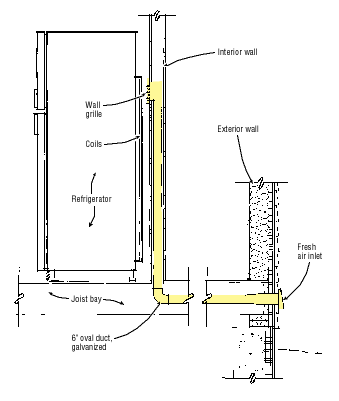
Glenn Mitchell, a designer in Comox, B.C., has developed an ingenious solution that represents a compromise between an active ducted system and a simple opened window. The “poor man’s HRV,” as Mitchell describes it, consists of a length of duct leading from an intake opening in the rim joist to a grille in the wall behind the refrigerator. When the air pressure indoors falls significantly below that of the outdoors, the required makeup air flows into the house through the duct. A backdraft damper at the rim-joist end of the duct prevents heated indoor air from passing out of the house when the interior is under positive pressure. (Mitchell’s original installations used flexible dryer duct and a 4-inch flapper-type dryer vent modified to work backwards, preventing air outflow rather than inflow. A more efficient installation would use a manufactured backdraft damper and rigid galvanized duct with sealed seams.)
When the refrigerator is running, the waste heat from the coils tempers the incoming air, which in turn cools the coils and increases the efficiency of the refrigerator. When the refrigerator is cycled off, the inlet air doesn’t receive the benefit of additional heating, but because it flows into the narrow, out-of-the-way space between the refrigerator and the wall, the likelihood that the homeowner will detect a cold draft is reduced. “I’ve used the design on several houses and never had a comfort complaint,” Mitchell says.


