
Myth 4: Water Heaters Are Unsafe
Out of the box, water heaters have more safety controls than the typical boiler. Horror stories where water heaters used as boilers blow up or blast off through the roof are almost always the result of improper installation or of someone doing something nutty like plugging the relief pipe. Properly installed, storage water heaters are as safe as any other heating appliance in my opinion.
Piping a Water Heater for Space Heating: The Basic System
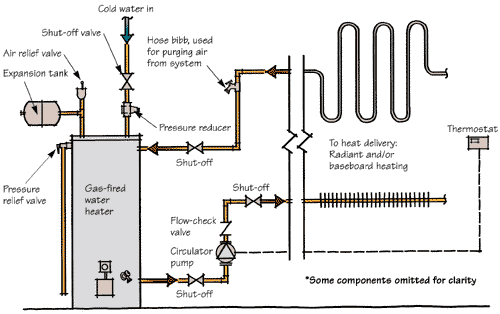
There are several ways to hook up water heaters to supply a heating system. The method you use will depend on balancing initial cost with system life and operating efficiency. If all you need to do is add a warm floor to a bathroom or some baseboard convectors in a small den and you are willing to live with lower efficiency, the least expensive method is to install a dedicated “hardware store” quality water heater with only minimal controls: A pump, backflow preventer, and expansion tank are all that are needed (Figure 2).
Water Heater Dedicated for Heating
Figure 2. A dedicated setup is the simplest, least expensive way to use a water heater for space heating. The author always uses a unit with side taps for easy installation. The pump is installed at the bottom to avoid air lock. The circulating pumps used with boilers require a separate “pump controller,” which is a relay that turns the pump on and off in response to the thermostat. Many basic systems will be single zone, so consider using a pump with a built-in relay to save the additional cost, such as the Taco “zone priority circulator” (Taco Inc., Cranston, R.I.; 401/942-8000). We install the pump at the bottom of the tank to minimize the problem of “air locking,” which occurs when the dissolved oxygen in the water forms bubbles that rise and prevent the water from circulating. To power the pump, we simply attach a flexible “pigtail” and plug it into a nearby outlet. The thermostat hooks directly to the relay terminals on the pump. If the water heater is below the heating units, you’ll also need a check valve to prevent thermosiphoning — the tendency of the system to circulate by itself as the hot water rises. Because this system will be circulating domestic drinking water at line pressure through the heating system, be sure to check with local authorities for code compliance, and only use components rated for use with potable water to limit corrosion and scaling. These problems occur when the oxygen dissolved in the domestic water comes into contact with carbon steel or iron components in the system, or with dissolved minerals such as calcium. For that reason, it’s necessary to use only brass, copper, stainless steel, or approved plastic components in systems that are in contact with potable water.
Dual-Purpose Systems
While it works fine to use a water heater for space heating alone, it makes sense to design a dual purpose system — one that’s capable of heating domestic water as well. If you use a high-quality sealed-combustion tank, such as a Bradford White TTW2 (Bradford White Corp., Ambler, Pa.; 800/538-2020), the real-world operating efficiency of this setup is close to 85%, better than just about anything else out there. This approach makes sense because of lower operating costs and more efficient use of floor space. There are two types of dual-purpose systems in use — those with heat exchangers and those without.
No Heat Exchanger
This system is nothing more than an expanded version of the basic system. The water tank provides domestic water to the building as normal, but a zone or zones are added for space heating (Figure 3).
Dual-Purpose Water Heater
Figure 3. The dual-purpose setup provides both space heating and domestic water heating. The timer on the circulator shunts water through the heating loop at regular intervals to prevent the growth of bacteria that might take place if the water were stagnant. Tread with caution — many local authorities frown on these systems, and with good reason. During the summer months, the water in the heating zones gets stagnant and can grow dangerous bacteria. If you install a dual-purpose system with no exchanger, always install a timer to circulate fresh water into the heating zones for a few minutes every day.


