
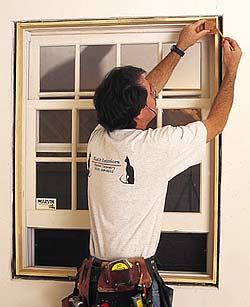
Take all dimensions at once and preassemble frames for fast & accurate window jambs
Window extension jambs are a fact of life for trim carpenters. In new construction, sometimes the wall thickness hasn’t been determined when the windows are ordered; in a remodel, the wall may gain thickness — from rigid foam insulation, for example, or the addition of furring and paneling. But often, we just plain forget to order wider window jambs, which is unfortunate because most window companies manufacture windows with either custom-sized jambs or factory-installed extensions at little or no additional cost. A Marvin window, for instance, should rarely need extensions because the company builds jambs to almost any width. There is one price for a typical 2/6 x 4/0 casement window if the jamb is between 4-11/16 and 5-9/16 inches, and the same window costs only $21 more if the jamb is up to an inch wider. Similar nominal charges apply to manufacturers who ship windows with factory-installed extensions. Andersen casement windows, on the other hand, always need extensions because the jambs are only 2-7/8 inches wide. The extensions, which are shipped loose, come in three sizes, but they’re reasonably priced. For a 2/6 x 4/0 casement, for example, jamb extensions run from $18.50 to $41.50, depending on whether the finished wall is 4-9/16, 6-1/4, or 7-1/8 inches thick.
Three Types of Jamb Extensions
Depending on the design and width of the window jamb, the profile of the extensions takes one of three shapes (see Figure 1).
Figure 1. Jamb extension profiles differ, depending on the shape of the window jamb and the width of the wall. A square edge works well on a plain window jamb when the extension is narrow, while some extensions must be milled with a tongue to fit a corresponding groove in the jamb. For wide walls, a back-rabbet reduces the length of the screw needed to attach the extension. | |
The simplest extension is a piece of square-cut stock that butts against a square jamb edge. Another type of extension has a tongue that mates neatly into a corresponding dado in the jamb, such as you’ll find on Andersen jambs. A third type, called a back-rabbet, is standard for manufacturers like Eagle. A back-rabbet is especially useful for wide extensions where you want to avoid having to drill a deep countersink.


