
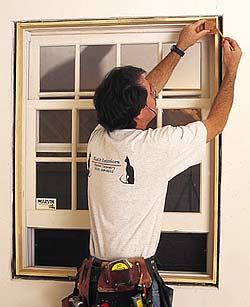
Site-built extensions.
Either because of job-site complications or forgetfulness, I
often mill my own extensions from S4S stock. For paint-grade
windows, I use finger-jointed pine. While it’s tempting
to use MDF because it’s readily available, mills easily,
and paints beautifully, I think MDF is the wrong material for
jamb extensions. Fastening through the face of MDF material
works well, but nails or screws driven into the edge without
predrilling cause flaking and splitting (Figure 2).
| Figure
2. MDF is not a good material to use for
extension jambs. While it mills easily and takes paints
well, it tends to split when screwed or nailed through
the edge. |
Since jamb extensions are all about endgrain —
extensions are fastened to the jamb through the edge, then the
casing is fastened to the extension by nailing into the same
edge — it’s best to use real wood. If the job is
being stained, pick material that matches the grain pattern of
the window jambs.
Milling jamb
extensions.
I prefer to mill extensions in my small
shop because it’s easier and faster, though I often cut
them on site, too. Either way, to increase productivity and
save installation time, I measure all window and door
extensions before I’m called to install the finish work
so that all the material is on the job the first day of work. I
purchase stock in widths and lengths that result in the least
amount of waste, though I try to avoid ripping more than two
extensions from one piece of stock. This reduces milling time
and eliminates the need for a surface planer, because I can use
the factory edge on the room side. A table saw equipped with a
fine-tooth carbide blade makes a smooth enough cut for the
inside edge, which is butted against the window jamb. If the
extensions are thin, however, I often rip more than two out of
a single piece of stock, then pass them through my portable
surface planer. I also ease the exposed corner of all
extensions with a table-mounted router or hand-held laminate
trimmer using a 3/16-inch roundover bit. If you don’t own
all those tools, buy the narrowest stock you can find and
anticipate a little more waste.
Tongues and back-rabbets can be milled quickly with only a
table saw. The tongue for an Andersen extension requires
several passes, though I often eliminate the tongue for thin
extensions, and apply them flat, directly on top of the dado.
Back-rabbets can be made in two passes (Figure 3).

Figure
3. A back-rabbeted extension can be milled on site in
two passes with a table saw. The bevel cut begins at the corner
of the stock and meets the shoulder cut about 1 inch from the
window-side edge. Back-rabbeted extensions can be fastened with
a nail gun before the window is installed.
The shoulder cut for a back-rabbet should be made about 1
inch from the window-side edge of the stock; the bevel cut
begins at the corner and angles to meet the shoulder cut. If
the extension can be applied before the window is installed,
using a nailgun to fasten the extensions is faster than
screws.
Picture Frame Extensions
Most of the jamb extensions I apply are less than 1 inch wide
to make up for the thickness of shear paneling that was
forgotten when the windows were ordered. For narrow extensions,
I measure all the windows on the job, precut the pieces to
length using a repetitive stop on my chopsaw, and pin-nail them
to the jambs. To find the width of the extensions, I hold a
block of wood or a square flat against the wall and measure
from the window jamb, then I add 1/16 inch to make it easier to
install the casing. I take several measurements on each window,
especially at the head and sill, where drywall tends to
thicken, then I average the measurements. If the difference is
more than 3/16 inch, I make custom rips.
When extensions are wider than 1 inch, however, I
preassemble them in my shop, where I can work faster on a large
waist-high work surface with all the necessary tools in easy
reach. I fasten the corners with screws (adding glue
won’t hurt, but it’s slower), just like the head
and legs of a jamb, so that the joints will never spread
(Figure 4).
Figure
4. The author preassembles picture-framed extensions in
his shop. All four corners are screwed to the keep the joints
tight.
I approach picture-frame windows differently from windows
with stool and apron. Because I preassemble the frames in my
shop, I measure for picture-frame jamb extensions while
I’m figuring the material takeoff. It’s faster than
it sounds, because no matter how many windows a house has, most
are the same size. Measure the inside dimension of the jamb and
add twice the reveal — 3/8 inch for a 3/16-inch reveal,
1/2 inch for a 1/4-inch reveal. Sometimes, the extension frame
has to slip over window stops that are proud of the jamb. In
that case, measure outside to outside between stops and add
1/16 inch for clearance.
My extension jamb takeoff is usually a short list of window
sizes with slash marks for each frame I’ll need.
Occasionally, a window size will be listed twice, with
different extension widths.


