-
Q.
When there’s an entry between an exterior tiled deck and an interior living space, how should the threshold be detailed so that the doorway doesn’t leak? My client uses a wheelchair and would like the interior and exterior floors to be in approximately the same plane.
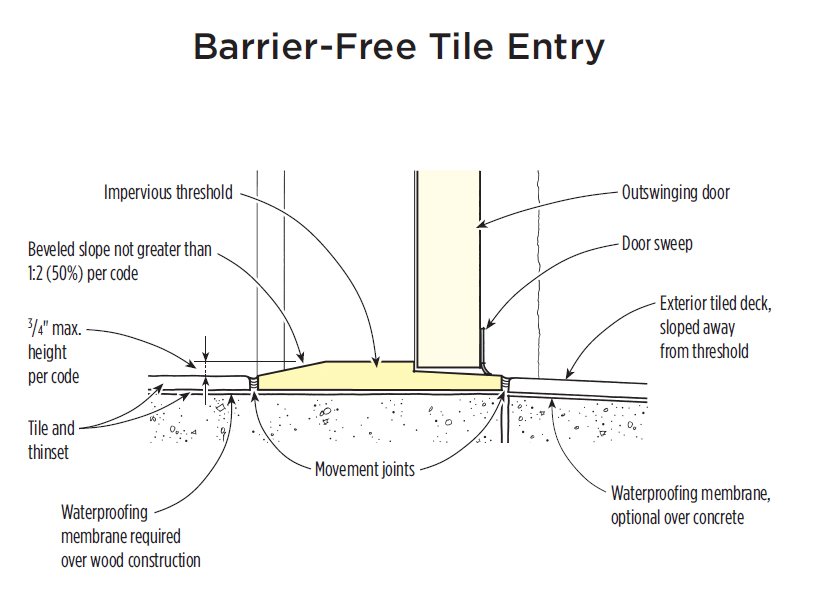
A.Contributing editor Michael Byrne, moderator of the JLC online tile forum and an industry consultant in Los Olivos, Calif., responds: Unless there is frequent precipitation that makes it impractical, I usually build tiled decks so that the finished floor at the threshold is level with — or slightly below — the interior floor. Since this detail works best with outswinging doors that don’t have an integral threshold, the door must have an effective sweep to prevent water from blowing in.
For a true barrier-free installation in a dry climate, I eliminate the threshold completely and separate the interior and exterior tiles with a movement joint at the doorway. In wetter climates, or if the deck is regularly exposed to wind and stormy weather, I use a stepped threshold to better resist leaks (see illustration). I typically have these thresholds fabricated out of a durable impervious stone, like granite, in a profile that provides weather resistance while meeting code requirements.The exterior waterproofing should be joined to the threshold with an appropriate long-life sealant. Water will still occasionally get past the threshold, but this shouldn’t be a problem if the interior floor is covered with tiles installed over a waterproofing membrane.
However, if the interior floor is covered with wood strip flooring or another absorbent material, a flush deck is probably a bad idea. Instead, the deck should be designed so that there is a full 4- to 7-inch step up to the threshold. The exterior deck membrane will then resemble a shower pan, with upturned walls and the upturned membrane flashed and sealed at the threshold to prevent wicking.
Tile Doorway Detail
2 MIN READ