
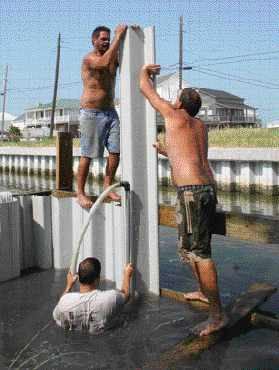
When you live on a barrier island, just keeping your little piece of real estate from washing away is a constant struggle. Fred Sprinkle, a foundation and excavation contractor on Dauphin Island, Ala., frequently uses vinyl sheet pilings to keep the ground beneath his clients’ homes from ending up in the Gulf of Mexico.
His employees — who spend as much time in the water as they do on land, and dress accordingly — start one of their vinyl seawalls by building a frame of pressure-treated wood pilings and dimensional lumber (1). The lumber and pilings are CCA-treated; newer pressure-treating formulas don’t hold up as well in saltwater and aren’t as resistant to marine-boring organisms.
Once the frame is assembled, the crew ties it to dry ground with stainless-steel threaded rods and earth anchors (2).
Next, workers use a gas-powered pump (3) to wash holes in the sea floor for the 12-inch-wide piles. The pump sends water first through a 2-inch hose and then through a 11/2-inch steel pipe (4); the transition from a larger to a smaller diameter increases head pressure. The pipe’s weight makes controlling and directing the stream of water easier.
Once the holes are made, the crew pushes the 12-foot-long sheet pilings in; some piles go easy, and others require persuasion with a sledge or a small pneumatic jackhammer (5). All have mating edges that lock them together (6). They’re nailed to the wood frame at the top and at the water line.
The walls’ integrity depends on how deep the pilings are placed in the sand. The day I visited, workers were replacing a poorly built wall with one that went about twice as deep.
Unscrupulous contractors often use shorter pilings to save time and money, but occasionally even competent installers face an obstacle that makes it impossible to drive the pilings to their intended depth.
When Sprinkle’s employees run into this problem, they try to remove the obstacle any way they can. Sometimes they keep enlarging the hole till they can pull the object out by hand; other times they lug it out with a chain connected to their excavator or backhoe (7). Only as a last resort do they cut the pile shorter.
Once all the piles are installed, the area is backfilled with sand and the wall is finished with a pressure-treated cap.
This kind of work may sound like a day at the beach, but crew members told me cuts and puncture wounds on hands and feet — plus nasty sunburns — are common. They also said that despite the large retrieval magnet kept permanently in the truck, they lose hammers and other hand tools regularly. —


