
Q. I’ve completed a couple of projects with cellular PVC trim boards, and in both of them wide gaps have opened up in the joints even though we used both glue and nails during installation. Is there a way to prevent these gaps from occurring?
A. Mike Sloggatt, a remodeling contractor in Levittown, N.Y., responds: While wood trim expands and contracts across its width with changes in moisture content, PVC trim expands and contracts along its length with changes in temperature. An 18-foot-long PVC board can change seasonally by as much as 3/16 inch — easily enough to create the large gaps you describe.
So it’s important to account for your climate’s overall temperature range and the temperature of the material during installation. In cold weather, for example, I make an allowance for summer expansion so that the boards don’t buckle when they warm up. In hot weather, a little extra spring in the boards helps keep the joints intact when the material contracts during the colder months.
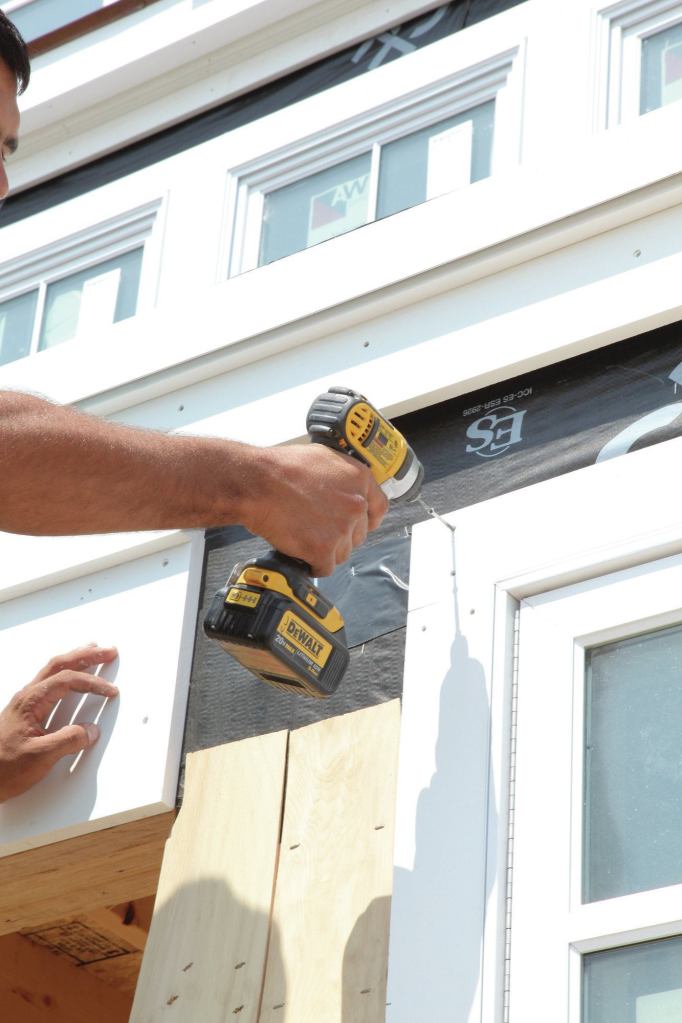
Proper fastening along each trim board’s entire length will also help limit seasonal movement. I never use nails with PVC trim, because they don’t have enough holding power; instead, I use stainless steel trim screws long enough to penetrate the substrate by at least 1 1/2 inches. For 4- and 6-inch-wide PVC boards, I use two screws every 16 inches on center; for 8- and 10-inch-wide boards, I use three screws; and for 12-inch wide boards, I use four screws.
Proper structural support helps, too. For example, instead of fastening PVC fascia trim to rafter tails, I first install a sawn-lumber subfascia, which provides a solid substrate — particularly when rafters are on 24-inch centers.
Finally, I glue the butt joints. On long runs, I cut 15-degree or 30-degree scarf joints. I use PVC glue in the joint and fasten the joint to the subfascia with trim screws within 2 inches of the end of each board. I also apply construction adhesive between the subfascia and the PVC in the area of the joint.
It’s worth noting that polyash composite trim, while more expensive than cellular PVC, does not have the same expansion coefficient as PVC and will not move in any direction very much. However, it still needs to be fastened according to the manufacture’s instructions (typically every 16 inches placed within 2 inches of the edges).


