
Q. I have a question about the hidden soffit vent details you’ve published recently (Backfill, 7/04; Letters, 10/04). Is it possible to build this so that you get a positive transfer of lateral loads from the roof sheathing to the frieze blocking and into the top plate? This is required by building officials here on the West Coast. Also, do standard eaves blocks with vent holes provide proper shear transfer?
A. Scott McVicker, S.E., of McVicker Associates, Inc., Structural Engineers in Half Moon Bay, Calif., responds: Let’s look at the second condition first (see illustration): The vent holes in the diaphragm blocking are positioned at the top of the blocks, so they clear the insulation. As far as strength goes, the 2-inch-diameter holes will reduce the shear transfer ability of the block, but not by so much that typical diaphragm nailing will be affected.
Here’s a sample calculation, assuming that the horizontal shear strength of the wood is 63 pounds per square inch, with a one-third increase allowed for dynamic (seismic or wind) loading. If the 2-by rafters are spaced 24 inches on-center, the blocks are 22 1/2 inches long. Assume that for venting you need three 2-inch-diameter holes spaced equally along the block. The remaining area of wood between the holes will be 16.5 inches in length (22.5 – 6). With 2-by blocking, that gives 24.75 square inches of shear area (16.5)(1.5). The maximum force to be resisted by each block will be the remaining area times the allowable stress: (24.75)(63)(1.33) = 2,073 pounds total, or 1,036 pounds per foot, which is off the chart for typical diaphragm nailing, so no problem there.
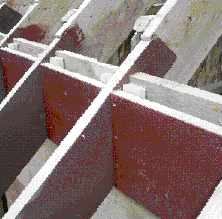
Now let’s look at the hidden vent detail featured in JLC. Assume that we’re using sawn lumber at 19 percent moisture content, which will shrink following construction. The outermost block in the photo will receive the diaphragm nailing. (Its top should have been beveled to match the slope of the roof; otherwise, the diaphragm nails will be subject to bending where they cross the gap.) I note that these blocks are toenailed into the rafters, which is okay so far.
Now look at my detail (“Hidden Vent-Screen Detail”). The shear is transferred from the exterior block to the vertical spacer blocks — but at the bottom only. (If the exterior block were nailed to the vertical block along its full height, it would fracture as it dried and shrank.) The vertical spacer blocks, in turn, are nailed to the interior block, which is attached to the top plate using a metal clip. There you have it: The shear transfer path is complete.
This detail has a couple of possible limitations. First, as the photo shows, the contractor assumes that when the rafters and blocking shrink, they will not shrink beyond the 1/2-inch gap provided between the top of the vertical spacer block and the bottom of the sheathing. Time will tell: Bumps at the edge of the roof would be a sign that more space should have been provided.
Second, there is a practical limit on the number of nails one can use before the individual pieces tend to split. I could see four 10ds at each end of the exterior block and four 10ds from the vertical block to the interior block. Assuming 90 pounds per nail, the maximum lateral load would be: (8)(90 lb./nail)(1.33) = 957.6 lb. per 2-foot rafter spacing, or 478 lb./ft. This is certainly not in the same league as the blocks with drilled holes, but is probably sufficient for low shear conditions.


