
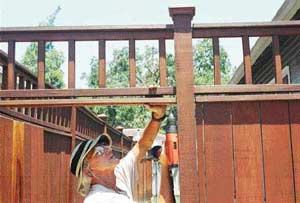
Along with providing security and privacy, a nice wood fence can serve as a property’s crowning design element. Leaving wood outside in a wet climate like mine, though, borders on criminal behavior — and so as a restoration carpenter working in New Orleans, I’ve focused throughout my career on making exterior wood last as long as possible.
Early in 2005, my best rot-prevention techniques were put to the test when some past clients approached me about building a fence on one side of their restored house. Natives of New Orleans, these folks knew how fast things decay here and they wanted something that would be around for a long time.
To prevent rot and discourage insects, I keep in mind five simple rules whenever I’m building a fence — or anything outdoors, for that matter.
1) Keep joints — which hold water — to a minimum.
2) Avoid applied moldings. They trap water and organic material, the prime ingredients for rot and mildew.
3) Pooling — or sitting — water is much more destructive than flowing water; if you can’t properly shield a joint, open it up so that water can move through freely.
4) If there are enclosed spaces like column wraps or boxed beams, provide some form of ventilation to dry the inside.
5) Seal all end grain.
Materials
Basically, my clients wanted a spindle section above a vertical-board fence, dressed up with a trim board at the bottom. Complicating matters, they also wanted fence panels between the posts.
Given the rough parameters, the first order of business was picking a type of post. I like to use 21/4-inch hot-dipped galvanized metal pipe because it holds up very well in our climate. But my clients didn’t like the pipe’s appearance, and wrapping it with wood wasn’t in the budget, so the only option was No. 2-grade pressure-treated 4x4s.
Lumber. We chose a clear-grade PT for the rest of the fence; it’s not as expensive as redwood or exotics and it warps less and machines better than the other PT grades.
I generally try, when using a lesser grade, to air-dry it out of the weather and sun for at least a month. That way, I can cut up the worst material and put pieces with bows, crooks, twists, and checks in places where they’ll be less visible.
Also, despite what the lumber salesmen may tell you, .25-pcf pressure-treated wood will rot above-ground in the Deep South, so we used lumber with a .40-pcf treatment.
Fasteners and hardware. Stainless steel is my preferred material for exterior applications. Grade 304 or 305 stainless is generally fine — unless you’re near saltwater, in which case you will want Grade 316.
After balancing cost considerations against expected longevity, we settled on USP’s MP34-SS connectors (800/328-5934, www.uspconnectors.com) to fasten the fence rails to the posts. The only nonstainless hardware that went into this fence was a black powder-coated gate latch, installed with stainless screws.
Post Installation
Laying out and setting the 4×4 posts was done in the standard manner of setting batter boards and pulling a centerline string.
I spaced the posts 8 feet on-center and dug 2-foot-deep holes with a 10-inch auger. I flared the hole bottoms by hand and then filled them with several inches of coarse gravel for drainage. Some fence builders, I know, object to installing fence posts in concrete, but our “gumbo” soils down here make it a necessity.
I put the two straightest 4x4s aside for the gate posts and used the two next best for the end posts. I set the end posts first, doming the concrete several inches above grade to shed water. The posts were braced off in both directions while the concrete set up. The next day I installed the remaining posts, using string lines stretched between the end posts.
There are two things to keep in mind here: First, no matter how careful you are, the fence won’t be dead straight. If you want it perfectly straight, you’ll have to go with wrapped metal or redwood posts.
Second, concrete footings like the ones I used here are very good, but if you want the fence to stay as straight as the day you built it, you’ll need to link the post footings together with a small grade beam. This adds significantly to the project’s cost and complexity, but it’s often a good idea, especially for heavier fences built on wet soil.
Assembly Prep
I started assembling the fence sections by putting a 15-degree bevel on the top of each horizontal member and drip grooves on the bottom of the top rail. This would prevent water from sitting on the surface and make it drip off instead of following the wood.
For safer and more precise cutting, I typically use feather boards from Bench Dog Tools (800/786-8902, www.benchdog.com) to hold the lumber tight to the fence and table.
Once all the pieces are cut, I prestain them, which saves a lot of time down the road. In this case, the client coated everything with reddish-brown semitransparent stain.
When the pieces were ready, I figured out the highest part of the yard and added 2 inches. This would be the elevation of the bottom of the fence and would keep the bottom trim board 2 to 5 inches above grade. I then used a level/transit to mark the location of the horizontal rails on all the posts, so I could install the angle brackets that would hold the fence panels.
Next I sorted through all the shaped rails and placed the best pieces toward the front, with increasingly twisted ones going toward the rear. I cut the rails 1/2 inch short of the actual measurement to obtain a 1/4-inch drainage gap on each end.
Spindle Assembly
The spindle assembly on top of the fence came next. I juggled the spindle spacing so that a common spacing would work in all the post bays. And to hide slight discrepancies in the 8-foot post spacing, I didn’t place spindles against the posts.
I was able to get three spindles from a 3-foot-long PT baluster. I put a 15-degree cut on the spindle bottom to correspond with the bevel I made on the bottom spindle rail. After laying the cut spindles into a jig I’d made, I screwed them into the top rail.
Fence Boards
The fence boards started out as 12-foot 1x6s. After cutting them in half, I turned them around and cut off both factory ends at 5 feet 11 inches. Since they were already prestained, the boards were ready for pilot holes — which, though they are not absolutely necessary, make installation much easier. Plus, level screws look better on the finished product.
Before drilling, I arranged the boards with the flat grain pointing down, so if the grain lifts in the future it will still shed water. Then I made a jig to drill the pilot holes.
Prior to installing the fence boards, I cut and applied 3-inch strips of Colbond’s Enkamat 7010 drainage matting (800/365-7391, www.colbond-usa.com) to the fence rails. Enkamat — a matrix of black spun nylon — creates a slight drainage gap where two pieces of wood are placed together.
To ease installation, I made a “sideways” story pole, marking it out with the nominal board width of 51/2 inches, separated by 1/8-inch gaps. With the story pole I could center the layout so that both end pieces would come out about the same width.
I could also easily determine whether starting with full boards on the ends and making the center board different would be a better option, as it was with the gate.
Once the fence boards were ready for installation, I sorted them for graining. The ones with the best vertical grain were set aside for the gate; other vertically grained boards were set aside for ripping into each bay’s end boards. The rest were arranged in agreeable patterns, with the best arrangements placed toward the front.
Before installing the boards on the horizontal rails, I ran a bead of Titebond III along each board’s top edge. Then I slid the boards into the dadoes and fastened them with 2-inch-long #10 square-head screws.
House Attachment
Down here in New Orleans, Formosan termites are a serious problem. If you attach any wood structure to the house, the termite guys want a sighting gap, so you often have to get creative. In this case I used 1/4-inch stainless-steel eyebolts and 3/8-inch carriage bolts to attach the fence to the house.
With everything straight and secure, I marked and cut off the fence posts and installed copper-topped post caps.
The Gate
The construction method for gates has become standard for me. The perimeter and intermediate rails are made from 2x4s with plastic biscuits and epoxy connecting the joints. I prefer this method — even though I’ve used traditional diagonal braces in the past — because it better matches the rest of the fence and provides solid stock for mounting a latch.
I actually started working on the gate frame immediately after setting the posts, because I wanted the epoxy to fully cure before the gate went into service.
Once the frame was complete, I used three 8-inch stainless-steel T hinges to mount it. To give the gate a little more pizzazz, I accented the front with a piece of canary wood, which is a dense tropical species with distinctive grain.
Coatings
Rot tends to get its foothold in any of several places — fastener penetrations and areas that hold water rank high on the list — but the most common starting point is probably end grain.
I protect end grain with DuPont Corlar 2.1 ST, formerly Corlar 25P (800/438-3876, www.performancecoatings.dupont.com). This two-part high-build epoxy is thick enough that it doesn’t totally disappear into the end grain, so I get a complete seal with one coat. West System epoxy (866/937-8797, www.westsystem.com) works, too, but it costs more and generally takes several coats.
After applying the Corlar, I mixed up some DuPont Imron 2.8 HG high-gloss polyurethane, formerly Imron 333 (DuPont, 800/438-3876, www.performancecoatings.dupont.com), in reddish-brown and applied two coats to the same areas. The color blended in with the stain pretty well.
I prefer Imron to regular paint because it dries fast enough on a warm day that you don’t need to wait between coats. Also, since Corlar and Imron are part of the same system, Imron bonds chemically to Corlar.
Had it been my call, I would have used the same paint recipe on the rail tops. This would have gone a long way toward protecting these components, which get the brunt of sun and rain.
I also recommended installing backer rod and caulking the joint between the posts and top rail to shed water; in this project, those tasks were left up to the owners. I like Dow Corning’s 795 Silicone, but anything is better than nothing.
I can say with some pride that despite Hurricane Katrina’s 105-mph sustained winds and even stronger gusts, which knocked down fences, light poles, and traffic signs everywhere, my fence came through unscathed. The only visible evidence of the storm was a line about 3 feet up, a reminder of the weeks it spent under water.
Michael Davis is a restoration carpenter in New Orleans.


