
After emerging from the machine coater, the primed wood is
dried. Latex primer can be dried under controlled conditions in
15 to 30 minutes - much faster than oil-based primer, which
spends 12 to 24 hours in special drying rooms (Figure 2).
| Figure 2. After
leaving the machine coater, the siding is placed on
racks to dry.
|
Prepriming Advantages
Clearly, one advantage of using preprimed siding is that there
is no need to wait for good weather to get a protective coat of
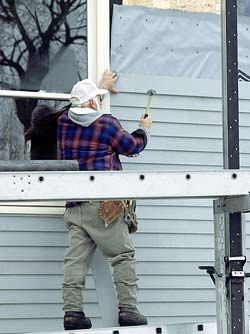
primer on the boards (Figure 3).
| Figure
3. Preprimed or prefinished siding can be
installed at any time of year, since proper painting
conditions are of no concern. |
Fans of preprimed siding tout other advantages as well: The
siding's moisture content can be controlled; all four sides of
a board can be coated; and the coating can be applied at a
consistent thickness.
Moisture content.
At a
job site, the moisture content of unprimed siding varies.
Especially in areas with frequent spells of cool, damp weather,
painters are often tempted to work in less than ideal
conditions. "We have to be careful. We have days when in the
morning it's 45 degrees outside, and it can be 110 by the end
of the day," says Jesse Head, who appreciates factory-primed
siding. "At least with prepriming, it's been done under
controlled conditions."
When siding is factory primed by a reputable company, the
siding is usually tested for moisture content. For example,
Cape Cod Siding in Nova Scotia, kiln dries their siding to a
moisture content of 12% to 14% before priming. However, smaller
companies may not be so careful. In one instance, a factory
finisher reported "occasionally" checking for moisture content
in siding before machine priming.
Priming all four sides.
If siding is nailed up unfinished, then only the front face of
the siding can be coated with paint. "To do it right, the wood
must be totally encapsulated - front, sides and back," says
John Lahey, president of Fine Paints of Europe. Otherwise the
back face of the siding will pick up moisture from the
sheathing, which can be dampened by condensation from the
building's interior, or from wind-driven rain.
Factory-primed siding is encapsulated on four sides - at
least until the first cut is made. When installing preprimed
siding, a can of paint and a brush should always be on hand.
"That's the largest problem that plagues us - installers forget
that when the product is cut, the ends need to be sealed," says
Scott Babbitt, eastern market manager at Olympic Factory Finish
Group. "Unfortunately, a majority of the time it isn't done.
Unsealed cuts tend to absorb moisture. That can lead to tannin
bleed and premature failure of the siding."
Manufacturers of fiber-cement siding point out that unlike
wood siding, fiber-cement doesn't need to be encapsulated. "The
nature of the substrate doesn't require back priming," says
John Dybsky of James Hardie Co.
Coating consistency and coating
thickness.
Fans of factory priming appreciate the
evenness of machine application. "We are able to get more
consistent rates of application using a machine than you can
with a brush," says Dan Landry of Cape Cod Siding. On the other
hand, just because a coating is consistent, doesn't mean it is
thick enough. The major manufacturers of preprimed siding claim
they achieve adequate thickness through a stringent quality
control program. This includes machine measurements of paint
thickness. However, not all factory finishers are scrupulous,
and less reputable finishers have been known to thin the
primer. "There is a tendency on the part of the preprimer to
choose a paint that goes through the machine easiest and dries
the quickest," says John Lahey.
Mark Knaebe at the Forest Product Laboratory agrees. "I've
seen some lousy stuff coming out," he says. "Some of it has
only half a mil of primer. It should be a minimum of one and a
half mils." For adequate priming, according to Knaebe, none of
the wood grain should be visible through the primer, which
should form a hard film with no noticeable chalkiness. Most
experts recommend that 6 mils of wet primer be applied to
achieve a dry film thickness of 1.5 to 2 mils.
Who's Doing the
Prepriming?
When you buy preprimed siding at the
lumberyard, it isn't always clear whether it was primed by the
siding manufacturer or by a so-called "prestaining" company.
Some brand-name siding is factory primed by the siding
manufacturer (for example, lodgepole pine siding from Cape Cod
Siding in Nova Scotia, or StepSaver cedar siding from Skookum
Lumber Co. in Olympia, Wash.). These larger companies are
likely to have well established quality control programs.
Increasingly, lumberyards purchase unprimed siding and
contract with a local priming company. Sometimes this is done
in large lots, for inventory. Some lumberyards can even arrange
for custom priming to meet a builder's needs.
The turnaround time for a custom order varies. In parts of
the country where construction is booming, the typical
three-week turnaround time for custom priming has recently
stretched to up to eight weeks.
Cost
If you
are convinced of the advantages of factory priming, you're
probably ready to ask how much it costs. In most cases, a
factory can prime siding cheaper than you can, making the
purchasing decision a no-brainer. "Factory priming costs
one-third the cost of doing it ," says Tucker Smith from
Skookum Lumber. Mark Knaebe agrees. "It can be painted cheaper
in the factory, and you don't get the problem with sunlight,"
he says.
The cost of preprimed wood siding varies, of course,
depending on the species, profile, and grade of siding. Dan
Landry of Cape Cod Siding says that their preprimed lodgepole
pine siding "would cost the contractor, depending on the
profile used, in the neighborhood $2.00 to $2.50 a square
foot."
Topcoat Available,
Too
Some siding manufacturers or distributors
offer siding that is not only preprimed, but is also
prefinished with a topcoat. "Seven years ago, we expanded our
business to include two-coat work," says Fred Churchill of
Churchill Coatings. "We can put on one primer and one finish.
The extra coat only adds about $400 for 3,000 square feet of
siding, compared to an $800 first coat."
Prefinishing saves contractors from braving the inclement
weather in the Northwest, the Northeast, and the Midwest, the
strongest markets for manufacturers of preprimed siding. "The
demand is great in the winter," says Churchill. "When you buy a
preprimed product and put it up, you have to get that finish
coat up in 60 days. Sometimes you can't do it in 60 days in New
England. When you buy preprimed and finished siding, you can
wait until next spring."
Several manufacturers, including Maibec Industries in
Quebec, offer factory-stained cedar shingles. Each kiln-dried
shingle is dipped in an acrylic stain, dried, and boxed for
shipment. "The use of stained shingles has doubled every year
over the last three years," says Danny Rouleau, sales manager
for Maibec. "Thirty percent of our production is stained or
bleached."
Some manufacturers of prefinished siding offer impressive
paint warranties. For example, Cape Cod Siding guarantees the
coating to stay on the wood for 15 years. "If the coating fails
within the first 5 years, we supply the labor and materials to
fix it," Landry says. "Between 5 and 15 years, we would supply
the coating."
New Jersey builder Matt Porraro usually buys siding
preprimed and prefinished. "I know when it's shipped, it's
protected," he says. Through his local lumberyard, he requests
two coats, and tops the boards with a third coat after
installation. He has a simple solution when customers don't
think their siding needs prefinishing: He won't guarantee the
finish.
Not every builder who has tried prefinished siding is a fan.
Bob Lipovsky sticks with preprimed siding rather than
prefinished. "You end up putting nails into it and you end up
painting it anyway," he explains.
Scott Babbitt of Olympic notes that some installers have
unrealistic expectations for prefinished siding. "It's a
problem - the perception that prefinished siding can be nailed
up and you can walk away," he says. "We're not applying vinyl
siding here, guys." In most cases, prefinished siding will need
a third coat of paint after installation, if only to cover
caulk and nail heads. "Some colors - particularly the whites
and the yellows - don't lend themselves to two coats," says
Babbitt. "They require a field-applied third coat, partly
because of the handling and the dust on the job site."
Ordering Preprimed
Siding
Factory priming seems to be the way to go,
with one important qualification - it has to be done right. If
you're ready to try preprimed siding, ask your supplier to
identify who does the priming. If you get assurances that the
finisher checks the moisture content of the siding before
running it through the machine, uses a quality paint, and can
verify a minimum dry film thickness of 1.5 mils, then it might
be time to try some preprimed siding.
Marie Tupot Stock, is a New York City based
construction and design writer, and executive editor of
Tile & Decorative Surfacesand
Fenestrationmagazines.
| Sources of Supply |
|---|
Cabot
Stains 100 Hale St.
Newburyport, MA 01950
508/465-1900
800/877-8246
Manufacturer of primer and
stains for machine finishers
| Granville
Manufacturing Co. P.O. Box 15
Granville, VT 05747
802/767-4747
www.woodsiding.com
Preprimed and prefinished
quartersawn clapboard sidings
|
Canton Lumber
Co.
9110 83rd Ave. North
Brooklyn Park, MN 55445-2197
800/367-9663
A distributor of preprimed siding | Maibec
Industries
660 Rue Lenoir
Sainte-Foy, Quebec G1X 3W3
Canada
800/363-1930
Preprimed wood siding |
Cape Cod
Siding
1948 Hammonds Plains Rd.
Bedford, NS B4A 1A0
Canada
800/565-7577
www.capcod.ca
Preprimed lodgepole pine siding
| Olympic Factory
Finish Group
P.O. Box 6
Accord, MA 02018
800/266-5143
Manufacturer of primer, stains,
and paints for machine finishers
|
Churchill
Coatings
P.O. Box 2222
Grafton, MA 01519
508/839-9700
Factory finisher | Skookum Lumber
Co.
P.O. Box 7309
Olympia, WA 98507-7309
360/426-3944
Preprimed cedar siding
|
Goodfellow
Inc.
225, Rue Goodfellow
Delson, QC B4A 1A0
Canada
450/635-6511
www.gdfellow.com
Preprimed and prefinished pine
and cedar siding
| Windsor Mill
P.O. Box 39
Windsor, CA 95492
707/838-7101
Preprimed pine and
Douglas fir siding |


