
by Marie Tupot Stock
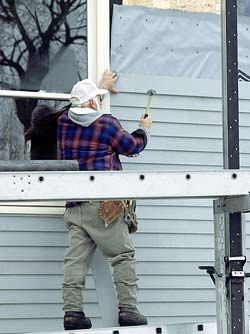
Although wood siding has lost market share to vinyl and fiber-cement in recent years, sales of wood siding remain strong in many parts of the country, especially in the northern half of the U.S. Increasingly, when wood siding is chosen, it’s being installed preprimed or prefinished. “It’s becoming rare to see a builder install raw wood on the exterior of a house,” notes Tom Daniels at Cabot Stains.
Machine priming of siding was first developed in the 1940s, but the use of preprimed siding didn’t take off until recently. Fred Churchill, owner of a machine finishing company called Churchill Coatings in Grafton, Mass., recalls, “When we started more than 30 years ago, the lumberyards laughed at us.” Today, a wide selection of wood siding, as well as some fiber-cement and composite siding, is readily available preprimed or prefinished.
Bracing For the Elements
Although wood siding has been installed unpainted for hundreds of years, there are several disadvantages to doing it the old-fashioned way. The unpainted siding can pick up moisture while being transported or stored on site, meaning paint is less likely to adhere. Moreover, when unpainted siding is exposed to the sun, it loses its paint-holding ability and can begin to cup. “We used to buy hemlock, fir, or spruce. Within two days in the sun, it warped,” says Jesse Head of Head Construction in Middletown, Calif. “It’s not worth bringing on the job.” Head, who builds two or three homes a year, hasn’t put up a bare piece of siding in over five years. According to Mark Knaebe, wood surface chemist at the USDA Forest Products Laboratory in Madison, Wisconsin, sunlight destroys the lignin near the surface of unpainted wood. Lignin is the glue that holds the cellulose fibers together. “When the sun destroys the lignin, the fibers are still sitting there, but they are not glued very well to the wood anymore,” says Knaebe. “If you paint the siding after a couple of weeks of exposure, you’re painting over those loose fibers.” In controlled tests, wood exposed to the sun for four weeks before painting failed five years earlier than wood painted immediately. Most experts recommend that wood siding be primed within two weeks of installation.
Factory Priming
Factory-primed siding is produced by passing the siding through a machine coater, which floods the wood with paint. As the board leaves the machine, it passes through a roller or set of brushes designed to remove excess paint (see Figure 1).
Figure 1. As a piece of siding is pulled through a machine coater, it is flooded with paint (top). On the other side of the machine, rollers or brushes remove the excess paint (bottom). | |
Some prefinishers use a vacuum coating machine, which sucks the excess primer off of a board that has been flooded with coating.


