
Between 1941 and 1945, the U.S. military mass-produced more than 150,000 distinctive metal structures patterned after the Nissen huts developed by the British military 25 years and one world war earlier. Because the British hut’s designer held a number of international patents, the American version was quickly renamed the Quonset hut, for the manufacturing plant near the Naval Air Station at Quonset Point, R.I., where the first units were produced.
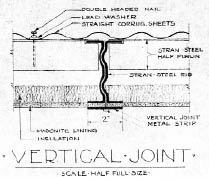
The Quonset hut’s arched steel ribs were assembled from two deformed sections of steel channel tack-welded back to back, creating a serpentine nailing groove that would accept conventional fasteners for both the outer steel cladding and the interior finish of battened 3/16-inch hardboard.
For its day, the Quonset hut was an engineering marvel. When dismantled, it was lighter and less bulky than the canvas tents with wooden frames that it replaced. It could be shipped anywhere and — thanks to its ingenious nailable steel ribs — assembled by a 10-man crew in one day, using only hand tools. Throughout World War II, the Quonset became the standard military utility building of all regions and climates, from the Greenland icecap to the South Pacific.
Quon-Kote paint was just the thing to give a Quonset that “trim, well-kept look.” It came in five colors — white, cream, red, green, and gray.
At the end of the war, when returning servicemen and pent-up demand led to a desperate housing shortage — government estimates put the need for additional homes at 3.5 million for 1946 alone — the Quonset hut rose to the emergency yet again. Surplus huts were sold to veterans for as little as $295, and the Great Lakes Steel Corp. — the largest manufacturer of wartime huts — began churning out Quonsets for the civilian market. (The word “hut” was quietly dropped at about this time, perhaps because it smacked of wartime austerity).
The owner of this modest residence followed the advice of the Arts & Architecture magazine writer who urged readers to “keep the form simple. Avoid dormers with orthodox roofs, period balustrades, unrelated forms. The Quonset can be accented with trellises.”
For several years it seemed that Quonsets were everywhere, from homes to churches and auto dealerships. Other manufacturers quickly joined in, spinning off such products as the wonderfully named Quon-Kote paint from Sherwin-Williams. But while the humble structures hung on for a surprisingly long time in some applications — at Yale they housed married students until well into the ’60s — they fell from grace as residential development ramped up and more traditional housing became available. Outside of Alaska, where military surplus huts are still fairly common, Quonsets are now a rarity.
Few mourn their passing, but those who do can turn to the Princeton Architectural Press’s Quonset Hut: Metal Living for a Modern Age for a wealth of information and images like those shown here. — Jon Vara


