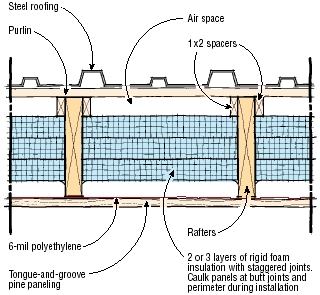
- Q. I need to insulate a cathedral ceiling that will be finished with tongue-and-groove pine paneling. The house has steel roofing installed over 1×3 purlins. There is no plywood roof sheathing. I’m concerned about possible condensation on the underside of the steel roofing, and I would like to know the best way to insulate this ceiling from the underside. Can I insulate with foam board insulation between the rafters? I intend to install a 6-mil poly vapor barrier under the ceiling boards.
A.Corresponding editor Henri de Marne responds: Condensation on the underside of steel roofing is a common problem, so your concern is justified. Condensation above a cathedral ceiling can run down the poly vapor retarder until it finds its way through nail perforations in the ceiling, or enter the wall cavity at the base of the ceiling slope.
The best solution is to install the steel roofing over a solid deck covered with a water-shedding membrane like 30-pound asphalt felt. The felt should convey the liquid condensation all the way down to the drip-edge. To provide air flow above the sheathing, it would be preferable to have the roofing elevated above the deck on sleepers and purlins.
In your case, you are working from below after the roofing is installed, so the next best solution would be to have urethane foam insulation sprayed between the rafters. Since the insulation would seal all convective paths from the heated interior, it would effectively prevent condensation. The disadvantage of sprayed urethane is its relatively high cost.
It is possible to insulate from below, as you suggest, with rigid polystyrene insulation. First, nail 1x2s to the rafter sides, up against the roof strapping. This will provide an air space above the foam insulation, to improve ventilation on the underside of the metal roofing. Without an air space under the strapping to promote drying, condensation can cause the strapping to rot. Install the rigid insulation in layers, staggering the joints as much as possible. To prevent warm humid air from rising or condensation from trickling down, you must caulk each panel to the next, and to the rafters, as they are installed. Since rigid insulation shrinks slightly with time, use a quality polyurethane caulk.
Whatever insulation method you choose, you should install 6-mil poly on the warm side.
Residential
Q&A: Insulating a Cathedral Ceiling Under Metal Roofing
2 MIN READ