
Q. I’ve been a builder for more than 20 years and have come across my first serious mold problem — in my own home in Maine. The house was for sale and under contract pending a building inspection. The inspection revealed mold growth on one entire underside of the roof sheathing (the other side was not affected). The home has adequate soffit-to-ridge ventilation, and no signs of bath ventilation failure or roof leaks. However, there is a lake 75 feet away to the north, on the affected side. Could this be the cause? Can I remove the mold myself?
A. Paul Fisette responds: It’s important to correctly identify the source of the problem before you try to remove the mold contamination. Certainly evaporation from the lake elevates the humidity of the air surrounding your home and likely adds to your mold problem. But there are probably other contributing factors.
In an “ideal” attic design, the air in the attic should be completely isolated from the conditioned air of the home. As a result, the temperature and humidity of the attic space would be very close to ambient outdoor conditions. If you have mold on the attic sheathing, you would then also typically find mold on the outside of the home.
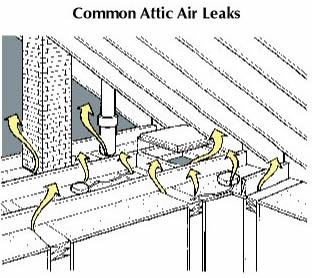
Most homes aren’t perfect, however: They have air-leakage pathways that allow indoor air to pass into the attic, bringing household moisture along for the ride. If the attic air is cooler than the air that eventually reaches the attic, the relative humidity (RH) of the attic air will rise and you run the risk that mold will grow in the attic. Attic ventilation is installed with the goal of removing moisture from the attic. But if the outdoor air is damp, ventilation is not as effective.
You report that you have mold on only one side of the roof sheathing — the north face. The underside of north-facing roof sheathing is typically damper than south-facing roof sheathing. This is because the daytime sun beats on the south-facing roof, keeping it warmer and drier. The daytime sun also works to warm the attic air. Thus, if the only source of attic moisture were outdoor air, then the RH of the attic air would be, on average, lower than the outdoor air due to the drying effect of the hot sun. This supports the notion that you may have moist indoor air leaking into the attic.
The remedy is to find and seal the air leaks. Go up into the attic, lift up all the insulation, and seal any penetrations with expanding foam and caulking. Seal all pipes, wires, junction boxes, fans, ducts, recessed lights, and chimney penetrations. Also pay attention to the places where interior wall plates intersect the home’s ceiling. Indoor air enters the wall cavities, rises up within the wall, and passes into the attic through the gap that exists between the wall’s drywall and the top plate that it’s nailed to.
Once the leaks are sealed, carefully replace the insulation and work to remove the mold. Nisus Corporation (800/264-0870; www.nisuscorp.com) sells a full line of products designed to eliminate and control wood-destroying organisms and mold.


