
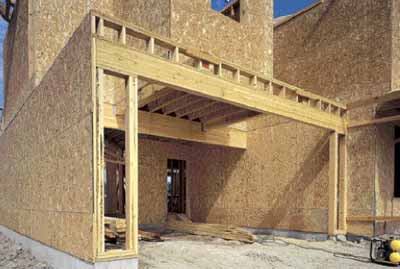
Most builders use plywood or OSB sheathing to laterally brace their framed walls and typically feel comfortable when they have a full sheet at both ends of the wall. I suspect that feeling is based more on intuition than on calculated strength, but most of the time it works. The plywood prevents the studs from racking and folding over, while nails through the bottom plate and hold-down straps prevent sliding and uplift from wind and earthquakes.
But what about walls with large openings and not much room for sheathing on each side? The most common example is the garage wall with, say, an 18-foot overhead door and two 16-inch walls at each side.
It’s not difficult to prevent the wall from sliding using anchor bolts; the sliding forces at the plate are fairly small. The anchor bolts might also prevent uplift, but what about the racking issue? We no longer have a full sheet of sheathing at each end — only a 16-inch-wide strip. Considering the gaping hole for the garage doors, it’s hard to imagine that a strip of sheathing would provide adequate lateral bracing.
But, in fact, if they’re built properly, those 16-inch end walls can provide the needed lateral strength. When it comes to the engineering calculations, APA has done the heavy lifting for us, having tested and documented a method they refer to as the Narrow Wall Bracing Method. Using this approach, builders can develop the required lateral bracing in walls with end panels as narrow as 16 inches.
The best news about the APA approach is that it requires no exotic connectors or expensive materials. The entire system can be built using off-the-shelf materials. The APA method does require that you pay close attention to details, however — details that likely differ from the way you’re used to building garage end walls.
Sizing the Header
When faced with a long span, builders typically double or triple the cripple studs, and while that provides additional bearing for the ends of the header, it adds no lateral strength to the wall system. In the Narrow Wall Bracing Method, the header must extend to the end of the wall (minus 1 1/2 inches to allow for a king stud on each end).
Extending the header like that increases the available fastening area where the narrow wall sheathing overlays the header, a critical element in developing the needed lateral strength. The header must be built using at least two 2x12s. Solid-sawn headers, glulams, and built-up LVLs are also acceptable as long as they’re at least 11 1/4 inches deep and 3 inches thick.
Stud Layout
When framing the narrow walls at either end, you start with an outside king stud, with a single jack fastened to the king stud and another pair of jacks at the edge of the garage door opening. Also, make sure to frame the narrow walls so they run by the side walls at the corner. This allows the sheathing on the side walls to lap the edges, which ties the corners of the garage door wall to the side walls.
Header Straps
To prevent the header from rolling toward the outside of the wall, you have to install two 1,000-pound tension straps connecting the header to the double cripple studs next to the door opening. These connectors are available at most lumberyards; just make sure that the strap is rated for at least 1,000 pounds in tension, and that you use the right number of fasteners to develop the required strength.
Sheathing Details
The minimum allowable sheathing is 3/8-inch structural-rated plywood. Both 7/16-inch OSB and 15/32-inch exterior structural plywood — the most common sheathings in my area — are therefore acceptable. The sheathing must run from the bottom of the sill plate to the top of the header but does not have to be “L cut” around the header — the way you would typically install sheathing or interior drywall. It’s okay to L-cut the sheathing, but no lateral strength gain is recognized. In cases where the narrow wall is taller than 8 feet, you must piece the plywood so the joint is located within 24 inches of mid-height in the narrow wall.
The maximum hole size in the sheathing is 7/8 inch, so be sure you consider any penetrations in the narrow wall area (electrical boxes, for example). The sheathing on the return walls must completely cover the king stud at the corner.
Nails, Nails, and More Nails
The heart of the Narrow Wall Bracing Method is the nailing schedule. The top plate of the narrow walls gets two rows of 16d sinker nails (0.148-inch diameter x 3 1/4 inches long) 3 inches on-center. The end stud on the return wall is fastened to the narrow-wall king stud and double cripple studs with two rows of 16d nails at 24 inches on-center. Nail the narrow wall sheathing 3 inches on-center using 8d common nails (.131-inch-diameter shank x 2 1/2-inch length). The sheathing lapping the ends of the narrow walls should also be nailed with 8d commons, every 6 inches. Keep in mind that nail heads must be flush with the sheathing. Overdriven nails compromise the lateral strength.
Anchor Bolts
To resist the uplift forces, two 1/2-inch anchor bolts are installed for each narrow wall section. The bolts should be located 1 1/2 inches from the doubled cripple studs to provide enough room for the required 2x2x3/16-inch plate washers. Don’t cheat and use standard 1/2-inch round washers: The square washers provide approximately three times more hold-down area — a critical detail when uplift loads start to ratchet up. These washers are standard issue in seismic areas and are readily available from connector manufacturers. The anchor bolts should be imbedded in the foundation at least 7 inches. When using a single bottom plate, you’ll need an anchor bolt that’s at least 10 inches long.
Slenderness Ratio
The minimum width of the narrow end walls is governed by the height of the top of the header. The APA recommended ratio is 1 to 6. For example, an 8-foot-tall wall — measured at the top of the header — requires a minimum 16-inch end wall (16 x 6 = 96). A 10-foot wall — the maximum allowable — requires a minimum 20-inch end wall.


