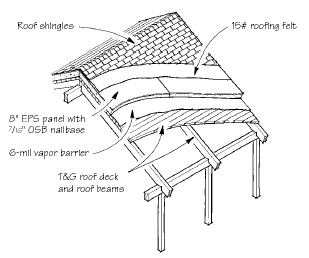
- Q. What is the best way to insulate a cathedral ceiling with exposed 2×6 T&G boards above the rafters? I’m in a 6,000-degree-day climate.
A.Bill Zoeller, an architect with Steven Winter Associates in Norwalk, Conn., responds: Assuming the rafters and 2×6 boards are properly sized to handle the roof loads, a simple, cost-effective solution is to use a preassembled panel of expanded polystyrene (EPS) laminated to a single layer of 7/16-inch OSB (see illustration). This is essentially a structural insulated panel (SIP) with one layer of OSB missing. Install a 6-mil polyethylene vapor retarder over the tongue-and-groove roof planks. The EPS panels attach to the roof structure with long spikes. You can then roof over the OSB surface with any conventional sloped roof application. The overall panel thickness varies depending on the desired R-value. A nominal 8-inch panel will provide an R-value of around 30.
This method complies with the CABO code. The poly meets Section 321, which requires a vapor retarder on the “warm-in-winter side of the thermal insulation” of all unventilated walls, floors, and ceilings. Section 806, requiring roof ventilation, applies only to enclosed attics and enclosed rafter bays, not to a solid panel roof system.
An alternative is to have the tongue-and-groove decking laminated to the interior OSB surface of a structural insulated panel. In this case, since the panel itself is designed to carry the roof loads, you can save money by using 3/4-inch T&G planks instead of the 1 1/2-inch thickness. These panels are available in 4-foot widths and lengths up to 24 feet (long panels require a crane to set). For a SIP manufacturer in your area, call the Structural Insulated Panel Association at 202/347-7800.
Q&A: Insulating an Exposed Plank Cathedral Ceiling
1 MIN READ